
SuperNice

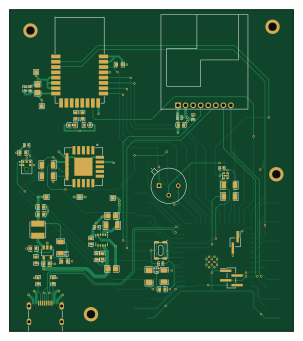
About the SuperNice PCB
SuperNice is an open source ESP32 PCB design by laemo10, published on GitHub. It is a 4-layer board measuring 75 × 85 mm, with 54 components from 32 distinct parts.
Its main chip is the ESP32-S3-WROOM-1-N8, from the ESP32 family. Other key parts include the SY8089AAAC, SGM2048-ADJXTEK8G/TR, ICS-43434_C5656610, AM312 and SCD40-D-R1. By type, the board carries 20 capacitors, 18 resistors, 9 ICs, 2 LEDs and 1 inductor.
It belongs with the iot & wireless, sensors and rf & radio designs in this gallery.
From the project
An integrated, multi-sensor UWB anchor PCB designed for real-time indoor object tracking (via Double-Sided Two-Way Ranging) and non-invasive human presence/occupancy monitoring. Built on a compact 75 × 85 mm² 4-layer stackup, this node timestamps sensor data with microsecond prec
An integrated, multi-sensor UWB anchor PCB designed for real-time indoor object tracking (via Double-Sided Two-Way Ranging) and non-invasive human presence/occupancy monitoring. Built on a compact 75 × 85 mm² 4-layer stackup, this node timestamps sensor data with microsecond precision via Wi-Fi TSF and streams payload telemetry to a central data fusion server.
Main components on the SuperNice
SuperNice bill of materials (BOM)
54 components, 32 distinct parts.
| Qty | Part | Footprint | Refs |
|---|---|---|---|
| 1 | ESP32-S3-WROOM-1-N8 ESPRESSIF(乐鑫) | C2913198_WIFIM-SMD_ESP32-S3-WROOM-1-N8 | U1 |
| 1 | SY8089AAAC Silergy(矽力杰) | C78988_SOT-23-5_L3_0-W1_7-P0_95-LS2_8-BR | U2 |
| 1 | SGM2048-ADJXTEK8G/TR SGMICRO(圣邦微) | C3294704_VDFN-8_L3_0-W3_0-P0_65-BL-EP | U3 |
| 1 | ICS-43434_C5656610 TDK InvenSense(应美盛) | C5656610_MIC-SMD_6P-L3_5-W2_7-P0_90-BL | U4 |
| 1 | AM312 森霸 | C114881_TO-5-3_L8_2-W8_2 | U5 |
| 1 | SCD40-D-R1 Sensirion(瑞士盛思锐) | C3037696_LGA-20_L10_1-W10_1-P1_25-TL | U6 |
| 1 | SHT40-AD1B-R3 Sensirion(瑞士盛思锐) | C2848306_DFN-4_L1_5-W1_5-P0_8-TL-EP | U7 |
| 1 | HLK-LD6002 HI-LINK(海凌科) | C37897213_SENSOR-TH_HLK-LD6002 | U8 |
| 1 | DWM3000TR13 Qorvo | C5299931_WIRELM-SMD_DWM3000TR13 | U9 |
| 3 | 1010301753 Liansheng(连盛) | C52016809_HDR-SMD_14P-P2_54-V-M-S4_8 | H1, H2, H3 |
| 1 | TYPE-C-31-M-12 韩国韩荣 | C165948_USB-C_SMD-TYPE-C-31-M-12_1 | USBC1 |
| 1 | 0603 KENTO | C2289_LED0603-RD | LED1 |
| 1 | APHD1608LCGCK Kingbright(今台) | C5139863_LED-SMD_L1_6-W0_8-RD_GREEN-1 | LED2 |
| 1 | 1.5uH Sunlord(顺络) | C42100_IND-SMD_L4_0-W4_0 | L1 |
| 1 | 22uF FH(风华) | C1859_C1206 | C1 |
| 5 | 100nF SAMSUNG(三星) | C1525_C0402 | C2, C3, C14, C15, C17 |
| 1 | 1uF SAMSUNG(三星) | C1592_C0603 | C4 |
| 3 | 22uF YAGEO(国巨) | C109448_C0603 | C5, C10, C11 |
| 3 | 10nF SAMSUNG(三星) | C1589_C0603 | C6, C9, C12 |
| 2 | 10uF SAMSUNG(三星) | C1713_C0805 | C7, C13 |
Show 12 more
| Qty | Part | Footprint | Refs |
|---|---|---|---|
| 1 | 22pF muRata(村田) | C76919_C0201 | C8 |
| 1 | 4,7uF SAMSUNG(三星) | C1705_C0603 | C16 |
| 2 | 100n SAMSUNG(三星) | C1525_C0402 | C18, C19 |
| 1 | 10u SAMSUNG(三星) | C1713_C0805 | C20 |
| 6 | 10K UNI-ROYAL(厚声) | C1489_R1206 | R1, R9, R10, R11, R13, R14 |
| 2 | 5.1K YAGEO(国巨) | C14677_R0603 | R2, R3 |
| 4 | 100K YAGEO(国巨) | C14675_R0603 | R4, R7, R12, R18 |
| 1 | 90k YAGEO(国巨) | C871504_R1206 | R5 |
| 1 | 20K UNI-ROYAL(厚声) | C4184_R0603 | R6 |
| 1 | 3.2K YAGEO(国巨) | C705066_R0402 | R8 |
| 1 | 2K UNI-ROYAL(厚声) | C4109_R0402 | R15 |
| 2 | 2.7k UNI-ROYAL(厚声) | C13167_R0603 | R16, R17 |
SuperNice design files
The KiCad project lives in the laemo10/SuperNicePCB repository on GitHub; these links point at the commit this page was built from.
- LayoutSuperNicePCB.kicad_pcb
- SchematicSuperNicePCB.kicad_sch
SuperNice: common questions
What microcontroller does the SuperNice use?
The SuperNice is built around the ESP32-S3-WROOM-1-N8, from the ESP32 family.
How big is the SuperNice PCB?
The SuperNice measures 75 × 85 mm, has 4 copper layers and is 1.5994 mm thick.
How many components are on the SuperNice?
54 components, from 32 distinct parts. The full bill of materials is listed on this page.
Where can I download the SuperNice design files?
From the laemo10/SuperNicePCB repository on GitHub, which has the KiCad layout and the schematic; the links under Design files point to each one.
Can I use the SuperNice design in my own project?
The repository has no license, so all rights stay with laemo10. Use it as a reference, and ask the author before reusing the design.
Can I test firmware for the SuperNice without the hardware?
Yes. HardLabs builds a simulation of the board from its netlist and BOM, so you can run and debug ESP32 firmware against it before you order a PCB.
Similar boards
 ESP32
OSO-BOOK-B1
joeycastillo
85 × 115 mm65 parts2LCC-BY-SA-4.08.1k ESP32
Powertrain
byrantech
64 × 45.4 mm171 parts4LMIT4.3k ESP32
Badge
atopile
56.3 × 39 mm239 parts4LMIT4.0k ESP32
Esp32 minimal
36.2 × 26.8 mm20 parts2LMIT4.0k ESP32
Controller
StuckAtPrototype
29 × 74 mm58 parts4LApache-2.03.8k ESP32
Racer
36 × 50.2 mm70 parts4LApache-2.03.8k