
Conchodytes

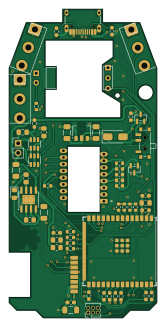
About the Conchodytes PCB
Conchodytes is an open source ESP32 PCB design by mornepousse, published on GitHub. It is a 4-layer board measuring 39 × 81.6 mm, with 64 components from 38 distinct parts.
Its main chip is the ESP32-S3-WROOM-1, from the ESP32 family. Other key parts include the PMW3389, NRF24L01_BREAKOUT, TP4056-42-ESOP8, HT7833 and DW01A. By type, the board carries 28 resistors, 14 capacitors, 8 ICs, 4 switches, 3 connectors and 2 transistors.
It belongs with the iot & wireless and keyboards designs in this gallery.
From the project
Sleeper mouse: a wireless PMW3360 PCB inside a Logitech M100/M90 shell, talking to the same KaSe dongle as the Niphargus keyboard
The mouse runs the KeSp firmware (role MOUSE: PMW3389, three clicks, wheel, HID relayed to the dongle's slot 2). Since 2026-09-21 its board lives here, not in the firmware repository:
- boards/conchodytes/ — board.h (pinout, netlist-checked), sdkconfig.defaults, testpins.c (the pinout contract); - firmware/ — the KeSp firmware as a git submodule, pinned on a release (git submodule update --init); - .github/workflows/firmware.yml — calls the firmware's reusable workflow: every push builds conchodytes.bin (+ full.bin), a v tag publishes a release here.
Main components on the Conchodytes
Conchodytes bill of materials (BOM)
64 components, 38 distinct parts — part numbers from the project's BOM.
| Qty | Part | Footprint | Refs |
|---|---|---|---|
| 1 | PMW3389 | PMW3360 | U2 |
| 1 | ESP32-S3-WROOM-1 | ESP32-S3-WROOM-1U | U6 |
| 1 | NRF24L01_BREAKOUT NRF24L01_Breakout | NRF24L01 | U8 |
| 1 | TP4056-42-ESOP8 | SOIC-8-1EP_3.9x4.9mm_P1.27mm_EP2.41x3.3mm_ThermalVias | U18 |
| 1 | HT7833 | SOT-89-3 | U20 |
| 1 | DW01A | SOT-23-6 | U23 |
| 1 | USBLC6-2SC6 | SOT-23-6 | U54 |
| 1 | LDO 2V0 | SOT-23 | U100 |
| 1 | AO3407 | SOT-23 | Q2 |
| 1 | FS8205 | SOT-23-6 | Q4 |
| 1 | CONN_02X03_ODD_EVEN Conn_02x03_Odd_Even | PinHeader_2x03_P1.27mm_Vertical | J1 |
| 1 | Battery | PinHeader_1x02_P2.54mm_Vertical | J10 |
| 1 | USB_C_RECEPTACLE_USB2.0_16P USB_C_Receptacle_USB2.0_16P | USB_C_Receptacle_HRO_TYPE-C-31-M-12 | J48 |
| 1 | NEPHARGUS_10MM_CU nephargus_10mm_Cu | Niphargus_10mm_Cu | HS1 |
| 1 | photodetecteur | LQ1 | LQ1 |
| 1 | Left click | SPDT_Switch | SW1 |
| 1 | Right Click | SPDT_Switch | SW2 |
| 1 | Middle click | SPDT_Switch | SW3 |
| 1 | C431540 SW_SPDT | SW_SPDT_PCM12 | SW54 |
| 1 | IR encodeur | Rot_LED | LD1 |
Show 18 more
| Qty | Part | Footprint | Refs |
|---|---|---|---|
| 1 | LED | LED_0805_2012Metric_Pad1.15x1.40mm_HandSolder | D49 |
| 1 | SS14 | D_SMA | D52 |
| 3 | 100NF 100nF | C_0603_1608Metric_Pad1.08x0.95mm_HandSolder | C1, C8, C21 |
| 2 | 1UF 1uF | C_0805_2012Metric_Pad1.18x1.45mm_HandSolder | C3, C27 |
| 5 | 10UF 10uF | C_1206_3216Metric_Pad1.33x1.80mm_HandSolder | C11, C20, C24, C26, C29 |
| 3 | 100NF 100nF | C_0603_1608Metric | C100, C101, C102 |
| 1 | 1UF 1uF | C_0603_1608Metric | C103 |
| 2 | 10K 10k | R_0603_1608Metric_Pad0.98x0.95mm_HandSolder | R2, R34 |
| 7 | 100 | R_0603_1608Metric_Pad0.98x0.95mm_HandSolder | R16, R18, R30, R36, R39, R41, R70 |
| 1 | 100K 100k | R_0603_1608Metric_Pad0.98x0.95mm_HandSolder | R60 |
| 2 | 1k | R_0805_2012Metric_Pad1.20x1.40mm_HandSolder | R62, R73 |
| 2 | 1M | R_0805_2012Metric_Pad1.20x1.40mm_HandSolder | R64, R67 |
| 1 | 2K4 2k4 | R_0805_2012Metric_Pad1.20x1.40mm_HandSolder | R68 |
| 2 | 5K1 5k1 | R_0603_1608Metric_Pad0.98x0.95mm_HandSolder | R90, R92 |
| 8 | 10K 10k | R_0603_1608Metric | R100, R103, R105, R106, R107, R108, R109, R110 |
| 1 | 16 | R_0603_1608Metric | R101 |
| 1 | 820 | R_0603_1608Metric | R102 |
| 1 | 0 | R_0603_1608Metric | R104 |
Conchodytes design files
The KiCad project lives in the mornepousse/Conchodytes repository on GitHub; these links point at the commit this page was built from.
Conchodytes: common questions
What microcontroller does the Conchodytes use?
The Conchodytes is built around the ESP32-S3-WROOM-1, from the ESP32 family.
How big is the Conchodytes PCB?
The Conchodytes measures 39 × 81.6 mm, has 4 copper layers and is 1.6 mm thick.
How many components are on the Conchodytes?
64 components, from 38 distinct parts, with part numbers taken from the project's own BOM. The full bill of materials is listed on this page.
Where can I download the Conchodytes design files?
From the mornepousse/Conchodytes repository on GitHub, which has the KiCad layout, the schematic and the BOM; the links under Design files point to each one.
Can I use the Conchodytes design in my own project?
The repository has no license, so all rights stay with mornepousse. Use it as a reference, and ask the author before reusing the design.
Can I test firmware for the Conchodytes without the hardware?
Yes. HardLabs builds a simulation of the board from its netlist and BOM, so you can run and debug ESP32 firmware against it before you order a PCB.
Similar boards
 ESP32
ESP32Open Book Abridged Edition
joeycastillo
85 × 115 mm65 parts2LCC-BY-SA-4.08.1k ESP32
ESP32Esp32 minimal
atopile
36.2 × 26.8 mm20 parts2LMIT4.0k ESP32
ESP32Badge
56.3 × 39 mm239 parts4LMIT4.0k ESP32
ESP32Controller
StuckAtPrototype
29 × 74 mm58 parts4LApache-2.03.8k ESP32
ESP32Racer
36 × 50.2 mm70 parts4LApache-2.03.8k ESP32
ESP32Bitaxe
skot
56.5 × 99.8 mm86 parts4LCERN-OHL-S-2.01.4k