
Elec Anything2EtherCAT

About the Elec Anything2EtherCAT PCB
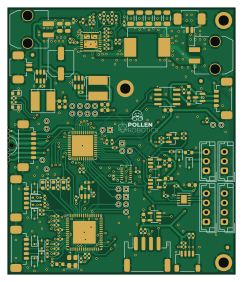
Elec Anything2EtherCAT is an open source STM32 PCB design by pollen-robotics, published on GitHub under the Apache-2.0 license. It is a 4-layer board measuring 60 × 70.3 mm, with 200 components from 78 distinct parts.
Its main chip is the STM32G431CBUx, from the STM32 family. Other key parts include the TCAN3413, 74LVC1G08, SN74LVC1G125DBV, SN74LVC1G126DBVR and SIT3088E. By type, the board carries 64 capacitors, 57 resistors, 16 diodes, 14 connectors, 12 ICs and 8 inductors.
From the project
As its name tells. Basically for CAN bus and Dynamixel 3/4
Anything2EtherCAT is built to put an end to CAN bus and Dynamixel on Reachy x.
Nobody talks about EtherCAT on Reachy 2 — because it simply works. Orbitas 2-DoF and 3-DoF run flawlessly at 1 kHz over EtherCAT, while the Mobile Base still relies on CAN-over-USB, and the grippers/antennas still depend on Dynamixel 3p/4p. Only a handful of devices speak EtherCAT today, so we built this board to change that — a clean, robust translator to EtherCAT, ready to drop anywhere.
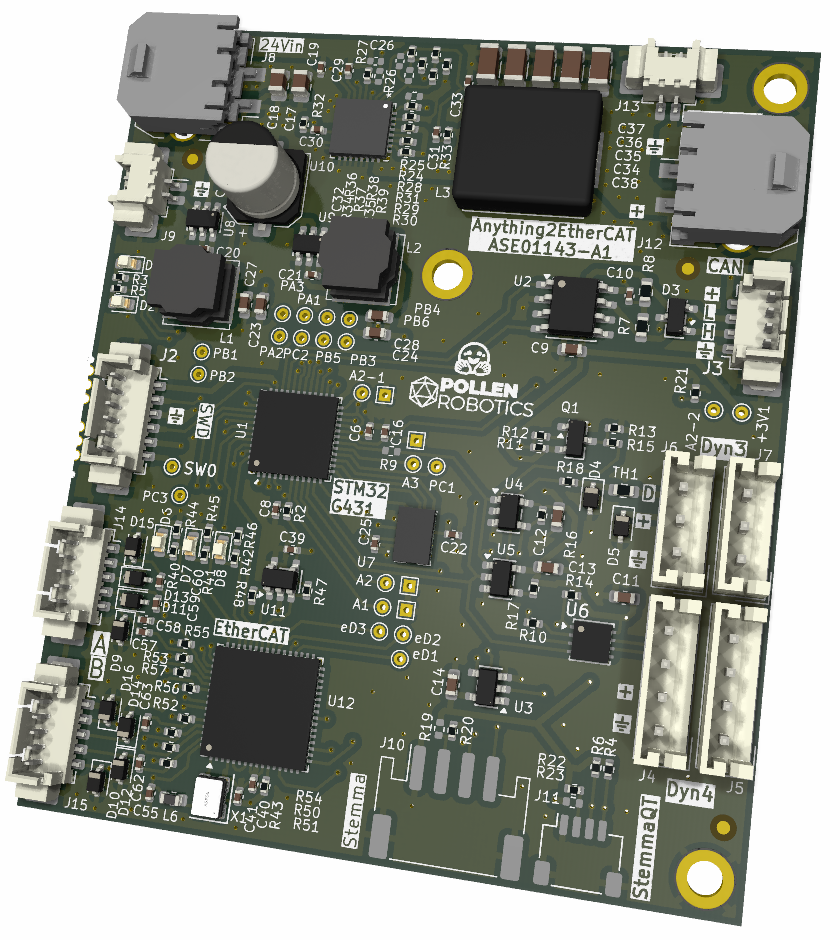
Main components on the Elec Anything2EtherCAT
Elec Anything2EtherCAT bill of materials (BOM)
200 components, 78 distinct parts.
| Qty | Part | Footprint | Refs |
|---|---|---|---|
| 1 | STM32G431CBUx | QFN-48-1EP_7x7mm_P0.5mm_EP5.6x5.6mm | U1 |
| 1 | TCAN3413 | SOIC-8_3.9x4.9mm_P1.27mm | U2 |
| 1 | 74LVC1G08 | SOT-23-5 | U3 |
| 1 | SN74LVC1G125DBV | SOT-23-5 | U4 |
| 1 | SN74LVC1G126DBVR | SOT-23-5 | U5 |
| 1 | SIT3088E | DFN-8-1EP_3x3mm_P0.65mm_EP1.5x2.25mm | U6 |
| 1 | BMI088 | BMI088 | U7 |
| 1 | AP63205 | TSOT-23-6 | U8 |
| 1 | AP63203 | TSOT-23-6 | U9 |
| 1 | SIC402A | QFN_C403_VIS | U10 |
| 1 | 24LC32xx/OT | SOT-23-5 | U11 |
| 1 | LAN9253 | QFN-64-1EP_9x9mm_P0.5mm_EP6x6mm | U12 |
| 5 | TestPoint | TestPoint_THTPad_D1.0mm_Drill0.5mm | A1, A2, A2-1, A2-2, A3 |
| 1 | MMBT3906 | SOT-23 | Q1 |
| 1 | 25MHz | Oscillator_SMD_Abracon_ASE-4Pin_3.2x2.5mm | X1 |
| 1 | Pico6 | Molex_PicoBlade_53398-0671_1x06-1MP_P1.25mm_Vertical | J2 |
| 1 | Pico4 | Molex_PicoBlade_53398-0471_1x04-1MP_P1.25mm_Vertical | J3 |
| 2 | Dynamixel-4 | JST_EH_B4B-EH-A_1x04_P2.50mm_Vertical | J4, J5 |
| 2 | Dynamixel-3 | JST_EH_B3B-EH-A_1x03_P2.50mm_Vertical | J6, J7 |
| 2 | MicroFit2 | Micro-Fit_43650-0210_Horizontal | J8, J12 |
Show 58 more
| Qty | Part | Footprint | Refs |
|---|---|---|---|
| 2 | Pico2 | Molex_PicoBlade_53261-0271_1x02-1MP_P1.25mm_Horizontal | J9, J13 |
| 1 | JST PH | JST_PH_S4B-PH-SM4-TB_1x04-1MP_P2.00mm_Horizontal | J10 |
| 1 | JST SH | JST_SH_SM04B-SRSS-TB_1x04-1MP_P1.00mm_Horizontal | J11 |
| 2 | Pico5 | Molex_PicoBlade_53398-0571_1x05-1MP_P1.25mm_Vertical | J14, J15 |
| 16 | TestPoint | TestPoint_THTPad_D1.0mm_Drill0.5mm | +3V1, PA1, PA2, PA3, PB1, PB2, PB3, PB4 +8 |
| 1 | TestPoint | TestPoint_THTPad_D1.0mm_Drill0.5mm | SW0 |
| 1 | 100R thermistor | R_0603_1608Metric | TH1 |
| 4 | TestPoint_Alt | TestPoint_THTPad_1.0x1.0mm_Drill0.5mm | TP1, TP2, TP3, TP4 |
| 2 | Green | LED_0603_1608Metric | D1, D6 |
| 1 | Red | LED_0603_1608Metric | D2 |
| 1 | D_TVS_Dual_AAC | SOT-23 | D3 |
| 1 | 5V1 | D_SOD-323 | D4 |
| 1 | B5819WS | D_SOD-323 | D5 |
| 2 | Yellow | LED_0603_1608Metric | D7, D8 |
| 8 | D_Schottky | D_SOD-323 | D9, D10, D11, D12, D13, D14, D15, D16 |
| 1 | FerriteBead_Small | L_0402_1005Metric | FB1 |
| 2 | 6,8u 2A | L_Bourns_SRN6045TA | L1, L2 |
| 1 | 1 uH 20A | L_Vishay_IHLP-4040 | L3 |
| 4 | FB | L_0603_1608Metric | L4, L5, L6, L7 |
| 22 | 100n 6V3 | C_0402_1005Metric | C1, C2, C3, C4, C5, C8, C22, C25 +14 |
| 1 | 1u | C_0402_1005Metric | C6 |
| 1 | 10n | C_0402_1005Metric | C7 |
| 5 | 100n | C_0603_1608Metric | C9, C11, C12, C13, C14 |
| 1 | 10p | C_0402_1005Metric | C10 |
| 1 | 10u 35V | CP_Elec_6.3x7.7 | C15 |
| 1 | 10n 6V3 | C_0402_1005Metric | C16 |
| 2 | 22u 35V | C_0805_2012Metric | C17, C18 |
| 3 | 10n 50V | C_0402_1005Metric | C19, C31, C33 |
| 10 | 100n 50V | C_0402_1005Metric | C20, C21, C57, C58, C59, C60, C61, C62 +2 |
| 4 | 22u 6V3 | C_0603_1608Metric | C23, C24, C27, C28 |
| 1 | DNP-2u2 | C_0402_1005Metric | C26 |
| 1 | 2,2n 50V | C_0402_1005Metric | C29 |
| 1 | 100n 35V | C_0402_1005Metric | C30 |
| 1 | DNP-2n2 50V | C_0402_1005Metric | C32 |
| 5 | 47u 16V | C_1206_3216Metric | C34, C35, C36, C37, C38 |
| 3 | 10u 6V3 | C_0402_1005Metric | C47, C48, C49 |
| 1 | 470p 6V3 | C_0402_1005Metric | C50 |
| 13 | 10k | R_0402_1005Metric | R1, R11, R12, R14, R16, R17, R30, R31 +5 |
| 1 | 100k | R_0402_1005Metric | R2 |
| 2 | 470R | R_0402_1005Metric | R3, R5 |
| 4 | 3k3 | R_0402_1005Metric | R4, R6, R47, R48 |
| 2 | 56R 0603 | R_0603_1608Metric | R7, R8 |
| 4 | DNP-0R | R_0402_1005Metric | R9, R19, R23, R34 |
| 5 | 0R | R_0402_1005Metric | R10, R15, R20, R22, R35 |
| 2 | 20k | R_0402_1005Metric | R13, R36 |
| 1 | 150R | R_0402_1005Metric | R18 |
| 1 | 4k7 | R_0402_1005Metric | R21 |
| 1 | 249k | R_0402_1005Metric | R24 |
| 1 | DNP-100k | R_0402_1005Metric | R25 |
| 1 | DNP-169k | R_0402_1005Metric | R26 |
| 1 | 30k | R_0402_1005Metric | R27 |
| 1 | 75R | R_0402_1005Metric | R28 |
| 1 | 5k1 | R_0402_1005Metric | R29 |
| 1 | 10R | R_0402_1005Metric | R32 |
| 5 | 1k | R_0402_1005Metric | R37, R39, R40, R41, R42 |
| 1 | 7k5 | R_0402_1005Metric | R38 |
| 1 | 12.1k - 1% | R_0603_1608Metric | R49 |
| 8 | 49R9 | R_0402_1005Metric | R50, R51, R52, R53, R54, R55, R56, R57 |
Elec Anything2EtherCAT design files
The KiCad project lives in the pollen-robotics/elec_Anything2EtherCAT repository on GitHub; these links point at the commit this page was built from.
Elec Anything2EtherCAT: common questions
What microcontroller does the Elec Anything2EtherCAT use?
The Elec Anything2EtherCAT is built around the STM32G431CBUx, from the STM32 family.
How big is the Elec Anything2EtherCAT PCB?
The Elec Anything2EtherCAT measures 60 × 70.3 mm, has 4 copper layers and is 1 mm thick.
How many components are on the Elec Anything2EtherCAT?
200 components, from 78 distinct parts. The full bill of materials is listed on this page.
Where can I download the Elec Anything2EtherCAT design files?
From the pollen-robotics/elec_Anything2EtherCAT repository on GitHub, which has the KiCad layout and the schematic; the links under Design files point to each one.
Can I use the Elec Anything2EtherCAT design in my own project?
Yes, under the terms of its Apache-2.0 license, which pollen-robotics chose for the repository.
Can I test firmware for the Elec Anything2EtherCAT without the hardware?
Yes. HardLabs builds a simulation of the board from its netlist and BOM, so you can run and debug STM32 firmware against it before you order a PCB.
Similar boards
 STM32
STM32LumenPnP Motherboard
opulo-inc
149 × 95 mm296 parts4LCC-BY-SA-4.03.7k STM32
STM32AxxSolder
AxxAxx
39 × 82.5 mm122 parts2LGPL-3.01.7k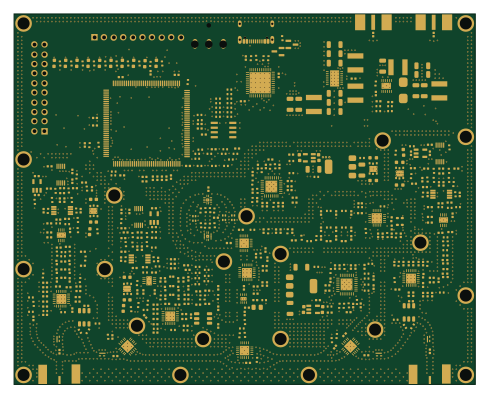 STM32
STM32LibreVNA
jankae
122 × 98 mm592 parts6LGPL-3.01.6k STM32
STM32AIOC
skuep
21 × 31.5 mm47 parts2LMIT1.4k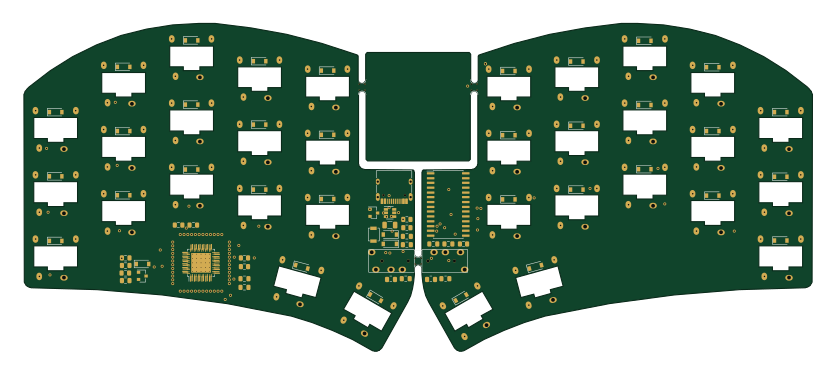 STM32
STM32Ferris
pierrechevalier83
208.8 × 86.8 mm102 parts2LSHL-2.11.3k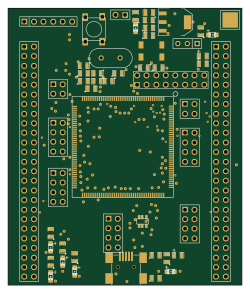 STM32
STM32176 pin board
rusefi
61.8 × 73.2 mm76 parts2LGPL-3.01.2k