
DronPi

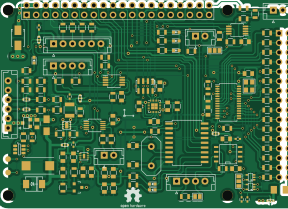
About the DronPi PCB
DronPi is an open source Raspberry Pi PCB design by radioelf, published on GitHub. It is a 2-layer board measuring 71.8 × 50.9 mm, with 135 components from 64 distinct parts.
Its main chip is the RPi_GPIO, from the Raspberry Pi family. Other key parts include the MIC5332, MPU-9250, MS5611-01BA, PCA9306 and ADC_ADS1115. By type, the board carries 61 resistors, 25 capacitors, 14 diodes, 13 ICs, 7 inductors and 3 connectors.
It belongs with the robotics & motion and wearables designs in this gallery.
From the project
Placa sensores para ardupilot y Raspberry (drone)
Sensores: -MS5611 Sensor de presión barométrica (Bus SPI) -MPU9250 Giroscopio/Acelerómetro/Compás interno/9-AXIS (Bus SPI) -MCP2515 CAN Bus (Bus SPI) -ADS1115 ADC 16bits (Bus I2C) dirección 0x48, canal 0 tensión, canal 1 intensidad -PCA9685 Generador de PWM (Bus I2c) dirección 0x40 y 0x70(ALLCALL)
Periféricos: zumbador, RS-232, i2C, PowerOOF, PPM S-BUS, ADC, Can-Bus, HATs (Hardware Attached on Top)
Main components on the DronPi
DronPi bill of materials (BOM)
135 components, 64 distinct parts — part numbers from the project's BOM.
| Qty | Part | Footprint | Refs |
|---|---|---|---|
| 1 | MIC5332 | MLF-8-1EP | IC1 |
| 1 | MPU-9250 | QFN-24-1EP_3x3mm_Pitch0.4mm | IC2 |
| 1 | MS5611-01BA | MS5611 | IC3 |
| 1 | PCA9306 | MSOP-8_3x3mm_Pitch0.65mm | IC4 |
| 1 | ADC_ADS1115 | MSOP-10_3x3mm_Pitch0.5mm | IC5 |
| 1 | PCA9685 | TSSOP-28_4.4x9.7mm_Pitch0.65mm | IC6 |
| 1 | BQ24315 | BQ24313_DSG_8 | IC7 |
| 1 | MCP2515 | SOIC-18 | IC8 |
| 1 | MCP2551 | SOIC-8-N | IC9 |
| 1 | 24AA32 | MSOP-8_3x3mm_Pitch0.65mm | IC10 |
| 1 | MAX3370 | SC70-5 | IC11 |
| 1 | SN74LVC1G07 SN74AHC1G04 | SC70-5 | IC12 |
| 1 | DMMT5401 | SOT-23-6 | U1 |
| 1 | MMBT3906LT1 | SOT-23 | Q1 |
| 1 | DMG2305 | SOT23-3 | Q2 |
| 1 | RPi_GPIO | raspberrypi2 | J1 |
| 1 | CONN_3X16 | IDC_Header_Straight_34pins | P1 |
| 1 | PowerOff | JST_EH_B02B-EH-A_02x2.50mm_Straight | P2 |
| 1 | CONN_01X02 | JST_EH_B02B-EH-A_02x2.50mm_Straight | ADC1 |
| 1 | CONN_01X04 | JST_EH_B02B-EH-A_02x2.50mm_Straight | BUZZER1 |
Show 44 more
| Qty | Part | Footprint | Refs |
|---|---|---|---|
| 2 | JST_4PIN | JST_EH_B04B-EH-A_04x2.50mm_Straight | CAN-Bus1, I2C1 |
| 2 | 0ZCA0035FF2G | Fuse_SMD1206_Wave | F1, F2 |
| 2 | JST_6PIN | JST_EH_B06B-EH-A_06x2.50mm_Straight | POWER1, USART5 |
| 1 | CRYSTAL_ASE-25MHZ CRYSTAL_ASE-25mhz | ASEseries | XT1 |
| 1 | 16MHZ 16Mhz | HC-18UV | XT2 |
| 1 | SMBJ5V | DO-214AA | D1 |
| 6 | PESD0402-140 | C_0402 | D2, D3, D4, D5, D9, D13 |
| 1 | LED_rojo | LED_0603 | D6 |
| 1 | LED_verde | LED_0603 | D7 |
| 1 | LED_azul | LED_0603 | D8 |
| 1 | STPS1L30A | SMA_Standard | D10 |
| 1 | verde | LED_0603 | D11 |
| 1 | Rojo | LED_0603 | D12 |
| 1 | LED_blanco | LED_0603 | D14 |
| 7 | KNH16C104DA5TS | KYOCERA-KNH16-DA | L1, L2, L3, L4, L5, L6, L7 |
| 13 | 100NF 100nF | C_0805 | C1, C5, C7, C10, C11, C14, C15, C16 +5 |
| 1 | 10UF 10uF | C_0805 | C2 |
| 1 | 2U2F 2u2F | C_0805 | C3 |
| 1 | 220UF 220uF | TantalC_SizeD_EIA-7343_Reflow | C4 |
| 3 | 22UF 22uF | C_0805 | C6, C9, C17 |
| 1 | 1UF 1uF | C_0805 | C8 |
| 1 | 10NF 10nF | C_0805 | C12 |
| 1 | 2U2 2u2 | C_0805 | C13 |
| 1 | 100UF 100uF | C_1210 | C18 |
| 2 | 22PF 22pF | C_0805 | C20, C22 |
| 5 | 120R | R_0805 | R1, R2, R3, R4, R49 |
| 4 | 1K5 | R_0805 | R5, R6, R8, R9 |
| 1 | 200K | R_0805 | R7 |
| 1 | 10R | R_0805 | R10 |
| 1 | 1K8 1k8 | R_0805 | R11 |
| 3 | 1M | R_0805 | R12, R13, R33 |
| 8 | 10K/0.1% | R_0805 | R14, R15, R16, R17, R18, R19, R55, R56 |
| 6 | 10K | R_0805 | R20, R21, R31, R47, R57, R59 |
| 15 | 220 | R_0805 | R22, R23, R24, R25, R26, R27, R28, R29 +7 |
| 1 | 100 | R_0805 | R30 |
| 1 | 24K | R_0805 | R32 |
| 3 | 680 | R_0805 | R34, R35, R60 |
| 1 | 820 | R_0805 | R36 |
| 1 | 18K | R_0805 | R44 |
| 2 | 560 | R_0805 | R45, R46 |
| 3 | 1K | R_0805 | R48, R54, R58 |
| 2 | 3K9 | R_0805 | R50, R51 |
| 2 | 47K 47k | R_0805 | R52, R53 |
| 1 | 100R | R_0805 | R61 |
DronPi design files
The KiCad project lives in the radioelf/DronPi repository on GitHub; these links point at the commit this page was built from.
DronPi: common questions
What microcontroller does the DronPi use?
The DronPi is built around the RPi_GPIO, from the Raspberry Pi family.
How big is the DronPi PCB?
The DronPi measures 71.8 × 50.9 mm, has 2 copper layers and is 1.6 mm thick.
How many components are on the DronPi?
135 components, from 64 distinct parts, with part numbers taken from the project's own BOM. The full bill of materials is listed on this page.
Where can I download the DronPi design files?
From the radioelf/DronPi repository on GitHub, which has the KiCad layout and the BOM; the links under Design files point to each one.
Can I use the DronPi design in my own project?
The repository has no license, so all rights stay with radioelf. Use it as a reference, and ask the author before reusing the design.
Can I test firmware for the DronPi without the hardware?
Yes. HardLabs builds a simulation of the board from its netlist and BOM, so you can run and debug Raspberry Pi firmware against it before you order a PCB.
Similar boards
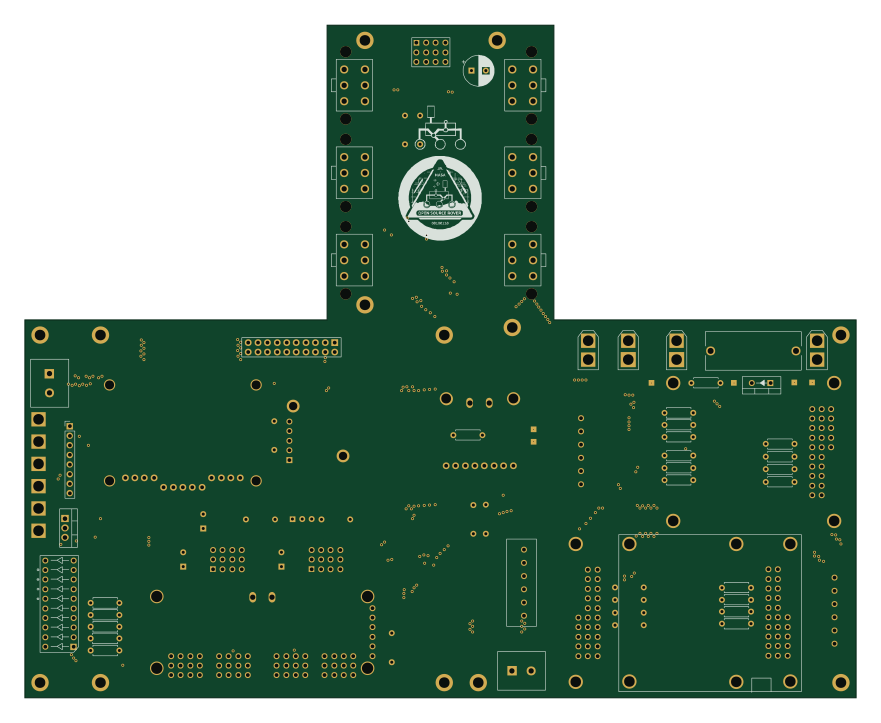 Raspberry Pi
Open source rover
nasa-jpl
220 × 178 mm144 parts2LApache-2.09.7k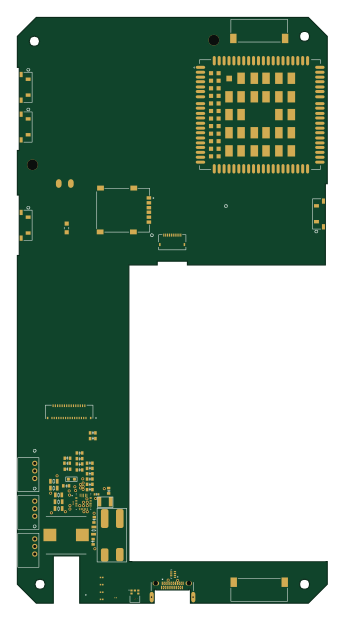 Raspberry Pi
SPIRIT
SPIRIT-org
82 × 155 mm130 parts6LCERN-OHL-S-2.01.3k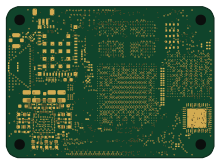 Raspberry Pi
CM5RevEng
schlae
55 × 40 mm417 parts10LNo license1.0k Raspberry Pi
Haxo hw
cardonabits
102.4 × 211.3 mm38 parts2LCustom license672 Raspberry Pi
Desktop 50 Pin TopConn
BlueSCSI
89.2 × 82.6 mm103 parts2LGPL-3.0449 Raspberry Pi
PowerBook
74.5 × 56.3 mm78 parts2LGPL-3.0449