
RoboDojo

About the RoboDojo PCB
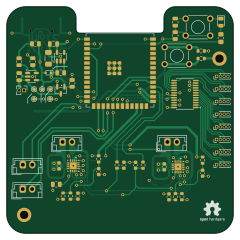
RoboDojo is an open source ESP32 PCB design by Amoskeag, published on GitHub under the BSD-2-Clause license. It is a 4-layer board measuring 60 × 60 mm, with 63 components from 41 distinct parts.
Its main chip is the ESP32-S3-WROOM-1, from the ESP32 family. Other key parts include the TCA9548ARGER, STSPIN250, USBLC6-2P6, MCP73831-2-OT and AP2112K-3.3. By type, the board carries 10 connectors, 10 resistors, 8 capacitors, 7 ICs, 2 switches and 2 diodes.
It belongs with the robotics & motion and dev boards & breakouts designs in this gallery.
From the project
Super Cool Small Form Factor Robotics
This repo contains all the firmware and hardware for the RoboDojo.
If you're looking for the latest docs/builds, see our Releases Page.
First, clone this repo (and optionally checkout a branch)
Some libraries and resources are included as submodules, run the following command to initialize them before opening the main sch
(If you get a missing library error, make sure to do this)
Main components on the RoboDojo
RoboDojo bill of materials (BOM)
63 components, 41 distinct parts.
| Qty | Part | Footprint | Refs |
|---|---|---|---|
| 1 | ESP32-S3-WROOM-1 | ESP32-S3-WROOM-1 | U1 |
| 1 | TCA9548ARGER | TSSOP-24_4.4x7.8mm_P0.65mm | U2 |
| 2 | STSPIN250 | ST_Microelectronics-STSPIN250-0 | U4, U5 |
| 1 | USBLC6-2P6 | SOT-666 | U6 |
| 1 | MCP73831-2-OT | SOT-23-5 | U8 |
| 1 | AP2112K-3.3 | SOT-23-5 | U9 |
| 1 | DMP2045U | SOT-23 | Q1 |
| 1 | USB_C_Receptacle_USB2.0 | USB_C_Receptacle_GCT_USB4110 | J1 |
| 1 | Conn_01x02_Pin | PinHeader_1x02_P1.27mm_Vertical | J2 |
| 8 | ~ | PinHeader_1x04_P1.00mm_Vertical | J3, J4, J5, J6, J7, J8, J9, J10 |
| 1 | 1 nF | C_0603_1608Metric | Cen1 |
| 2 | 22 nF | C_0603_1608Metric | Coff1, Coff2 |
| 3 | 10 nF | C_0603_1608Metric | Cr1, Cr2, Cs1 |
| 1 | Motor A Output | JST_EH_B2B-EH-A_1x02_P2.50mm_Vertical | J_A1 |
| 1 | Motor B Output | JST_EH_B2B-EH-A_1x02_P2.50mm_Vertical | J_B1 |
| 1 | Left Encoder | JST_EH_B2B-EH-A_1x02_P2.50mm_Vertical | J_LE1 |
| 1 | Right Encoder | JST_EH_B2B-EH-A_1x02_P2.50mm_Vertical | J_RE1 |
| 3 | 18 KΩ | R_0603_1608Metric | Ren1, Rs1, Rs2 |
| 2 | 1 KΩ | R_0603_1608Metric | Roff1, Roff3 |
| 2 | 47 KΩ | R_0603_1608Metric | Roff2, Roff4 |
Show 21 more
| Qty | Part | Footprint | Refs |
|---|---|---|---|
| 2 | 750 KΩ | R_0603_1608Metric | Rr1, Rr2 |
| 1 | 100 | R_0603_1608Metric | Rs3 |
| 2 | 330 mΩ | R_0805_2012Metric | Rsns1, Rsns2 |
| 1 | SW_Push_Dual_x2 | SW_TH_Tactile_Omron_B3F-100x | SW1 |
| 1 | SW_Push | SW_TH_Tactile_Omron_B3F-100x | SW2 |
| 1 | RED LED | LED_0805_2012Metric | LED1 |
| 1 | 1N4448WT | D_SOD-523 | D2 |
| 1 | LED | R_0805_2012Metric | D3 |
| 1 | 10 µF | C_1206_3216Metric_Pad1.33x1.80mm_HandSolder | C1 |
| 1 | 1 µF | C_0805_2012Metric | C2 |
| 1 | 100 nF | C_0603_1608Metric | C3 |
| 2 | 2.2 uF | C_0603_1608Metric | C4, C6 |
| 1 | 1uF | C_0805_2012Metric | C5 |
| 1 | 10 uF | C_0805_2012Metric | C10 |
| 1 | 1 uF | C_0805_2012Metric | C11 |
| 2 | 5.1k | R_0805_2012Metric | R1, R6 |
| 2 | 100k | R_0805_2012Metric | R2, R9 |
| 2 | 5K1 | R_0603_1608Metric | R3, R13 |
| 1 | 5.1k | R_0805_2012Metric_Pad1.20x1.40mm_HandSolder | R4 |
| 2 | 200k | R_0805_2012Metric | R7, R8 |
| 1 | 10k | R_0805_2012Metric | R10 |
RoboDojo design files
The KiCad project lives in the Amoskeag/RoboDojo repository on GitHub; these links point at the commit this page was built from.
RoboDojo: common questions
What microcontroller does the RoboDojo use?
The RoboDojo is built around the ESP32-S3-WROOM-1, from the ESP32 family.
How big is the RoboDojo PCB?
The RoboDojo measures 60 × 60 mm, has 4 copper layers and is 1.6 mm thick.
How many components are on the RoboDojo?
63 components, from 41 distinct parts. The full bill of materials is listed on this page.
Where can I download the RoboDojo design files?
From the Amoskeag/RoboDojo repository on GitHub, which has the KiCad layout and the schematic; the links under Design files point to each one.
Can I use the RoboDojo design in my own project?
Yes, under the terms of its BSD-2-Clause license, which Amoskeag chose for the repository.
Can I test firmware for the RoboDojo without the hardware?
Yes. HardLabs builds a simulation of the board from its netlist and BOM, so you can run and debug ESP32 firmware against it before you order a PCB.
Similar boards
 ESP32
OSO-BOOK-B1
joeycastillo
85 × 115 mm65 parts2LCC-BY-SA-4.08.1k ESP32
Powertrain
byrantech
64 × 45.4 mm171 parts4LMIT4.3k ESP32
Badge
atopile
56.3 × 39 mm239 parts4LMIT4.0k ESP32
Esp32 minimal
36.2 × 26.8 mm20 parts2LMIT4.0k ESP32
Racer
StuckAtPrototype
36 × 50.2 mm70 parts4LApache-2.03.8k ESP32
Controller
29 × 74 mm58 parts4LApache-2.03.8k