
AnthC

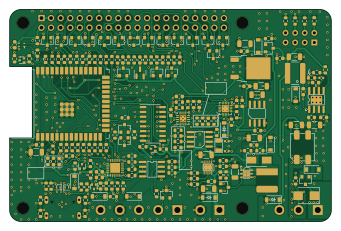
About the AnthC PCB
AnthC is an open source ESP32 PCB design by Anthilla, published on GitHub. It is a 4-layer board measuring 85 × 56 mm, with 203 components from 65 distinct parts.
Its main chip is the ESP32-S3-WROOM-1-N16, from the ESP32 family. Other key parts include the TPS54331DR, MCP73833-BZI/MF, BD33FC0FP-E2, SP3485EN-L/TR and CP2102N-A02-GQFN24. By type, the board carries 92 resistors, 44 capacitors, 33 diodes, 13 ICs, 9 transistors and 5 connectors.
It belongs with the iot & wireless, power & battery and sensors designs in this gallery.
From the project
Anthilla AnthC Board
The Anthilla Controller Board is a flexible controller for IoT projects. It can be easily adapted for different needs. The board has the Rasperry-pi form factor to fast the integration.
- Extended range temperature - Input power: 7V - 28V. The board can be powered by just powering 5V area. - 4 Digital inputs - 6 Open collector outputs - 4 Analog inputs (16 bit ADC) or 4-20mA inputs switchable (multiplexed) - RS485 communication - Real time clock - Rechargeable LiPo battery - I2C and SPI communication - USB-C port

Main components on the AnthC
AnthC bill of materials (BOM)
203 components, 65 distinct parts — part numbers from the project's BOM.
| Qty | Part | Footprint | Refs |
|---|---|---|---|
| 1 | TPS54331DR Texas Instruments | SOIC-8-1EP_3.9x4.9mm_P1.27mm_EP2.29x3mm_ThermalVias | U1 |
| 1 | MCP73833-BZI/MF MCP73833-DFN Microchip | DFN-10-1EP_3x3mm_P0.5mm_EP1.65x2.38mm_ThermalVias | U2 |
| 1 | BD33FC0FP-E2 Onsemi | TO-252-2 | U3 |
| 1 | SP3485EN-L/TR Exar | SOIC-8_3.9x4.9mm_P1.27mm | U4 |
| 1 | CP2102N-A02-GQFN24 Silicon Labs | QFN-24-1EP_4x4mm_P0.5mm_EP2.6x2.6mm | U5 |
| 1 | ESP32-S3-WROOM-1-N16 ESP32-S3-WROOM Espressif | ESP32-S3-WROOM | U6 |
| 1 | MCP7940N-I/SN Microchip | SOIC-8_3.9x4.9mm_P1.27mm | U7 |
| 1 | SHT40-AD1B-R2 Sensirion | DFN-4 | U8 |
| 1 | TLV9054SIRTER TLV9054 Texas Instruments | QFN-16-1EP_3x3mm_P0.5mm_EP1.7x1.7mm | U9 |
| 1 | MCP3464RT-E/NC MCP3464RT-E_NC Microchip | UQFN-20-1EP_3x3mm_P0.4mm_EP1.85x1.85mm_ThermalVias | U10 |
| 1 | ULN2004D1013TR ST Microelectronics | SO-16_3.9x9.9mm_P1.27mm | U11 |
| 1 | LM2735XMFX/NOPB LM2735X Texas Instruments | WSON-6-1EP_3x3mm_P0.95mm | U12 |
| 1 | REF5025AID Texas Instruments | SOIC-8_3.9x4.9mm_P1.27mm | U13 |
| 4 | 2N7002T-7-F ON Semiconductor | SOT-523 | Q1, Q2, Q5, Q7 |
| 2 | MMSS8050-H-TP Micro Commercial Co | SOT-23 | Q3, Q4 |
| 2 | SI2347DS-T1-GE3 Vishay Semiconductors | SOT-23 | Q8, Q9 |
| 1 | DMN67D8L-7 Diodes Incorporated | SOT-23 | Q10 |
| 1 | SC32S-7PF20PPM SC32S Seiko | Crystal_2pin_3.2mm_1.5mm | Y1 |
| 1 | USB4105-GF-A GCT | USB4105-GF-A | J1 |
| 1 | 691312510005 1x05 Wurth Elektronik | WURTH-691312510005 | J2 |
Show 45 more
| Qty | Part | Footprint | Refs |
|---|---|---|---|
| 1 | 10129381-940002BLF Conn_02x20_Odd_Even Amphenol ICC | PinHeader_2x20_P2.54mm_Vertical | J3 |
| 1 | 691312510003 01x03 Wurth Elektronik | WURTH-691312510003 | J5 |
| 1 | 691312510002 1x02 Wurth Elektronik | WURTH-691312510002 | J6 |
| 1 | 79527141 Battery_Cell_CR2032 Wurth Elektronik | BatteryHolder_WURTH_79527141-C_1x2032 | BT1 |
| 1 | ACM7060-701-2PL-TL01 TDK | ChokeSMD_ACM7060 | FL1 |
| 1 | 418217270904A SW_DIP_x04_Vertical Wurth Elektronik | SW_DIP_SPSTx04_Vertical_4_poles_P_2.54mm | SW1 |
| 1 | NTCG163JF103FT1 NTC_10K TDK | R_0603_1608Metric | TH1 |
| 8 | MMSZ5233B-E3-08 Zener_6V Vishay | D_SOD-123 | D1, D4, D8, D9, D14, D20, D24, D31 |
| 12 | PESD3V3L2BT,215 PESD3V3L2BT Nexperia | SOT-23 | D2, D15, D17, D21, D22, D25, D26, D27 +4 |
| 2 | B5819W Changjiang Electronics Tech (CJ) | D_SOD-123 | D3, D18 |
| 2 | SP3205-01ETG Littelfuse | D_SOD-882 | D5, D19 |
| 4 | BAT54S,235 BAT54S Nexperia | SOT-23 | D6, D10, D11, D16 |
| 1 | B220AF-13 Diodes Incorporated | D_SMA | D7 |
| 1 | SMBJ30CA Littelfuse | D_SMB | D13 |
| 3 | CDSOT23-SM712 TVS_2-Channel-7V Bourns | SOT-23 | D23, D30, D35 |
| 1 | 74439346100 10μH-5A Wurth Elektronik | Inductor_Wurth_XHMI-6060 | L1 |
| 1 | 74404064018 1.8μH-5.8A Wurth Elektronik | Inductor_Wurth_LQS-6045 | L2 |
| 8 | GRT31CR61H106ME01L 10uF Murata Electronics | C_1206_3216Metric | C1, C2, C16, C18, C21, C30, C41, C43 |
| 1 | CL10B223KB8WPNC 22nF Samsung Electro-Mechanics | C_0603_1608Metric | C3 |
| 19 | CL10B104KB8NNNC 100nF Samsung Electro-Mechanics | C_0603_1608Metric | C4, C6, C8, C11, C13, C14, C15, C20 +11 |
| 1 | 885012006055 47pF Wurth Elektronik | C_0603_1608Metric | C5 |
| 1 | 0402B472K500NT 4.7nF Guangdong Fenghua Advanced Tech | C_0402_1005Metric | C7 |
| 3 | GRT31CR61A476KE13L 47uF Murata Electronics | C_1206_3216Metric | C9, C12, C22 |
| 4 | CL10B105KA8NNNC 1uF Samsung Electro-Mechanics | C_0603_1608Metric | C17, C19, C39, C40 |
| 4 | CL10B103KB8NNNC 10nF Samsung Electro-Mechanics | C_0603_1608Metric | C25, C26, C27, C28 |
| 1 | CL10B102KB8NNNC 1nF Samsung Electro-Mechanics | C_0603_1608Metric | C44 |
| 2 | 06035A7R0CAT2A 7pF KYOCERA AVX | C_0402_1005Metric | C45, C46 |
| 3 | RT0603FRE0712KL 12K Yageo | R_0603_1608Metric | R1, R37, R87 |
| 1 | TNPW020149R9BEED 49.9 YAGEO | R_0603_1608Metric | R2 |
| 9 | AC0603JR-070RL 0 Yageo | R_0603_1608Metric | R3, R20, R31, R64, R83, R88, R91, R99 +1 |
| 1 | CR0603-FX-1200ELF 120 Bourns | R_0603_1608Metric | R5 |
| 18 | RC0603FR-0710KL 10K Yageo | R_0603_1608Metric | R6, R7, R9, R10, R13, R14, R15, R16 +10 |
| 1 | RC0603FR-0743KL 43K Yageo | R_0603_1608Metric | R8 |
| 3 | RC0603FR-071KL 1K Yageo | R_0603_1608Metric | R11, R12, R43 |
| 3 | RC0603FR-0710KL 10KΩ Yageo | R_0603_1608Metric | R18, R21, R41 |
| 4 | RK73B1JTTDD203J 20K KOA Speer | R_0603_1608Metric | R24, R27, R29, R32 |
| 32 | RC0603FR-07100RL 100 Yageo | R_0603_1608Metric | R25, R26, R28, R34, R48, R53, R54, R55 +24 |
| 1 | RN73H1JTTD3602F50 36KΩ KOA Speer | R_0603_1608Metric | R36 |
| 1 | RC0603FR-0751KL 51KΩ YAGEO | R_0603_1608Metric | R38 |
| 1 | RC0603FR-07100KL 100KΩ Yageo | R_0603_1608Metric | R39 |
| 9 | CR0603-FX-2001ELF 2KΩ Bourns | R_0603_1608Metric | R40, R44, R45, R46, R49, R50, R51, R52 +1 |
| 1 | CR0603-FX-2212ELF 22K1 Bourns Inc. | R_0603_1608Metric | R47 |
| 1 | RT0603DRE0747K5L 47K5 YAGEO | R_0603_1608Metric | R63 |
| 2 | CRCW02015K10JNED 5K1Ω Vishay | R_0603_1608Metric | R68, R84 |
| 1 | ERJ-3EKF8201V 8.2KΩ Panasonic | R_0603_1608Metric | R86 |
AnthC design files
The KiCad project lives in the Anthilla/AnthC repository on GitHub; these links point at the commit this page was built from.
AnthC: common questions
What microcontroller does the AnthC use?
The AnthC is built around the ESP32-S3-WROOM-1-N16, from the ESP32 family.
How big is the AnthC PCB?
The AnthC measures 85 × 56 mm, has 4 copper layers and is 1.6 mm thick.
How many components are on the AnthC?
203 components, from 65 distinct parts, with part numbers taken from the project's own BOM. The full bill of materials is listed on this page.
Where can I download the AnthC design files?
From the Anthilla/AnthC repository on GitHub, which has the KiCad layout, the schematic and the BOM; the links under Design files point to each one.
Can I use the AnthC design in my own project?
The repository has no license, so all rights stay with Anthilla. Use it as a reference, and ask the author before reusing the design.
Can I test firmware for the AnthC without the hardware?
Yes. HardLabs builds a simulation of the board from its netlist and BOM, so you can run and debug ESP32 firmware against it before you order a PCB.
Similar boards
 ESP32
OSO-BOOK-B1
joeycastillo
85 × 115 mm65 parts2LCC-BY-SA-4.08.1k ESP32
Powertrain
byrantech
64 × 45.4 mm171 parts4LMIT4.3k ESP32
Badge
atopile
56.3 × 39 mm239 parts4LMIT4.0k ESP32
Esp32 minimal
36.2 × 26.8 mm20 parts2LMIT4.0k ESP32
Controller
StuckAtPrototype
29 × 74 mm58 parts4LApache-2.03.8k ESP32
Racer
36 × 50.2 mm70 parts4LApache-2.03.8k