
Voice-Assistance-MoleNet

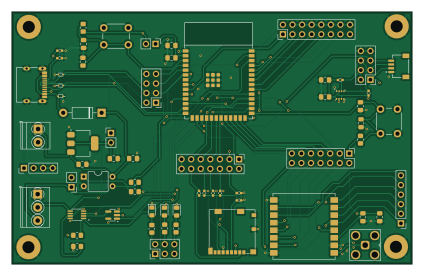
About the Voice-Assistance-MoleNet PCB
Voice-Assistance-MoleNet is an open source ESP32 PCB design by ComNets-Bremen, published on GitHub under the MIT license. It is a 4-layer board measuring 106 × 66.8 mm, with 65 components from 41 distinct parts.
Its main chip is the ESP32-S3-WROOM-1, from the ESP32 family. Other key parts include the 74AHC1G00, TLV76133DCY, PC817, Lora Module and 74LVC2G241. By type, the board carries 17 connectors, 17 resistors, 15 capacitors, 7 ICs, 7 diodes and 2 switches.
From the project
A voice assistance chatbot
Customized XiaoZhi voice-assistant firmware for the MoleNet v6.3 board and its INMP441 microphone. MoleNet v7.1 uses the same board layout for this build.
- Online voice-assistant mode through the configured XiaoZhi service. - Offline TinyML keyword detection for YES, NO, and UP when the network is unavailable. The responses are printed in the serial monitor; NO also turns off the GPIO38 LED, and UP prints “Today is Friday.” Offline model loading is still being validated against the board’s available RAM.
Main components on the Voice-Assistance-MoleNet
Voice-Assistance-MoleNet bill of materials (BOM)
65 components, 41 distinct parts — part numbers from the project's BOM.
| Qty | Part | Footprint | Refs |
|---|---|---|---|
| 1 | ESP32-S3-WROOM-1 | ESP32-S3-WROOM-1 | U1 |
| 1 | 74AHC1G00 | SC-74A-5_1.55x2.9mm_P0.95mm | U2 |
| 1 | TLV76133DCY | SOT-223-3_TabPin2 | U3 |
| 1 | PC817 | DIP-4_W7.62mm | U4 |
| 1 | Lora Module | Ai-Thinker-Ra-01-LoRa | U5 |
| 1 | 74LVC2G241 | SOP65P400X130-8N | U6 |
| 1 | BME280 | Bosch_LGA-8_2.5x2.5mm_P0.65mm_ClockwisePinNumbering | U7 |
| 1 | Micro SD connector | PinHeader_2x07_P2.54mm_Vertical | J1 |
| 1 | BME280 Connector | PinHeader_2x04_P2.54mm_Vertical | J2 |
| 1 | Power Out | PinHeader_1x04_P2.54mm_Vertical | J3 |
| 1 | Led Connector | PinHeader_2x03_P2.54mm_Vertical | J4 |
| 1 | Lora Connector | PinHeader_2x07_P2.54mm_Vertical | J5 |
| 1 | USB_C_RECEPTACLE_USB2.0 USB_C_Receptacle_USB2.0 | USB_C_Receptacle_G-Switch_GT-USB-7010ASV | J6 |
| 1 | 4.8V-16V Input | TerminalBlock_Phoenix_PT-1,5-2-3.5-H_1x02_P3.50mm_Horizontal | J7 |
| 1 | ~ | PinHeader_2x04_P2.54mm_Vertical | J8 |
| 1 | Unused Pin | PinHeader_2x08_P2.54mm_Vertical | J9 |
| 1 | SDI-12 | TerminalBlock_Phoenix_PT-1,5-3-3.5-H_1x03_P3.50mm_Horizontal | J10 |
| 1 | RA_01_DIO | PinHeader_1x06_P2.54mm_Vertical | J11 |
| 3 | CONN_01X02 Conn_01x02 | PinHeader_1x02_P2.54mm_Vertical | J12, J16, J17 |
| 1 | Micro SD Card | microSD_HC_Molex_104031-0811 | J13 |
Show 21 more
| Qty | Part | Footprint | Refs |
|---|---|---|---|
| 1 | Conn_Coaxial | SMA_Amphenol_901-143_Horizontal | J14 |
| 1 | Qwiic | SPARKFUN_PRT-14417 | J15 |
| 1 | RESET | SW_PUSH_6mm_H4.3mm | SW1 |
| 1 | BOOT | SW_PUSH_6mm_H4.3mm | SW2 |
| 3 | LESD5D5.0CT1G | LESD5D50CT1G | D2, D4, D5 |
| 1 | 1N5819 | D_DO-41_SOD81_P10.16mm_Horizontal | D3 |
| 3 | LED | LED_0805_2012Metric_Pad1.15x1.40mm_HandSolder | D6, D7, D8 |
| 2 | 22UF 22uF | C_0805_2012Metric_Pad1.18x1.45mm_HandSolder | C1, C14 |
| 2 | 100NF 100nF | C_0805_2012Metric_Pad1.18x1.45mm_HandSolder | C2, C15 |
| 3 | 1UF 1uF | C_0805_2012Metric_Pad1.18x1.45mm_HandSolder | C3, C6, C8 |
| 1 | 2.2UF 2.2uF | C_0805_2012Metric_Pad1.18x1.45mm_HandSolder | C4 |
| 4 | 0.1UF 0.1uF | C_0805_2012Metric_Pad1.18x1.45mm_HandSolder | C5, C7, C9, C10 |
| 1 | 10UF 10uF | C_0805_2012Metric_Pad1.18x1.45mm_HandSolder | C13 |
| 1 | 22UF 22uF | C_0402_1005Metric_Pad0.74x0.62mm_HandSolder | C16 |
| 1 | 100NF 100nF | C_0402_1005Metric_Pad0.74x0.62mm_HandSolder | C17 |
| 4 | 10K 10k | R_0805_2012Metric_Pad1.20x1.40mm_HandSolder | R1, R2, R3, R6 |
| 2 | 5.1K 5.1k | R_0402_1005Metric_Pad0.72x0.64mm_HandSolder | R4, R5 |
| 2 | 4.7K | R_0402_1005Metric_Pad0.72x0.64mm_HandSolder | R7, R17 |
| 4 | 220 | R_0805_2012Metric_Pad1.20x1.40mm_HandSolder | R8, R10, R11, R12 |
| 1 | 1k | R_0805_2012Metric_Pad1.20x1.40mm_HandSolder | R9 |
| 4 | 10K | R_0402_1005Metric_Pad0.72x0.64mm_HandSolder | R13, R14, R15, R16 |
Voice-Assistance-MoleNet design files
The KiCad project lives in the ComNets-Bremen/Voice-Assistance-MoleNet repository on GitHub; these links point at the commit this page was built from.
Voice-Assistance-MoleNet: common questions
What microcontroller does the Voice-Assistance-MoleNet use?
The Voice-Assistance-MoleNet is built around the ESP32-S3-WROOM-1, from the ESP32 family.
How big is the Voice-Assistance-MoleNet PCB?
The Voice-Assistance-MoleNet measures 106 × 66.8 mm, has 4 copper layers and is 1.6 mm thick.
How many components are on the Voice-Assistance-MoleNet?
65 components, from 41 distinct parts, with part numbers taken from the project's own BOM. The full bill of materials is listed on this page.
Where can I download the Voice-Assistance-MoleNet design files?
From the ComNets-Bremen/Voice-Assistance-MoleNet repository on GitHub, which has the KiCad layout, the schematic and the BOM; the links under Design files point to each one.
Can I use the Voice-Assistance-MoleNet design in my own project?
Yes, under the terms of its MIT license, which ComNets-Bremen chose for the repository.
Can I test firmware for the Voice-Assistance-MoleNet without the hardware?
Yes. HardLabs builds a simulation of the board from its netlist and BOM, so you can run and debug ESP32 firmware against it before you order a PCB.
Similar boards
 ESP32
OSO-BOOK-B1
joeycastillo
85 × 115 mm65 parts2LCC-BY-SA-4.08.1k ESP32
Powertrain
byrantech
64 × 45.4 mm171 parts4LMIT4.3k ESP32
Esp32 minimal
atopile
36.2 × 26.8 mm20 parts2LMIT4.0k ESP32
Badge
56.3 × 39 mm239 parts4LMIT4.0k ESP32
Racer
StuckAtPrototype
36 × 50.2 mm70 parts4LApache-2.03.8k ESP32
Controller
29 × 74 mm58 parts4LApache-2.03.8k