
Dronemagnav

About the Dronemagnav PCB
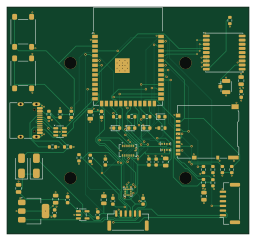
Dronemagnav is an open source ESP32 PCB design by Comrade-rn, published on GitHub under the Custom license license. It is a 4-layer board measuring 64 × 60 mm, with 56 components from 28 distinct parts.
Its main chip is the ESP32-S3-WROOM-1-N16R8, from the ESP32 family. Other key parts include the BMI088, LIS3MDLTR, BMP280, MAX-M10S-00B and AMS1117-3.3. By type, the board carries 18 capacitors, 17 resistors, 8 ICs, 6 diodes, 5 connectors and 2 switches.
It belongs with the robotics & motion, sensors and rf & radio designs in this gallery.
From the project
Magnetic-anomaly navigation (MagNav) board + firmware for drones: ESP32-S3, BMI088, LIS3MDL, BMP280, u-blox GNSS, WDMAM map matching, particle filter, MAVLink, phone route planner. Proprietary - all rights reserved.
GNSS-denied positioning from the Earth's crustal magnetic field, plus a phone-operated great-circle route planner.
Expectations, honestly: the WDMAM world grid is 3 arc-min (~5 km) and upward-continued to 5 km, so with it alone you get drift-free kilometre-class positioning — right for oceanic/jammed cruise, not landing. Load a local aeromagnetic survey (/maps/local.bin, same format) for tens of metres at drone altitude.
Main components on the Dronemagnav
Dronemagnav bill of materials (BOM)
56 components, 28 distinct parts — part numbers from the project's BOM.
| Qty | Part | Footprint | Refs |
|---|---|---|---|
| 1 | ESP32-S3-WROOM-1-N16R8 Espressif | ESP32-S3-WROOM-1 | U1 |
| 1 | BMI088 Bosch | Bosch_LGA-16_4.5x3mm_P0.5mm_LayoutBorder7x1y_ClockwisePinNumbering | U2 |
| 1 | LIS3MDLTR LIS3MDL STMicroelectronics | LGA-12_2x2mm_P0.5mm | U3 |
| 1 | BMP280 Bosch | Bosch_LGA-8_2x2.5mm_P0.65mm_ClockwisePinNumbering | U4 |
| 1 | MAX-M10S-00B MAX-M10S u-blox | ublox_MAX | U5 |
| 1 | AMS1117-3.3 AMS / UMW | SOT-223-3_TabPin2 | U6 |
| 1 | AP2112K-3.3TRG1 AP2112K-3.3 Diodes Inc. | SOT-23-5 | U7 |
| 1 | USBLC6-2SC6 STMicroelectronics | SOT-23-6 | U8 |
| 1 | TYPE-C-31-M-12 USB-C HRO | USB_C_Receptacle_HRO_TYPE-C-31-M-12 | J1 |
| 1 | SM06B-GHS-TB FC_TELEM JST | JST_GH_SM06B-GHS-TB_1x06-1MP_P1.25mm_Horizontal | J2 |
| 1 | DM3AT-SF-PEJM5 microSD Hirose | microSD_HC_Hirose_DM3AT-SF-PEJM5 | J3 |
| 1 | GNSS_ANT Hirose | U.FL_Hirose_U.FL-R-SMT-1_Vertical | J4 |
| 1 | SM06B-GHS-TB SENSOR_MAST JST | JST_GH_SM06B-GHS-TB_1x06-1MP_P1.25mm_Horizontal | J5 |
| 1 | PTS645SM43SMTR92 RESET C&K | SW_SPST_PTS645Sx43SMTR92 | SW1 |
| 1 | PTS645SM43SMTR92 BOOT C&K | SW_SPST_PTS645Sx43SMTR92 | SW2 |
| 2 | SS14 Vishay / MDD | D_SMA | D1, D2 |
| 1 | 19-217/GHC-YR1S2/3T PWR Everlight | LED_0603_1608Metric | D3 |
| 1 | 19-217/GHC-YR1S2/3T NAV Everlight | LED_0603_1608Metric | D4 |
| 1 | 19-217/BHC-ZL1M2RY/3T FIX Everlight | LED_0603_1608Metric | D5 |
| 1 | 19-217/Y2C-CQ2R2L/3T LINK Everlight | LED_0603_1608Metric | D6 |
Show 8 more
| Qty | Part | Footprint | Refs |
|---|---|---|---|
| 7 | 10uF Samsung | C_0805_2012Metric | C1, C2, C5, C8, C15, C16, C18 |
| 9 | 100nF Samsung | C_0603_1608Metric | C3, C6, C9, C10, C11, C12, C13, C14 +1 |
| 2 | 1uF Samsung | C_0603_1608Metric | C4, C7 |
| 1 | RC0603FR-071KL 1K Yageo | R_0603_1608Metric | R1 |
| 9 | RC0603FR-0710KL 10K Yageo | R_0603_1608Metric | R2, R3, R9, R10, R11, R12, R13, R14 +1 |
| 3 | RC0603FR-07330RL 330R Yageo | R_0603_1608Metric | R4, R5, R6 |
| 2 | RC0603FR-074.7KL 4.7K Yageo | R_0603_1608Metric | R7, R8 |
| 2 | RC0603FR-075.1KL 5.1K Yageo | R_0603_1608Metric | R16, R17 |
Dronemagnav design files
The KiCad project lives in the Comrade-rn/dronemagnav repository on GitHub; these links point at the commit this page was built from.
Dronemagnav: common questions
What microcontroller does the Dronemagnav use?
The Dronemagnav is built around the ESP32-S3-WROOM-1-N16R8, from the ESP32 family.
How big is the Dronemagnav PCB?
The Dronemagnav measures 64 × 60 mm, has 4 copper layers and is 1.6 mm thick.
How many components are on the Dronemagnav?
56 components, from 28 distinct parts, with part numbers taken from the project's own BOM. The full bill of materials is listed on this page.
Where can I download the Dronemagnav design files?
From the Comrade-rn/dronemagnav repository on GitHub, which has the KiCad layout, the schematic and the BOM; the links under Design files point to each one.
Can I use the Dronemagnav design in my own project?
It is published under Custom license, which limits how it may be reused; read the license before building on it.
Can I test firmware for the Dronemagnav without the hardware?
Yes. HardLabs builds a simulation of the board from its netlist and BOM, so you can run and debug ESP32 firmware against it before you order a PCB.
Similar boards
 ESP32
ESP32Open Book Abridged Edition
joeycastillo
85 × 115 mm65 parts2LCC-BY-SA-4.08.1k ESP32
ESP32Badge
atopile
56.3 × 39 mm239 parts4LMIT4.0k ESP32
ESP32Esp32 minimal
36.2 × 26.8 mm20 parts2LMIT4.0k ESP32
ESP32Racer
StuckAtPrototype
36 × 50.2 mm70 parts4LApache-2.03.8k ESP32
ESP32Controller
29 × 74 mm58 parts4LApache-2.03.8k ESP32
ESP32Bitaxe
skot
56.5 × 99.8 mm86 parts4LCERN-OHL-S-2.01.4k