
Esp32-IoT

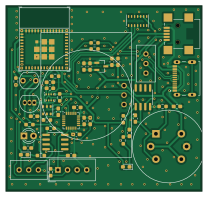
About the Esp32-IoT PCB
Esp32-IoT is an open source ESP32 PCB design by F45c, published on GitHub. It is a 2-layer board measuring 51.8 × 49 mm, with 47 components from 27 distinct parts.
Its main chip is the ESP32-C3-MINI-1, from the ESP32 family. Other key parts include the DHT11, AHT20, BMP280, MCP1702T-3302E/CB and LM393. By type, the board carries 17 capacitors, 13 resistors, 7 ICs, 2 connectors and 1 diode.
It belongs with the sensors, iot & wireless and rf & radio designs in this gallery.
From the project
An Esp32 packed with sensors for IoT use. It uses the Esp32-C3-Mini-1 module that includes an antenna and it receives data from lots of sensors like heart rate, temperature, flame detector and much more.
An Esp32 packed with sensors for IoT use. It uses the Esp32-C3-Mini-1 module that includes an antenna and it receives data from lots of sensors like heart rate, temperature, flame detector and much more.
Originally, I would have unsoldered the MQ-135 gas sensor and solder it to my pcb, but I wasn't able to because of how to module is designed so I stuck the pins that are sticking out of the bottom of the board into my pcb and it fits.
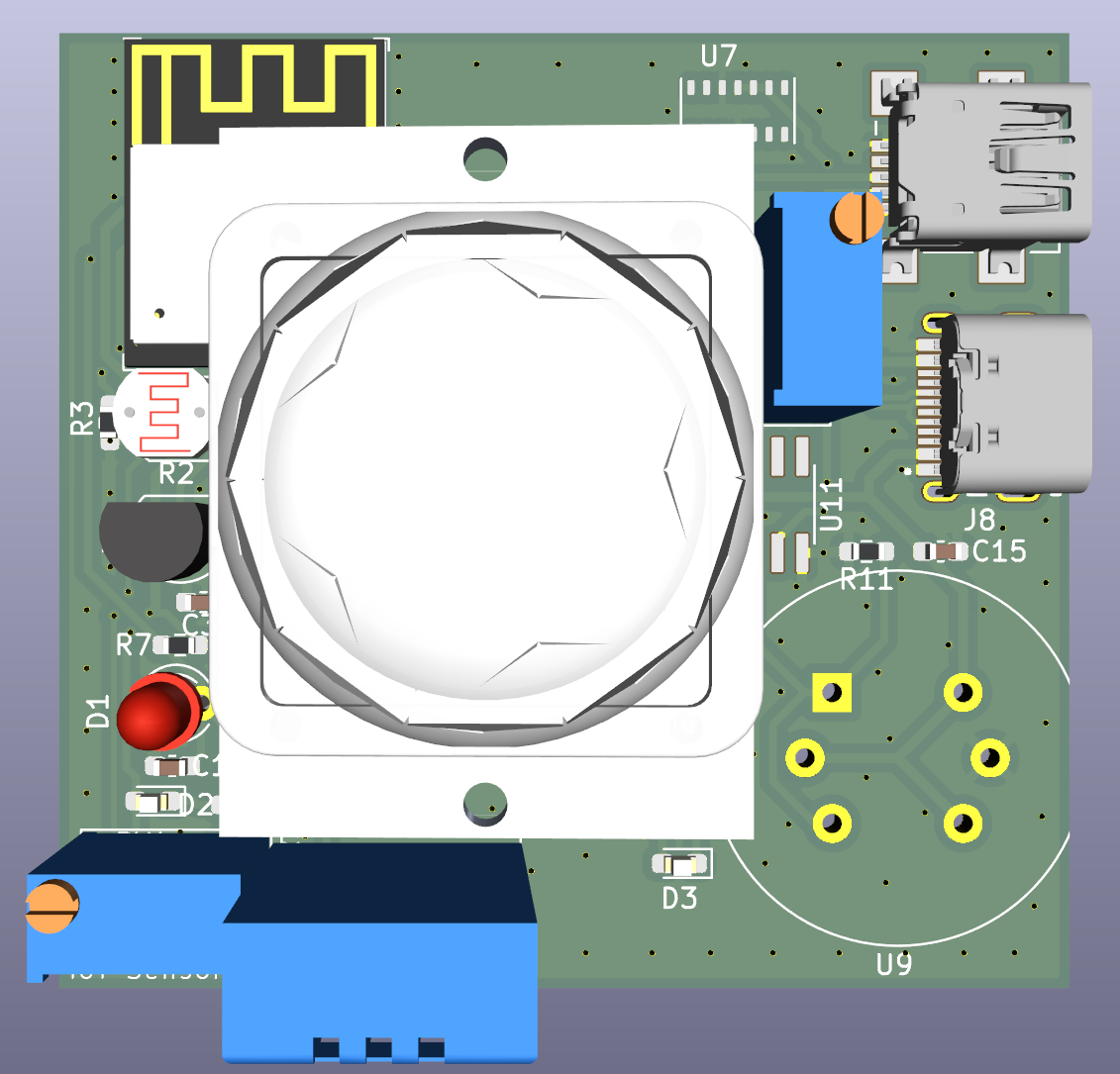
Main components on the Esp32-IoT
Esp32-IoT bill of materials (BOM)
47 components, 27 distinct parts — part numbers from the project's BOM.
| Qty | Part | Footprint | Refs |
|---|---|---|---|
| 1 | ESP32-C3-MINI-1 | ESP32-C3-MINI-1 | U1 |
| 1 | DHT11 | Aosong_DHT11_5.5x12.0_P2.54mm | U2 |
| 1 | AHT20 | PSON100P300X300X110-6N | U4 |
| 1 | BMP280 | Bosch_LGA-8_2x2.5mm_P0.65mm_ClockwisePinNumbering | U5 |
| 1 | MCP1702T-3302E/CB MCP1702T-3302E_CB | SOT95P255X145-3N | U8 |
| 2 | LM393 | SOIC127P600X265-8N | U10, U11 |
| 1 | GMSB0532112YEU | AMPHENOL_GMSB0532112YEU | J1 |
| 1 | USB4215-03-A_REVA | GCT_USB4215-03-A_REVA | J8 |
| 1 | DS18B20 | TO-92_Inline | DS18B20 |
| 1 | Motion Sensor | HC-SR501 | HC-SR501 |
| 1 | MAX30102 | Maxim_OLGA-14_3.3x5.6mm_P0.8mm | MAX30102 |
| 1 | MPU-6050 | InvenSense_QFN-24_4x4mm_P0.5mm | MPU-6050 |
| 1 | MQ-6 | MQ-6 | MQ-135 |
| 2 | 10k poty | Potentiometer_Bourns_3296W_Vertical | RV1, RV2 |
| 1 | LED | LED_0603_1608Metric_Pad1.05x0.95mm_HandSolder | D2 |
| 12 | 100NF 100nF | C_0603_1608Metric_Pad1.08x0.95mm_HandSolder | C1, C2, C4, C5, C6, C9, C10, C12 +4 |
| 1 | 10UF 10uF | C_0603_1608Metric_Pad1.08x0.95mm_HandSolder | C3 |
| 1 | 2.2NF 2.2nF | C_0603_1608Metric_Pad1.08x0.95mm_HandSolder | C7 |
| 1 | 10NF 10nF | C_0603_1608Metric_Pad1.08x0.95mm_HandSolder | C8 |
| 2 | 1UF 1uF | C_0603_1608Metric_Pad1.08x0.95mm_HandSolder | C11, C13 |
Show 7 more
| Qty | Part | Footprint | Refs |
|---|---|---|---|
| 1 | 5KOHM 5kohm | R_0603_1608Metric_Pad0.98x0.95mm_HandSolder | R1 |
| 4 | 10KOHM 10kohm | R_0603_1608Metric_Pad0.98x0.95mm_HandSolder | R3, R7, R8, R12 |
| 1 | 330OHM 330ohm | R_0603_1608Metric_Pad0.98x0.95mm_HandSolder | R4 |
| 2 | 2K-4.7K 2k-4.7k | R_0603_1608Metric_Pad0.98x0.95mm_HandSolder | R5, R6 |
| 2 | 100OHM 100ohm | R_0603_1608Metric_Pad0.98x0.95mm_HandSolder | R9, R13 |
| 1 | 33K 33k | R_0603_1608Metric_Pad0.98x0.95mm_HandSolder | R11 |
| 2 | 22OHM 22ohm | R_0603_1608Metric_Pad0.98x0.95mm_HandSolder | R14, R15 |
Esp32-IoT design files
The KiCad project lives in the F45c/esp32-IoT repository on GitHub; these links point at the commit this page was built from.
- Layoutpcb/Esp32Sensors.kicad_pcb
- Schematicpcb/Esp32Sensors.kicad_sch
- BOMpcb/pcba_BOM.csv
Esp32-IoT: common questions
What microcontroller does the Esp32-IoT use?
The Esp32-IoT is built around the ESP32-C3-MINI-1, from the ESP32 family.
How big is the Esp32-IoT PCB?
The Esp32-IoT measures 51.8 × 49 mm, has 2 copper layers and is 1.6 mm thick.
How many components are on the Esp32-IoT?
47 components, from 27 distinct parts, with part numbers taken from the project's own BOM. The full bill of materials is listed on this page.
Where can I download the Esp32-IoT design files?
From the F45c/esp32-IoT repository on GitHub, which has the KiCad layout, the schematic and the BOM; the links under Design files point to each one.
Can I use the Esp32-IoT design in my own project?
The repository has no license, so all rights stay with F45c. Use it as a reference, and ask the author before reusing the design.
Can I test firmware for the Esp32-IoT without the hardware?
Yes. HardLabs builds a simulation of the board from its netlist and BOM, so you can run and debug ESP32 firmware against it before you order a PCB.
Similar boards
 ESP32
ESP32Open Book Abridged Edition
joeycastillo
85 × 115 mm65 parts2LCC-BY-SA-4.08.1k ESP32
ESP32Badge
atopile
56.3 × 39 mm239 parts4LMIT4.0k ESP32
ESP32Esp32 minimal
36.2 × 26.8 mm20 parts2LMIT4.0k ESP32
ESP32Racer
StuckAtPrototype
36 × 50.2 mm70 parts4LApache-2.03.8k ESP32
ESP32Controller
29 × 74 mm58 parts4LApache-2.03.8k ESP32
ESP32Bitaxe
skot
56.5 × 99.8 mm86 parts4LCERN-OHL-S-2.01.4k