
Esp32

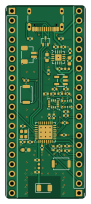
About the Esp32 PCB
Esp32 is an open source ESP32 PCB design by JunctionEDA, published on GitHub under the GPL-3.0 license. It is a 4-layer board measuring 21 × 51 mm, with 50 components from 29 distinct parts.
Its main chip is the ESP32-C3FH4, from the ESP32 family. Other key parts include the BQ24075RGTR, TLV75733PDBVR, LSM6DS3TR-C, BMP280 and TPD2E2U06DCKR. By type, the board carries 20 capacitors, 14 resistors, 6 ICs, 4 connectors, 2 switches and 1 crystal.
From the project
Junction mechanical CAD: collaborative part studios, assemblies, and multi-file projects
TypeScript and React, bundled by esbuild into server/static (npm run build; the entry points are in server/package.json). The tree has three areas:
- shared/ and platform/ should not grow new imports from domains/. Some imports already go that way (the chrome mounts the electronics editor's menus and toolbars, and platform/review diffs KiCad documents). Untangling them is on the roadmap. Don't add more. - A domain may import from shared/ and platform/, but never from another domain's internals. Share through shared/ or the domain's documented exports instead. - Files under…
Main components on the Esp32
Esp32 bill of materials (BOM)
50 components, 29 distinct parts.
| Qty | Part | Footprint | Refs |
|---|---|---|---|
| 1 | ESP32-C3FH4 Espressif | QFN-32-1EP_5x5mm_P0.5mm_EP3.7x3.7mm | U1 |
| 1 | BQ24075RGTR BQ24075RGT Texas Instruments | QFN-16-1EP_3x3mm_P0.5mm_EP1.7x1.7mm | U2 |
| 1 | TLV75733PDBVR TLV75733PDBV Texas Instruments | SOT-23-5 | U3 |
| 1 | LSM6DS3TR-C STMicroelectronics | LGA-14_3x2.5mm_P0.5mm_LayoutBorder3x4y | U4 |
| 1 | BMP280 Bosch Sensortec | Bosch_LGA-8_2x2.5mm_P0.65mm_ClockwisePinNumbering | U5 |
| 1 | TPD2E2U06DCKR TPD2E2U06DCK Texas Instruments | SOT-323_SC-70 | U6 |
| 1 | NX2016SA-40M-EXS00A-CS06465 40MHz NDK | Crystal_SMD_2016-4Pin_2.0x1.6mm | Y1 |
| 1 | USB4105-GF-A USB-C GCT | USB_C_Receptacle_GCT_USB4105-xx-A_16P_TopMnt_Horizontal | J1 |
| 1 | 61302011121 Pins 1-20 Wurth Elektronik | PinHeader_1x20_P2.54mm_Vertical | J2 |
| 1 | 61302011121 Pins 21-40 Wurth Elektronik | PinHeader_1x20_P2.54mm_Vertical | J3 |
| 1 | BM02B-SRSS-TB LiPo JST-SH JST | JST_SH_BM02B-SRSS-TB_1x02-1MP_P1.00mm_Vertical | J4 |
| 1 | 2450AT18A100E 2450AT18A100 Johanson Technology | Johanson_2450AT18x100 | AE1 |
| 1 | SKRKAEE020 RESET Alps Alpine | SW_Push_SPST_NO_Alps_SKRK | SW1 |
| 1 | SKRKAEE020 BOOT Alps Alpine | SW_Push_SPST_NO_Alps_SKRK | SW2 |
| 1 | LTST-C281KGKT CHG Lite-On | LED_0402_1005Metric | D1 |
| 1 | LQG15HS2N7S02D 2.7nH Murata | L_0402_1005Metric | L1 |
| 5 | CL05A105KA5NQNC 1uF Samsung Electro-Mechanics | C_0402_1005Metric | C1, C4, C5, C10, C13 |
| 2 | CL10A475KO8NNNC 4.7uF Samsung Electro-Mechanics | C_0603_1608Metric | C2, C3 |
| 1 | CL10A106KP8NNNC 10uF Samsung Electro-Mechanics | C_0603_1608Metric | C6 |
| 8 | CL05B104KO5NNNC 100nF Samsung Electro-Mechanics | C_0402_1005Metric | C7, C8, C9, C11, C18, C19, C20, C21 |
Show 9 more
| Qty | Part | Footprint | Refs |
|---|---|---|---|
| 2 | CL05C120JB5NNNC 12pF Samsung Electro-Mechanics | C_0402_1005Metric | C14, C15 |
| 2 | CL05C010CB5NNNC 1.0pF Samsung Electro-Mechanics | C_0402_1005Metric | C16, C17 |
| 2 | RC0402FR-075K1L 5.1k Yageo | R_0402_1005Metric | R1, R2 |
| 1 | RC0402FR-073K6L 3.6k Yageo | R_0402_1005Metric | R3 |
| 1 | RC0402FR-073K24L 3.24k Yageo | R_0402_1005Metric | R4 |
| 5 | RC0402FR-0710KL 10k Yageo | R_0402_1005Metric | R5, R7, R8, R9, R10 |
| 1 | RC0402FR-071KL 1k Yageo | R_0402_1005Metric | R6 |
| 2 | RC0402FR-074K7L 4.7k Yageo | R_0402_1005Metric | R13, R14 |
| 2 | RC0402FR-07220KL 220k Yageo | R_0402_1005Metric | R15, R16 |
Esp32 design files
The KiCad project lives in the JunctionEDA/junctioncad repository on GitHub; these links point at the commit this page was built from.
Esp32: common questions
What microcontroller does the Esp32 use?
The Esp32 is built around the ESP32-C3FH4, from the ESP32 family.
How big is the Esp32 PCB?
The Esp32 measures 21 × 51 mm, has 4 copper layers and is 1.6 mm thick.
How many components are on the Esp32?
50 components, from 29 distinct parts. The full bill of materials is listed on this page.
Where can I download the Esp32 design files?
From the JunctionEDA/junctioncad repository on GitHub, which has the KiCad layout and the schematic; the links under Design files point to each one.
Can I use the Esp32 design in my own project?
Yes, under the terms of its GPL-3.0 license, which JunctionEDA chose for the repository.
Can I test firmware for the Esp32 without the hardware?
Yes. HardLabs builds a simulation of the board from its netlist and BOM, so you can run and debug ESP32 firmware against it before you order a PCB.
More boards in junctioncad
Ampli ht
40 × 32 mm29 parts2LGPL-3.01 STM32
Stm32-usbc devboard
41.8 × 19 mm22 parts2LGPL-3.01
Blinker.guided
42 × 27 mm12 parts2LGPL-3.01
Blinker
42 × 27 mm12 parts2LGPL-3.01
USB-C 3.3 V regulator
34 × 22 mm9 parts2LGPL-3.01 AVR/Arduino
ATtiny85 development board
32 × 24 mm8 parts2LGPL-3.01
Keyboard-2x2
35 × 15 mm8 parts2LGPL-3.01
I2C temperature sensor breakout
26 × 18 mm6 parts2LGPL-3.01
Six layer unrouted
20 × 20 mm4 parts6LGPL-3.01
Similar boards
 ESP32
OSO-BOOK-B1
joeycastillo
85 × 115 mm65 parts2LCC-BY-SA-4.08.1k ESP32
Powertrain
byrantech
64 × 45.4 mm171 parts4LMIT4.3k ESP32
Esp32 minimal
atopile
36.2 × 26.8 mm20 parts2LMIT4.0k ESP32
Badge
56.3 × 39 mm239 parts4LMIT4.0k ESP32
Racer
StuckAtPrototype
36 × 50.2 mm70 parts4LApache-2.03.8k ESP32
Controller
29 × 74 mm58 parts4LApache-2.03.8k