
HackerDAQ Digital IO Card

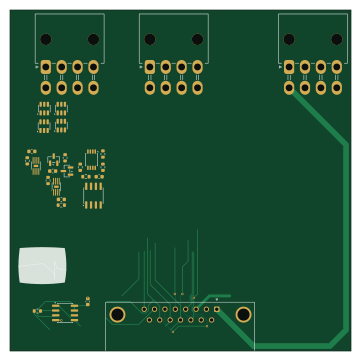
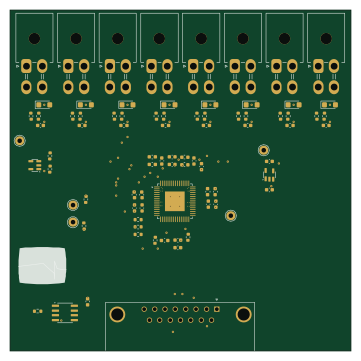
About the HackerDAQ Digital IO Card PCB
HackerDAQ Digital IO Card is an open source PCB design by multiplemonomials, published on GitHub. It is a 2-layer board measuring 90 × 90 mm, with 251 components from 88 distinct parts.
Other key parts include the SN74CB3Q3257PWR, TLV71333PDBV, MCXN547VKLT, KSZ8081RND and CY7C65223. By type, the board carries 107 resistors, 52 capacitors, 40 transistors, 37 ICs, 11 diodes and 4 connectors.
It belongs with the sensors and test & measurement designs in this gallery.
From the project
A Data Acquisition System for Hackers
HackerDAQ is a work-in-progress project to create an open-source data acquisition system. The project is currently in its early stages, but the goal is to create something that can be used in place of industrial DAQ systems to record high-quality data.
The tech industry is in kind of a weird place when it comes to data acquisition (DAQ) systems. Suppose you have some sort of mechanical system you want to work with -- maybe a science experiment, maybe an industrial process, maybe an automation system, who knows. You have some sensors that you need to read and record the data from, and maybe…
Main components on the HackerDAQ Digital IO Card
HackerDAQ Digital IO Card bill of materials (BOM)
251 components, 88 distinct parts — part numbers from the project's BOM.
| Qty | Part | Footprint | Refs |
|---|---|---|---|
| 2 | SN74CB3Q3257PWR RT9624CGQWA | DFN-8-1EP_2x2mm_P0.5mm_EP0.6x1.2mm_LeadsExtended | U1, U7 |
| 1 | TLV71333PDBV RT9624CGQWA | DFN-8-1EP_2x2mm_P0.5mm_EP0.6x1.2mm_LeadsExtended | U2 |
| 1 | SN74CB3Q3257PWR LM311DR | SOIC-8_3.9x4.9mm_P1.27mm | U3 |
| 1 | MCXN547VKLT M95320-RMN6 | SOIC-8_3.9x4.9mm_P1.27mm | U4 |
| 1 | KSZ8081RND LM311DR | SOIC-8_3.9x4.9mm_P1.27mm | U5 |
| 1 | SN74CB3Q3257PWR LM358 | TSSOP-8_3x3mm_P0.65mm | U6 |
| 1 | CY7C65223 RT9624CGQWA | DFN-8-1EP_2x2mm_P0.5mm_EP0.6x1.2mm_LeadsExtended | U8 |
| 1 | SN74AXC4T774 LM358 | TSSOP-8_3x3mm_P0.65mm | U9 |
| 1 | INA180A3 LM311DR | SOIC-8_3.9x4.9mm_P1.27mm | U10 |
| 2 | USBLC6-2SC6 RT9624CGQWA | DFN-8-1EP_2x2mm_P0.5mm_EP0.6x1.2mm_LeadsExtended | U11, U12 |
| 1 | AP22913W6-7 LM358 | TSSOP-8_3x3mm_P0.65mm | U13 |
| 1 | TPS56A37RPAR LM311DR | SOIC-8_3.9x4.9mm_P1.27mm | U14 |
| 1 | INA180A3 RT9624CGQWA | DFN-8-1EP_2x2mm_P0.5mm_EP0.6x1.2mm_LeadsExtended | U15 |
| 1 | TPS56A37RPAR RT9624CGQWA | DFN-8-1EP_2x2mm_P0.5mm_EP0.6x1.2mm_LeadsExtended | U16 |
| 1 | INA180A3 LM358 | TSSOP-8_3x3mm_P0.65mm | U17 |
| 4 | LM311DR | SOIC-8_3.9x4.9mm_P1.27mm | U18, U22, U26, U30 |
| 8 | RT9624CGQWA | DFN-8-1EP_2x2mm_P0.5mm_EP0.6x1.2mm_LeadsExtended | U19, U20, U23, U24, U27, U28, U31, U32 |
| 4 | LM358 | TSSOP-8_3x3mm_P0.65mm | U21, U25, U29, U33 |
| 2 | MCP23S17_SS | SSOP-28_5.3x10.2mm_P0.65mm | U34, U35 |
| 1 | SN74ACT17PWR | TSSOP-14_4.4x5mm_P0.65mm | U36 |
Show 68 more
| Qty | Part | Footprint | Refs |
|---|---|---|---|
| 1 | SN74AHC1G125 | SOT-23-5 | U38 |
| 16 | RVQ040N05 | SOT-23-6 | Q1, Q2, Q7, Q8, Q12, Q13, Q17, Q18 +8 |
| 24 | 2N7002 | SOT-23 | Q3, Q4, Q5, Q6, Q9, Q10, Q11, Q14 +16 |
| 1 | 3221-10-0300-00 MiniFit_Jr_5569_08A2 | Molex_Mini-Fit_Jr_5569-08A2_2x04_P4.20mm_Horizontal | J1 |
| 2 | 61801525123 MiniFit_Jr_5569_08A2 | Molex_Mini-Fit_Jr_5569-08A2_2x04_P4.20mm_Horizontal | J2, J3 |
| 1 | 61801525123 LD15S33E4GX00LF | Amphenol_LD15S33E4GX00LF | J9 |
| 1 | AA3528QBS AA3528SURSK | AA3528 | D1 |
| 1 | AA3528SURSK | AA3528 | D2 |
| 1 | ASMB-MTB0-0B3A2 AA3528SURSK | AA3528 | D3 |
| 2 | BAT54W AA3528SURSK | AA3528 | D4, D5 |
| 1 | ESDS304 AA3528SURSK | AA3528 | D6 |
| 2 | AA3528CGSK AA3528SURSK | AA3528 | D7, D8 |
| 1 | SMF24A BAT54W | SOT-323_SC-70 | D9 |
| 1 | AA3528QBS BAT54W | SOT-323_SC-70 | D10 |
| 1 | AA3528SYSK BAT54W | SOT-323_SC-70 | D11 |
| 20 | 100NF 1µF | C_0603_1608Metric | C1, C2, C7, C8, C10, C15, C16, C17 +12 |
| 7 | 1276-6524-1 1µF | C_0603_1608Metric | C3, C9, C14, C23, C39, C41, C45 |
| 10 | 100NF 100nF | C_0603_1608Metric | C4, C5, C18, C19, C24, C25, C30, C38 +2 |
| 2 | 1276-3137-1 100nF | C_0603_1608Metric | C6, C31 |
| 1 | 220NF 1µF | C_0603_1608Metric | C11 |
| 3 | 100nF | C_0603_1608Metric | C12, C13, C44 |
| 2 | 1276-3395-1 1µF | C_0603_1608Metric | C26, C46 |
| 3 | 1276-3395-1 100nF | C_0603_1608Metric | C32, C49, C51 |
| 1 | 1276-6524-1 100nF | C_0603_1608Metric | C37 |
| 1 | 150PF 1µF | C_0603_1608Metric | C47 |
| 1 | 1µF | C_0603_1608Metric | C48 |
| 1 | 150PF 100nF | C_0603_1608Metric | C50 |
| 9 | 2.2 | R_0603_1608Metric | R1, R17, R58, R70, R71, R83, R84, R96 +1 |
| 1 | 140 1 | R_0603_1608Metric | R2 |
| 3 | 140 2.2 | R_0603_1608Metric | R3, R31, R57 |
| 4 | 75k | R_0603_1608Metric | R4, R69, R82, R95 |
| 2 | 10K 30k | R_0603_1608Metric | R5, R18 |
| 4 | 10K 10k | R_0603_1608Metric | R6, R13, R23, R29 |
| 6 | 33.2k | R_0603_1608Metric | R7, R52, R65, R78, R91, R104 |
| 3 | 10K 133k | R_0603_1608Metric | R8, R24, R38 |
| 1 | 2.2K 133k | R_0603_1608Metric | R9 |
| 2 | 10K 14.7k | R_0603_1608Metric | R10, R48 |
| 3 | 10K 150 | R_1206_3216Metric | R11, R12, R28 |
| 1 | 10K 75k | R_0603_1608Metric | R14 |
| 11 | 1 | R_0603_1608Metric | R15, R21, R36, R62, R63, R75, R76, R88 +3 |
| 1 | 2.2K 2.2 | R_0603_1608Metric | R16 |
| 10 | 133k | R_0603_1608Metric | R19, R47, R60, R64, R73, R77, R86, R90 +2 |
| 5 | 14.7k | R_0603_1608Metric | R20, R61, R74, R87, R100 |
| 1 | 6.49K 1 | R_0603_1608Metric | R22 |
| 1 | 10K 33.2k | R_0603_1608Metric | R25 |
| 1 | 270 33 | R_0603_1608Metric | R26 |
| 1 | 4463-D1FCP0612D2M50FF-T5 10k | R_0603_1608Metric | R27 |
| 1 | 52.3K 75k | R_0603_1608Metric | R30 |
| 1 | 73.2K 2.2 | R_0603_1608Metric | R32 |
| 1 | 18.2K 30k | R_0603_1608Metric | R33 |
| 1 | 4.7K 133k | R_0603_1608Metric | R34 |
| 1 | 4463-D1FCP0612D2M50FF-T5 14.7k | R_0603_1608Metric | R35 |
| 1 | 52.3K 1 | R_0603_1608Metric | R37 |
| 1 | 3.01K 33.2k | R_0603_1608Metric | R39 |
| 10 | 10k | R_0603_1608Metric | R40, R53, R66, R68, R79, R81, R92, R94 +2 |
| 1 | 4463-D1FCP0612D2M50FF-T5 150 | R_1206_3216Metric | R41 |
| 1 | 45.3K 10k | R_0603_1608Metric | R42 |
| 1 | 18.2K 75k | R_0603_1608Metric | R43 |
| 2 | 5.1K 2.2 | R_0603_1608Metric | R44, R45 |
| 5 | 30k | R_0603_1608Metric | R46, R59, R72, R85, R98 |
| 1 | 3.01K 1 | R_0603_1608Metric | R49 |
| 1 | 5.1K 1 | R_0603_1608Metric | R50 |
| 1 | 5.1K 133k | R_0603_1608Metric | R51 |
| 1 | 270 150 | R_1206_3216Metric | R54 |
| 1 | 270 10k | R_0603_1608Metric | R55 |
| 1 | 4.7K 75k | R_0603_1608Metric | R56 |
| 3 | 150 | R_1206_3216Metric | R67, R80, R93 |
| 1 | 33 | R_0603_1608Metric | R107 |
HackerDAQ Digital IO Card design files
The KiCad project lives in the multiplemonomials/HackerDAQ repository on GitHub; these links point at the commit this page was built from.
HackerDAQ Digital IO Card: common questions
How big is the HackerDAQ Digital IO Card PCB?
The HackerDAQ Digital IO Card measures 90 × 90 mm, has 2 copper layers and is 1.6 mm thick.
How many components are on the HackerDAQ Digital IO Card?
251 components, from 88 distinct parts, with part numbers taken from the project's own BOM. The full bill of materials is listed on this page.
Where can I download the HackerDAQ Digital IO Card design files?
From the multiplemonomials/HackerDAQ repository on GitHub, which has the KiCad layout, the schematic and the BOM; the links under Design files point to each one.
Can I use the HackerDAQ Digital IO Card design in my own project?
The repository has no license, so all rights stay with multiplemonomials. Use it as a reference, and ask the author before reusing the design.
More boards in HackerDAQ
Similar boards
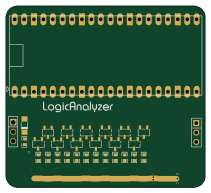
AnalyzerBoxPCB fork
gusmanb
52.7 × 47.9 mm54 parts4LGPL-3.05.0k
LevelShifter
28.3 × 39.8 mm21 parts2LGPL-3.05.0k
StackLink
52.3 × 10.5 mm5 parts2LGPL-3.05.0k
Sensor smd
scottbez1
40 × 20 mm5 parts2LApache-2.04.2k
Sensors
StuckAtPrototype
15.2 × 9 mm14 parts4LApache-2.03.8k
Microphone
Mentra-Community
5.5 × 6.1 mm6 parts2LMIT1.2k