
Bedroom-Engineering-Propulsive-Landing-Project

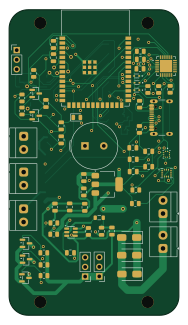
About the Bedroom-Engineering-Propulsive-Landing-Project PCB
Bedroom-Engineering-Propulsive-Landing-Project is an open source ESP32 PCB design by nimishcoder1232, published on GitHub. It is a 4-layer board measuring 45 × 81 mm, with 70 components from 34 distinct parts.
Its main chip is the ESP32-S3-WROOM-1-N8, from the ESP32 family. Other key parts include the CP2102N-A02-GQFN28, W25Q16JVSS, BMI270, TPS565208 and BMP390L. By type, the board carries 21 capacitors, 17 resistors, 11 connectors, 7 ICs, 7 diodes and 3 transistors.
From the project
This repo has everything that I made for my rocket that can propulsive landing, while still being under ITAR restrictions.
For this project, I will design a rocket that can launch and then do a propulsive landing. In order to meet this challenge, I will have to make a new custom ESP32-based flight computer. I will have to make a quaternion orientation calculation system, I will have to design a control loop, and I will have to make a simulator in Python, without vibe coding, because it is too complicated. The simulator will simulate the rocket’s flight to help tune the control loop and the propulsive landing.
Main components on the Bedroom-Engineering-Propulsive-Landing-Project
Bedroom-Engineering-Propulsive-Landing-Project bill of materials (BOM)
70 components, 34 distinct parts — part numbers from the project's BOM.
| Qty | Part | Footprint | Refs |
|---|---|---|---|
| 1 | CP2102N-A02-GQFN28 | QFN50P500X500X80-29N | U1 |
| 1 | ESP32-S3-WROOM-1-N8 | XCVR_ESP32-S3-WROOM-1-N8 | U2 |
| 1 | W25Q16JVSS | SOIC-8_5.3x5.3mm_P1.27mm | U3 |
| 1 | BMI270 | XDCR_BMI270 | U4 |
| 1 | TPS565208 | SOT-23-6 | U5 |
| 1 | BMP390L | XDCR_BMP390L | U6 |
| 1 | LD1117S33TR_SOT223 | SOT-223-3_TabPin2 | U7 |
| 3 | AO3400A | SOT-23 | Q1, Q2, Q3 |
| 5 | Screw_Terminal_01x02 | TerminalBlock_4Ucon_1x02_P3.50mm_Horizontal | J1, J2, J3, J4, J5 |
| 3 | Conn_01x03_Male | PinHeader_1x03_P2.54mm_Vertical | J6, J7, J8 |
| 1 | Conn_01x10 | 10 pad genaric | J9 |
| 1 | Conn_01x06 | 6pad genaric | J11 |
| 1 | USB_C_Receptacle_USB2.0_16P | USB_C_Receptacle_GCT_USB4105-xx-A_16P_TopMnt_Horizontal | J12 |
| 1 | Buzzer | Buzzer_TDK_PS1240P02BT_D12.2mm_H6.5mm | BZ1 |
| 2 | L8050QLT1G | SOT-23 | T1, T2 |
| 3 | LESD5D5.0CT1G | TVS_LESD5D5.0CT1G | D1, D2, D3 |
| 3 | D | D_SMA | D4, D5, D6 |
| 1 | LED | LED_0805_2012Metric | D7 |
| 1 | 22 uH | L_0805_2012Metric | L1 |
| 3 | 10uf | C_0805_2012Metric | C1, C2, C4 |
Show 14 more
| Qty | Part | Footprint | Refs |
|---|---|---|---|
| 2 | 1uf | C_0805_2012Metric | C3, C6 |
| 5 | 0.1uf | C_0805_2012Metric | C5, C12, C17, C18, C19 |
| 4 | 10 uf | C_0805_2012Metric | C7, C8, C9, C20 |
| 5 | 0.1 uf | C_0805_2012Metric | C10, C11, C13, C14, C16 |
| 2 | 22 uF | C_0805_2012Metric | C22, C23 |
| 1 | 1k | R_0805_2012Metric | R1 |
| 4 | 10K | R_0805_2012Metric | R2, R5, R6, R7 |
| 1 | 22.1 | R_0805_2012Metric | R3 |
| 1 | 47.5K | R_0805_2012Metric | R4 |
| 4 | 10 K | R_0805_2012Metric | R8, R15, R16, R17 |
| 1 | 60 omh | R_0805_2012Metric | R9 |
| 2 | 2.2k | R_0805_2012Metric | R11, R12 |
| 1 | 350 omh | R_0805_2012Metric | R13 |
| 2 | 5.1K | R_0805_2012Metric | R18, R19 |
Bedroom-Engineering-Propulsive-Landing-Project design files
The KiCad project lives in the nimishcoder1232/Bedroom-Engineering-Propulsive-Landing-Project repository on GitHub; these links point at the commit this page was built from.
- Layoutpcb/RAM R2.kicad_pcb
- Schematicpcb/RAM R2.kicad_sch
- BOMBOM.csv
Bedroom-Engineering-Propulsive-Landing-Project: common questions
What microcontroller does the Bedroom-Engineering-Propulsive-Landing-Project use?
The Bedroom-Engineering-Propulsive-Landing-Project is built around the ESP32-S3-WROOM-1-N8, from the ESP32 family.
How big is the Bedroom-Engineering-Propulsive-Landing-Project PCB?
The Bedroom-Engineering-Propulsive-Landing-Project measures 45 × 81 mm, has 4 copper layers and is 1.6 mm thick.
How many components are on the Bedroom-Engineering-Propulsive-Landing-Project?
70 components, from 34 distinct parts, with part numbers taken from the project's own BOM. The full bill of materials is listed on this page.
Where can I download the Bedroom-Engineering-Propulsive-Landing-Project design files?
From the nimishcoder1232/Bedroom-Engineering-Propulsive-Landing-Project repository on GitHub, which has the KiCad layout, the schematic and the BOM; the links under Design files point to each one.
Can I use the Bedroom-Engineering-Propulsive-Landing-Project design in my own project?
The repository has no license, so all rights stay with nimishcoder1232. Use it as a reference, and ask the author before reusing the design.
Can I test firmware for the Bedroom-Engineering-Propulsive-Landing-Project without the hardware?
Yes. HardLabs builds a simulation of the board from its netlist and BOM, so you can run and debug ESP32 firmware against it before you order a PCB.
Similar boards
 ESP32
OSO-BOOK-B1
joeycastillo
85 × 115 mm65 parts2LCC-BY-SA-4.08.1k ESP32
Powertrain
byrantech
64 × 45.4 mm171 parts4LMIT4.3k ESP32
Esp32 minimal
atopile
36.2 × 26.8 mm20 parts2LMIT4.0k ESP32
Badge
56.3 × 39 mm239 parts4LMIT4.0k ESP32
Racer
StuckAtPrototype
36 × 50.2 mm70 parts4LApache-2.03.8k ESP32
Controller
29 × 74 mm58 parts4LApache-2.03.8k