
Esp32-emu turbo
 pjcau·esp32-emu-turbo·hardware/kicad/esp32-emu-turbo.kicad_pcb
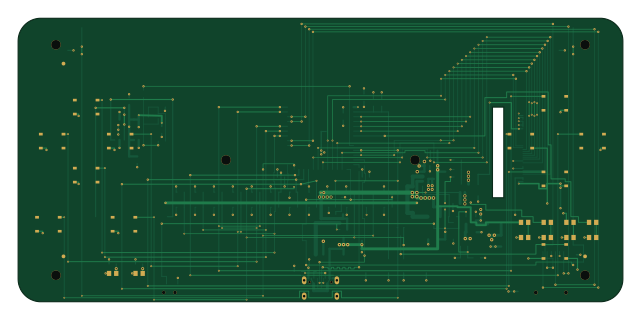
About the Esp32-emu turbo PCB
Esp32-emu turbo is an open source ESP32 PCB design by pjcau, published on GitHub. It is a 4-layer board measuring 160 × 75 mm, with 102 components from 38 distinct parts.
Its main chip is the ESP32-S3-WROOM-1-N16R8, from the ESP32 family. Other key parts include the IP5306, C78988, C7519, PAM8403 and C91145. By type, the board carries 32 resistors, 31 capacitors, 17 switches, 6 ICs, 6 LEDs and 3 connectors.
It belongs with the power & battery, retro computing and displays & leds designs in this gallery.
From the project
Handheld retro gaming console based on ESP32-S3 — SNES (primary) and NES (secondary) emulation.
Handheld retro gaming console based on ESP32-S3 — SNES (primary) and NES (secondary) emulation.
Build a portable battery-powered device based on ESP32-S3, capable of loading and playing retro games via SD card, with USB-C charging and an ILI9488 3.95" color LCD display.
- The first article works. Board v4.9.0 (article 0003, JLCPCB-assembled) passed every bring-up stage on 2026-09-11: USB power, rails, boot, display, SD, audio, all 12 buttons, and battery. - 17 systems run on the board. NES, GB/GBC, SMS/GG/SG-1000, PC Engine, Genesis, Neo Geo Pocket, Atari 2600, MSX, Colecovision at full…
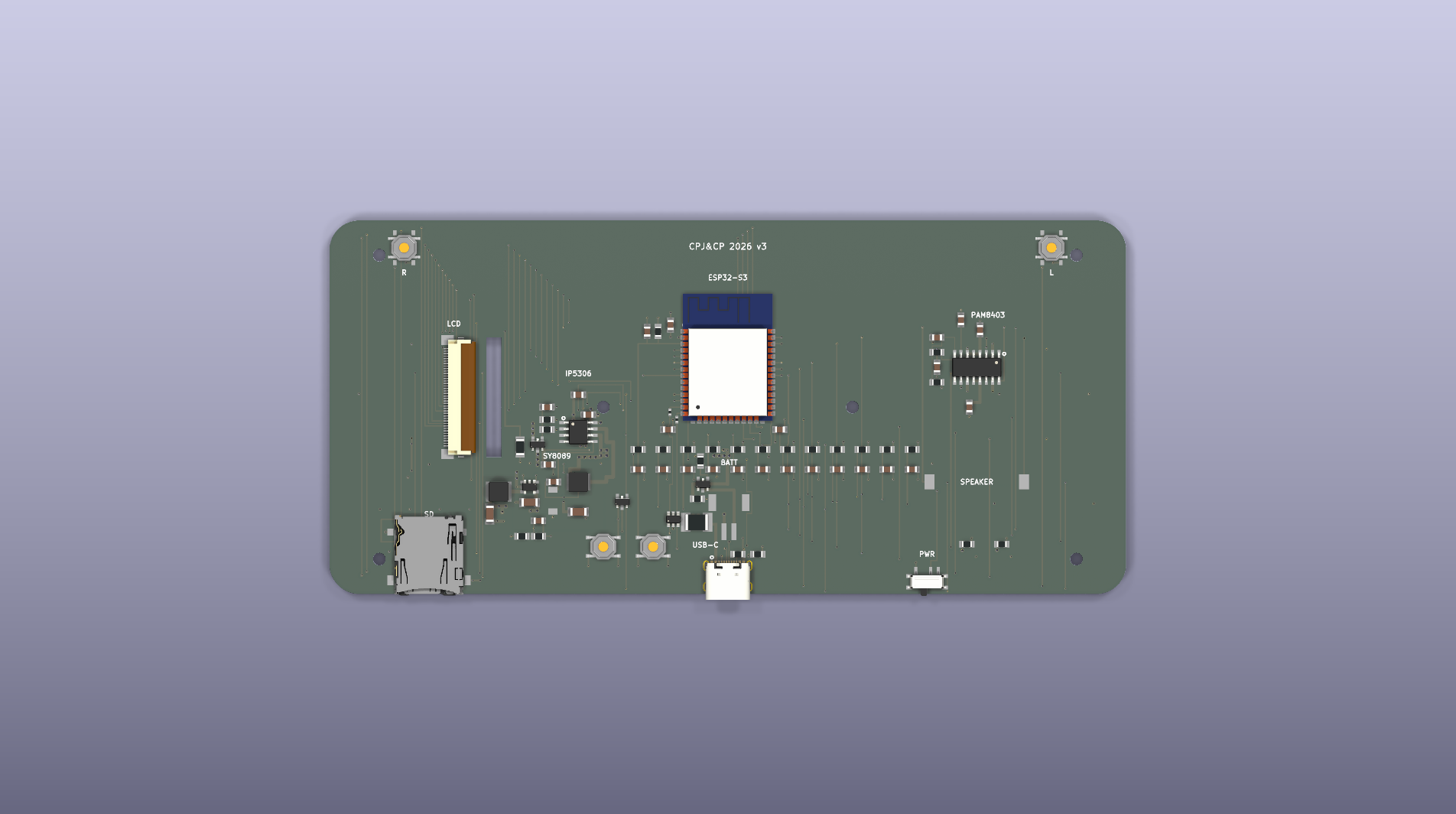
Main components on the Esp32-emu turbo
Esp32-emu turbo bill of materials (BOM)
102 components, 38 distinct parts — part numbers from the project's BOM.
| Qty | Part | Footprint | Refs |
|---|---|---|---|
| 1 | ESP32-S3-WROOM-1-N16R8 | ESP32-S3-WROOM-1-N16R8 | U1 |
| 1 | IP5306 ESOP-8 | ESOP-8 | U2 |
| 1 | C78988 SOT-23-5 | SOT-23-5 | U3 |
| 1 | C7519 SOT-23-6 | SOT-23-6 | U4 |
| 1 | PAM8403 SOP-16 | SOP-16 | U5 |
| 1 | C91145 TF-01A | TF-01A | U6 |
| 2 | C15127 SOT-23-3 | SOT-23-3 | Q1, Q2 |
| 1 | C2765186 USB-C-16P | USB-C-16P | J1 |
| 1 | C295747 JST-PH-2P-SMD | JST-PH-2P-SMD | J3 |
| 1 | C2856812 FPC-40P-0.5mm | FPC-40P-0.5mm | J4 |
| 1 | C960026 F_1812 | F_1812 | F1 |
| 1 | Speaker-28mm | Speaker-28mm | SPK1 |
| 15 | C318884 SW-SMD-5.1x5.1 | SW-SMD-5.1x5.1 | SW1, SW2, SW3, SW4, SW5, SW6, SW7, SW8 +7 |
| 1 | C431540 SS-12D00G3 | SS-12D00G3 | SW16 |
| 1 | C720477 SW-SMD-2P-TS1088 | SW-SMD-2P-TS1088 | SW17 |
| 1 | C84256 LED_0805 | LED_0805 | LED1 |
| 5 | C19171391 LED_0805 | LED_0805 | LED2, LED3, LED4, LED5, LED6 |
| 1 | C37704 SOT-23-3 | SOT-23-3 | D1 |
| 1 | C280579 SMD-4x4x2 | SMD-4x4x2 | L1 |
| 1 | C36409 IND-SMD-4.0x4.0 | IND-SMD-4.0x4.0 | L2 |
Show 18 more
| Qty | Part | Footprint | Refs |
|---|---|---|---|
| 3 | C12891 C_1206 | C_1206 | C1, C19, C30 |
| 17 | C49678 C_0805 | C_0805 | C3, C4, C5, C6, C7, C8, C9, C10 +9 |
| 3 | C15850 C_0805 | C_0805 | C17, C18, C27 |
| 1 | C13967 C_0805 | C_0805 | C22 |
| 4 | C28323 C_0805 | C_0805 | C23, C24, C25, C32 |
| 1 | C_0805 | C_0805 | C28 |
| 1 | C1804 C_0805 | C_0805 | C29 |
| 1 | C1779 C_0805 | C_0805 | C33 |
| 4 | C27834 R_0805 | R_0805 | R1, R2, R28, R29 |
| 12 | C17414 R_0805 | R_0805 | R3, R4, R5, R6, R7, R8, R9, R10 +4 |
| 1 | R_0805 | R_0805 | R14 |
| 5 | C17513 R_0805 | R_0805 | R17, R18, R30, R31, R33 |
| 2 | C4328 R_0805 | R_0805 | R20, R21 |
| 2 | C25092 R_0402 | R_0402 | R22, R23 |
| 2 | C149504 R_0805 | R_0805 | R24, R25 |
| 2 | C17560 R_0805 | R_0805 | R26, R32 |
| 1 | C17955 R_1206 | R_1206 | R27 |
| 1 | C17514 R_0805 | R_0805 | R34 |
Esp32-emu turbo design files
The KiCad project lives in the pjcau/esp32-emu-turbo repository on GitHub; these links point at the commit this page was built from.
Esp32-emu turbo: common questions
What microcontroller does the Esp32-emu turbo use?
The Esp32-emu turbo is built around the ESP32-S3-WROOM-1-N16R8, from the ESP32 family.
How big is the Esp32-emu turbo PCB?
The Esp32-emu turbo measures 160 × 75 mm, has 4 copper layers and is 1.6 mm thick.
How many components are on the Esp32-emu turbo?
102 components, from 38 distinct parts, with part numbers taken from the project's own BOM. The full bill of materials is listed on this page.
Where can I download the Esp32-emu turbo design files?
From the pjcau/esp32-emu-turbo repository on GitHub, which has the KiCad layout, the schematic and the BOM; the links under Design files point to each one.
Can I use the Esp32-emu turbo design in my own project?
The repository has no license, so all rights stay with pjcau. Use it as a reference, and ask the author before reusing the design.
Can I test firmware for the Esp32-emu turbo without the hardware?
Yes. HardLabs builds a simulation of the board from its netlist and BOM, so you can run and debug ESP32 firmware against it before you order a PCB.
Similar boards
 ESP32
OSO-BOOK-B1
joeycastillo
85 × 115 mm65 parts2LCC-BY-SA-4.08.1k ESP32
Powertrain
byrantech
64 × 45.4 mm171 parts4LMIT4.3k ESP32
Badge
atopile
56.3 × 39 mm239 parts4LMIT4.0k ESP32
Esp32 minimal
36.2 × 26.8 mm20 parts2LMIT4.0k ESP32
Racer
StuckAtPrototype
36 × 50.2 mm70 parts4LApache-2.03.8k ESP32
Controller
29 × 74 mm58 parts4LApache-2.03.8k