
PGR

About the PGR PCB
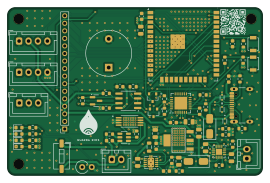
PGR is an open source ESP32 PCB design by Projeto-Guarda-Rios, published on GitHub under the MIT license. It is a 4-layer board measuring 67.5 × 44.4 mm, with 75 components from 44 distinct parts.
Its main chip is the ESP32-WROOM-32E, from the ESP32 family. Other key parts include the AP2114H-3.3TRG1, BQ24074RGT, TPS61200DRC, CP2102N-Axx-xQFN28 and DW01A. By type, the board carries 26 resistors, 16 capacitors, 10 diodes, 7 ICs, 6 connectors and 3 transistors.
It belongs with the power & battery, iot & wireless and sensors designs in this gallery.
From the project
O repositório para a PCB do Projeto Guarda Rios! Inclui todos os ficheiros relacionados com a PCB!
This repository contains all PCB design files for the Guarda-Rios Project — an open-source, low-cost, low-power water quality monitoring system. Multiple stations are deployed along a river so that parameter spikes between adjacent stations reveal precisely where pollution enters the waterway.
The AquaNode is the submerged node of each station. It is built around an STM32L053R8 microcontroller (ultra-low-power) and integrates a DS18B20 water temperature sensor (1-Wire) and a DFRobot SEN0554 turbidity sensor. Readings are encoded into the custom Guarda-Rios protocol and transmitted to the…
Main components on the PGR
PGR bill of materials (BOM)
75 components, 44 distinct parts — part numbers from the project's BOM.
| Qty | Part | Footprint | Refs |
|---|---|---|---|
| 1 | AP2114H-3.3TRG1 | SOT230P700X180-4N | IC1 |
| 1 | BQ24074RGT | VQFN-16-1EP_3x3mm_P0.5mm_EP1.6x1.6mm | U1 |
| 1 | TPS61200DRC | Texas_S-PVSON-N10_ThermalVias | U3 |
| 1 | CP2102N-Axx-xQFN28 | QFN-28-1EP_5x5mm_P0.5mm_EP3.35x3.35mm | U4 |
| 1 | ESP32-WROOM-32E | ESP32-WROOM-32D | U5 |
| 1 | DW01A | SOT-23-6 | U6 |
| 1 | MAX3485 | SOIC-8_3.9x4.9mm_P1.27mm | U8 |
| 2 | SS8050-G | TRANS_SS8050-G | Q1, Q2 |
| 1 | FS8205A | SOP65P640X120-8N | Q3 |
| 1 | Conn_01x16 | PinSocket_1x16_P2.00mm_Vertical | J1 |
| 1 | Conn_01x03 | JST_XH_B3B-XH-A_1x03_P2.50mm_Vertical | J7 |
| 2 | Conn_01x04 | JST_XH_B4B-XH-A_1x04_P2.50mm_Vertical | J8, J11 |
| 1 | USB_C_Receptacle | USB_C_Receptacle_GCT_USB4105-xx-A_16P_TopMnt_Horizontal | J9 |
| 1 | Conn_01x02 | JST_XH_B2B-XH-A_1x02_P2.50mm_Vertical | J10 |
| 1 | Battery | JST_XH_B2B-XH-A_1x02_P2.50mm_Vertical | BT1 |
| 1 | Buzzer | Buzzer_12x9.5RM7.6 | BZ1 |
| 1 | BOOT | SW_SPST_B3U-1000P | SW1 |
| 1 | RESET | SW_SPST_B3U-1000P | SW2 |
| 1 | SW_SPDT | SW_DIP_SPSTx01_Slide_6.7x4.1mm_W6.73mm_P2.54mm_LowProfile_JPin | SW4 |
| 1 | Thermistor_NTC 10 kΩ 25 °C | R_Axial_DIN0309_L9.0mm_D3.2mm_P2.54mm_Vertical | TH1 |
Show 24 more
| Qty | Part | Footprint | Refs |
|---|---|---|---|
| 2 | SS14 | D_SMA | D1, D2 |
| 3 | LESD5D5.0CT1G | TVS_LESD5D5.0CT1G | D3, D4, D5 |
| 1 | SM712_SOT23 | SOT-23 | D6 |
| 3 | BLUE | LED_0603_1608Metric | D7, D9, D10 |
| 1 | RED | LED_0603_1608Metric | D8 |
| 1 | L | L_0805_2012Metric | L1 |
| 7 | 0.1uF | C_0603_1608Metric | C1, C2, C3, C7, C10, C12, C15 |
| 5 | 10uF | C_0805_2012Metric | C4, C5, C6, C13, C14 |
| 2 | 22uF | C_0805_2012Metric | C8, C9 |
| 1 | 4.7uF | C_0805_2012Metric | C11 |
| 1 | 100nF | C_0603_1608Metric | C17 |
| 1 | 1.5K | R_0603_1608Metric | R1 |
| 3 | 2K | R_0603_1608Metric | R2, R8, R17 |
| 1 | 120R | R_0603_1608Metric | R3 |
| 2 | 5.1K | R_0603_1608Metric | R4, R5 |
| 1 | 22.1K | R_0603_1608Metric | R6 |
| 1 | 47.5K | R_0603_1608Metric | R7 |
| 9 | 10K | R_0603_1608Metric | R9, R10, R15, R16, R18, R19, R20, R28 +1 |
| 1 | 100R | R_0603_1608Metric | R11 |
| 1 | 22R | R_0603_1608Metric | R12 |
| 3 | 33R | R_0603_1608Metric | R13, R21, R24 |
| 1 | 150R | R_0603_1608Metric | R14 |
| 1 | 900K | R_0603_1608Metric | R22 |
| 1 | 100K | R_0603_1608Metric | R23 |
PGR design files
The KiCad project lives in the Projeto-Guarda-Rios/PCB repository on GitHub; these links point at the commit this page was built from.
PGR: common questions
What microcontroller does the PGR use?
The PGR is built around the ESP32-WROOM-32E, from the ESP32 family.
How big is the PGR PCB?
The PGR measures 67.5 × 44.4 mm, has 4 copper layers and is 1.6062 mm thick.
How many components are on the PGR?
75 components, from 44 distinct parts, with part numbers taken from the project's own BOM. The full bill of materials is listed on this page.
Where can I download the PGR design files?
From the Projeto-Guarda-Rios/PCB repository on GitHub, which has the KiCad layout, the schematic and the BOM; the links under Design files point to each one.
Can I use the PGR design in my own project?
Yes, under the terms of its MIT license, which Projeto-Guarda-Rios chose for the repository.
Can I test firmware for the PGR without the hardware?
Yes. HardLabs builds a simulation of the board from its netlist and BOM, so you can run and debug ESP32 firmware against it before you order a PCB.
More boards in PCB
Similar boards
 ESP32
ESP32Open Book Abridged Edition
joeycastillo
85 × 115 mm65 parts2LCC-BY-SA-4.08.1k ESP32
ESP32Badge
atopile
56.3 × 39 mm239 parts4LMIT4.0k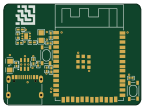 ESP32
ESP32Esp32 minimal
36.2 × 26.8 mm20 parts2LMIT4.0k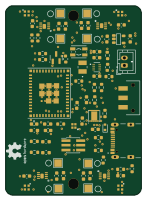 ESP32
ESP32Racer
StuckAtPrototype
36 × 50.2 mm70 parts4LApache-2.03.8k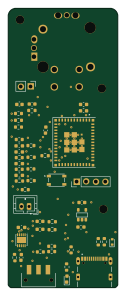 ESP32
ESP32Controller
29 × 74 mm58 parts4LApache-2.03.8k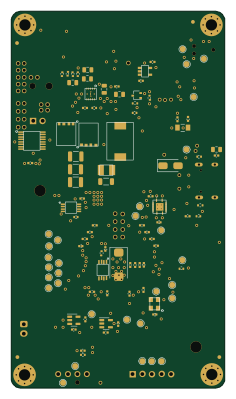 ESP32
ESP32Bitaxe
skot
56.5 × 99.8 mm86 parts4LCERN-OHL-S-2.01.4k