
Frank

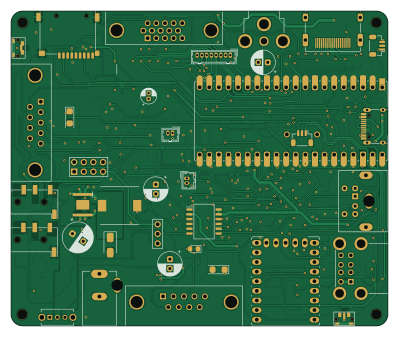
About the Frank PCB
Frank is an open source RP2040/RP2350 PCB design by rh1tech, published on GitHub under the GPL-3.0 license. It is a 2-layer board measuring 99.5 × 83.1 mm, with 162 components from 70 distinct parts.
Its main chip is the Rasberry Pi Pico 1/2, from the RP2040/RP2350 family. Other key parts include the ESP-01v090, MP1584EN-LF-Z, AMS1117 3.3, TXS0104EDR and MW7211A. By type, the board carries 80 resistors, 40 capacitors, 18 connectors, 12 ICs, 4 diodes and 3 switches.
It belongs with the retro computing designs in this gallery.
From the project
RP2350 Based Hardware Emulation Platform
FRANK is a hardware emulation platform built around the Raspberry Pi RP2350 (Pico 2 modules and RP2350A QFN). RP2040 / Pico still works in FRANK's socket, but in practice only a handful of firmware (mainly the older ZX Spectrum cores) still targets RP2040. Everything modern (IBM PC, NES, SNES, Genesis, the DOOM / id Tech 1 ports, FRANK OS, and so on) is RP2350-only.
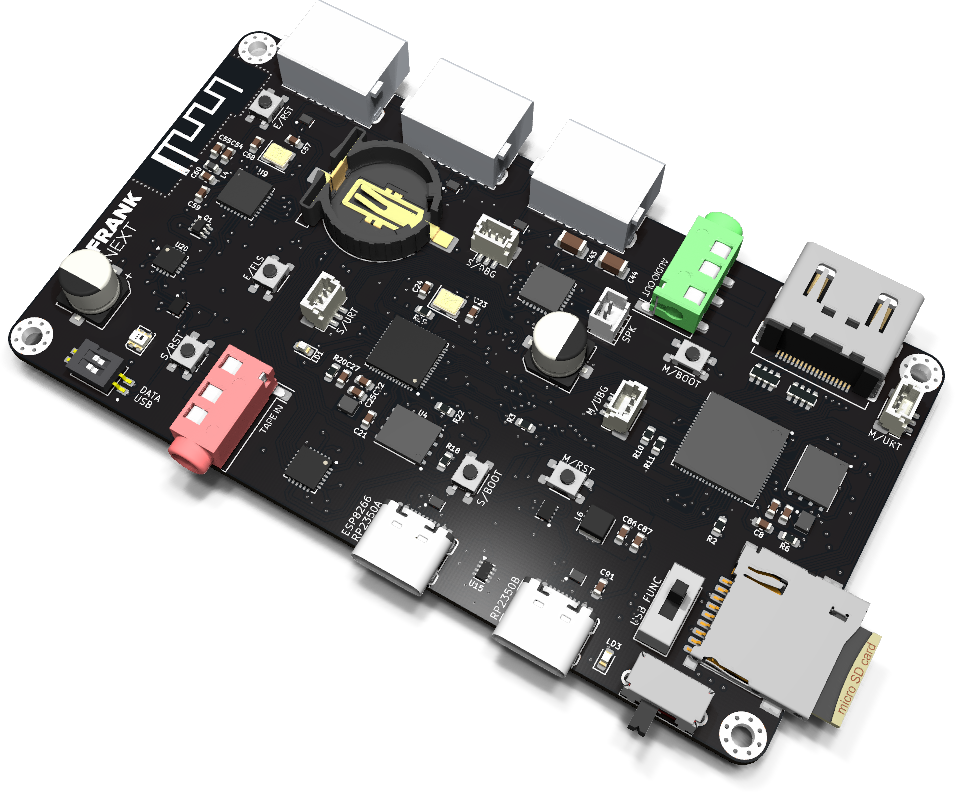
Main components on the Frank
Frank bill of materials (BOM)
162 components, 70 distinct parts.
| Qty | Part | Footprint | Refs |
|---|---|---|---|
| 1 | ESP-01v090 | ESP-01 | U1 |
| 1 | MP1584EN-LF-Z | SOIC-9_P1.27mm | U2 |
| 1 | AMS1117 3.3 | SOT-223 | U3 |
| 1 | TXS0104EDR | SOIC-14_P1.27mm | U4 |
| 1 | MW7211A | SOP-16_P1.27mm | U5 |
| 1 | Rasberry Pi Pico 1/2 | RaspberryPi_Pico | U6 |
| 1 | CD4069UBM | SOIC-14_P1.27mm | U7 |
| 1 | TDA1387T | SO-8 | U8 |
| 1 | MAX232CSE+ PAM8403D | SOP-16_P1.27mm | U9 |
| 1 | LM358 | SO-8 | U10 |
| 1 | 74HC4052D,653 74HC4052D | SOP-16_P1.27mm | U11 |
| 1 | RP2040-Zero | RaspberryPi_Zero | U12 |
| 1 | PWR | PinHeader_1x03_P2.54mm | J2 |
| 1 | USB Hub | JST_SH_1x03_P1.00mm_Vertical | J3 |
| 1 | USB4215-03-A | USB_C_Receptacle | J4 |
| 1 | DC-005-5A-2.0 | BarrelJack_DC-005 | J5 |
| 1 | MDC-036 | MiniDIN_6pin_Female | J6 |
| 1 | DC3RX19JA2 | HDMI_Female | J7 |
| 1 | RCA-103 | BarrelJack_RCJ-012 | J8 |
| 1 | Pin Header 1x08 | JST_GH_1x08_P1.25mm | J9 |
Show 50 more
| Qty | Part | Footprint | Refs |
|---|---|---|---|
| 1 | PJ-320D | AudioJack_3.5mm_PJ320D_TapeIn | J10 |
| 1 | PAM L | JST_GH_1x02_P1.25mm | J11 |
| 1 | PAM R | JST_GH_1x02_P1.25mm | J12 |
| 1 | PJ-320D | AudioJack_3.5mm_PJ320D_AudioOut | J13 |
| 2 | GP2 | DSUB-9_Male_TopMount | J14, J15 |
| 1 | 104031-0811 | MicroSD_SMD_Long | J16 |
| 1 | SS-52100-004 | USB_A_Stacked | J17 |
| 1 | VGA | DSUB-15_Female | J18 |
| 1 | PWR | JST_SH_1x03_P1.00mm_Vertical_UART | J19 |
| 1 | Config Switches | SOIC-12_P1.27mm | JP1 |
| 1 | 3V3 Jumper | Jumper_Solder | JP2 |
| 1 | RP Reset | Button_SMD_TS1234VW | S1 |
| 1 | ESP Reset | Button_SMD_TS1234VW | S2 |
| 1 | SK12D07VG3NS | Switch_Slide_SK12D07VG3NS | S3 |
| 1 | Power | LED_0805 | LD1 |
| 1 | 1N5822 | D_SMA | D1 |
| 1 | 1N5819WS | D_SOD-323 | D2 |
| 2 | 3V3 | D_miniMELF | D3, D4 |
| 1 | 330R | R_0805_2012Metric | L1 |
| 1 | 22uH | Inductor_CDRH104RNP | L2 |
| 1 | 680u | C_Radial_D8.0mm_P3.50mm | C1 |
| 12 | 10u | C_0805_2012Metric | C2, C8, C10, C22, C24, C26, C27, C28 +4 |
| 16 | 100n | C_0805_2012Metric | C3, C5, C6, C7, C11, C12, C13, C14 +8 |
| 1 | 150pF | R_0805_2012Metric | C4 |
| 2 | 220u | C_Radial_D6.3mm_P2.50mm | C9, C17 |
| 1 | 4.7u | C_0805_2012Metric | C15 |
| 2 | 47n | C_0805_2012Metric | C20, C21 |
| 3 | 1u | C_0805_2012Metric | C25, C30, C35 |
| 1 | 10u | CP_Radial_D4.0mm_P1.50mm | C31 |
| 1 | 100u | C_Radial_D6.3mm_P2.50mm | C36 |
| 16 | 10K | R_0805_2012Metric | R1, R2, R3, R4, R39, R41, R51, R53 +8 |
| 2 | 5.1K | R_0805_2012Metric | R5, R6 |
| 5 | 100K | R_0805_2012Metric | R7, R9, R10, R37, R38 |
| 1 | 24K | R_0805_2012Metric | R8 |
| 1 | 8.2K | R_0805_2012Metric | R11 |
| 1 | 43K | R_0805_2012Metric | R12 |
| 8 | 1K | R_0805_2012Metric | R13, R45, R46, R67, R68, R76, R77, R78 |
| 14 | 270R | R_0805_2012Metric | R14, R15, R16, R17, R18, R19, R20, R21 +6 |
| 1 | 750R | R_0805_2012Metric | R22 |
| 1 | 300R | R_0805_2012Metric | R29 |
| 5 | 150R | R_0805_2012Metric | R30, R31, R32, R33, R34 |
| 1 | 51R | R_0805_2012Metric | R35 |
| 1 | 4.7K | R_0805_2012Metric | R36 |
| 6 | 2K | R_0805_2012Metric | R40, R42, R43, R44, R50, R52 |
| 4 | 100R | R_0805_2012Metric | R47, R62, R79, R80 |
| 2 | 470R | R_0805_2012Metric | R48, R49 |
| 2 | 47K | R_0805_2012Metric | R59, R60 |
| 2 | 20K | R_0805_2012Metric | R63, R64 |
| 4 | 22R | R_0805_2012Metric | R69, R70, R71, R72 |
| 3 | 330R | R_0805_2012Metric | R73, R74, R75 |
Frank design files
The KiCad project lives in the rh1tech/frank repository on GitHub; these links point at the commit this page was built from.
- Layouthardware/frank/frank.kicad_pcb
- Schematichardware/frank/frank.kicad_sch
Frank: common questions
What microcontroller does the Frank use?
The Frank is built around the Rasberry Pi Pico 1/2, from the RP2040/RP2350 family.
How big is the Frank PCB?
The Frank measures 99.5 × 83.1 mm, has 2 copper layers and is 1 mm thick.
How many components are on the Frank?
162 components, from 70 distinct parts. The full bill of materials is listed on this page.
Where can I download the Frank design files?
From the rh1tech/frank repository on GitHub, which has the KiCad layout and the schematic; the links under Design files point to each one.
Can I use the Frank design in my own project?
Yes, under the terms of its GPL-3.0 license, which rh1tech chose for the repository.
Can I test firmware for the Frank without the hardware?
Yes. HardLabs builds a simulation of the board from its netlist and BOM, so you can run and debug RP2040/RP2350 firmware against it before you order a PCB.
More boards in frank
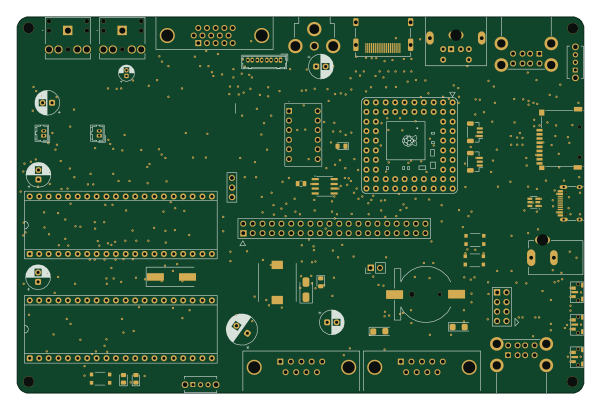
Megafrank
149.9 × 99.5 mm256 parts2LGPL-3.065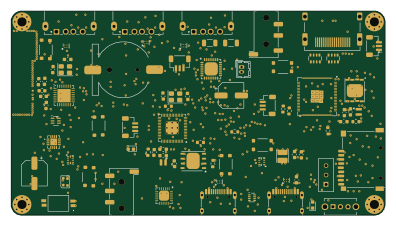 RP2040/RP2350
Frank next
99 × 54 mm245 parts4LGPL-3.065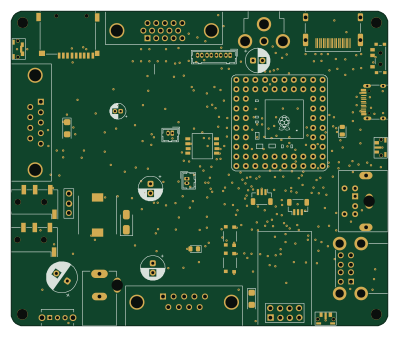
Frank pga
99.5 × 83.1 mm171 parts2LGPL-3.065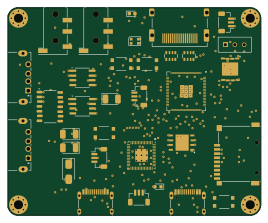 RP2040/RP2350
Frank core2u
67 × 55 mm146 parts4LGPL-3.065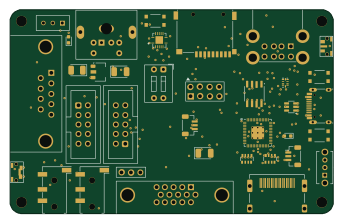 RP2040/RP2350
Minifrank
85.6 × 54 mm139 parts4LGPL-3.065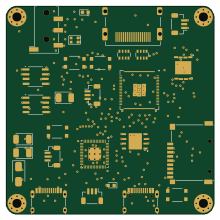 RP2040/RP2350
Frank core2 proto
55 × 55 mm129 parts4LGPL-3.065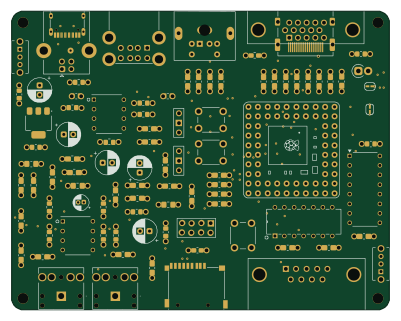 ESP8266
Oldskool
100 × 79 mm100 parts2LGPL-3.065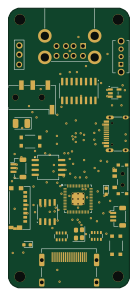 RP2040/RP2350
Microfrank
32 × 74 mm99 parts4LGPL-3.065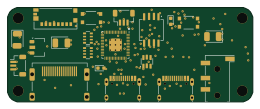 RP2040/RP2350
Zerofrank
65 × 25 mm89 parts4LGPL-3.065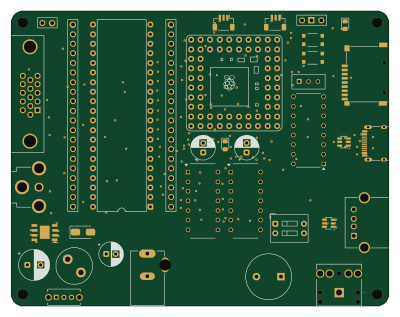
Xt8086 alpha
99.9 × 78 mm80 parts2LGPL-3.065 RP2040/RP2350
Nyx
51 × 21 mm53 parts4LGPL-3.065
Similar boards
 RP2040/RP2350
Open Book Abridged Edition
joeycastillo
85 × 115 mm29 parts2LCC-BY-SA-4.08.1k RP2040/RP2350
Corne
foostan
277.2 × 107.5 mm164 parts2LCC-BY-4.07.7k RP2040/RP2350
Corne
277.2 × 107.5 mm164 parts2LCC-BY-4.07.7k RP2040/RP2350
LogicAnalyzer
gusmanb
57 × 55.2 mm6 parts2LGPL-3.05.0k RP2040/RP2350
Jitx design
55.5 × 65 mm26 parts4LGPL-3.05.0k RP2040/RP2350
Main
google
98 × 71 mm102 parts2LApache-2.02.9k