
Iotuz esp32-hardware

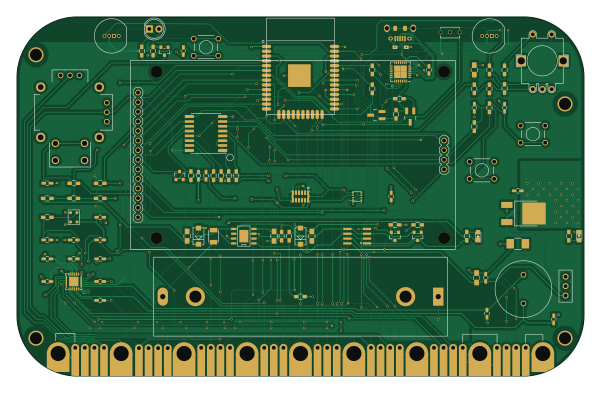
About the Iotuz esp32-hardware PCB
Iotuz esp32-hardware is an open source ESP32 PCB design by CCHS-Melbourne, published on GitHub under the TAPR-OHL-1.0 license. It is a 2-layer board measuring 150 × 95 mm, with 97 components from 49 distinct parts.
Its main chip is the ESP32-WROOM, from the ESP32 family. Other key parts include the CP2102, NCP5501, JOYSTICK, ili9341.TouchLCD.Red.NoName and PCF8574. By type, the board carries 30 resistors, 28 capacitors, 11 ICs, 6 transistors, 6 connectors and 5 switches.
It belongs with the iot & wireless and sensors designs in this gallery.
From the project
Project for the InternetOfTuz (LCA2017 Open Hardware Mini-Conference)
IoTuz - The Internet of Tuz =============
Welcome to the linux.conf.au 2017 Open Hardware Project. You can see information about this and other MiniConfs at http://www.openhardwareconf.org/wiki/Main_Page
This year we're bringing a project with the hottest new micro for people to have a play with. The ESP32 is the successor to the hugely popular ESP8266 chip we used for 2016 Open Hardware Project, the (ESPlant, https://github.com/CCHS-Melbourne/ESPlant).
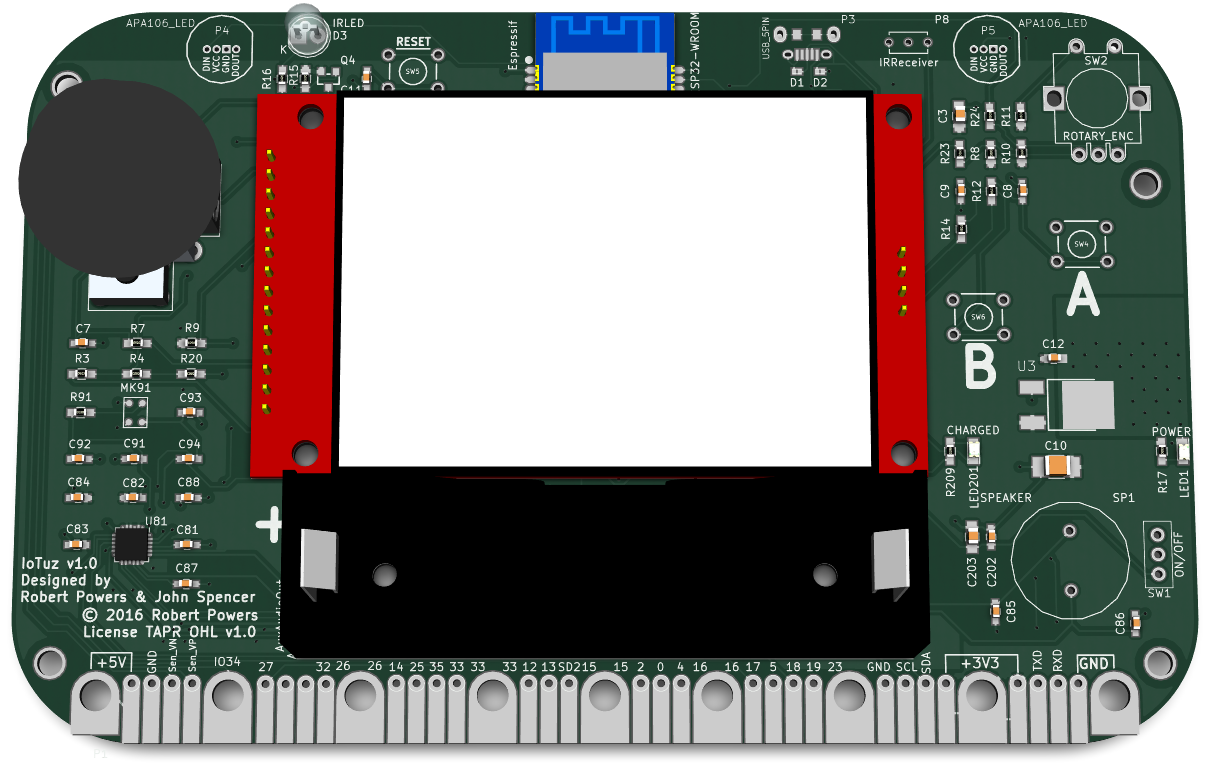
Main components on the Iotuz esp32-hardware
Iotuz esp32-hardware bill of materials (BOM)
97 components, 49 distinct parts.
| Qty | Part | Footprint | Refs |
|---|---|---|---|
| 1 | CP2102 | QFN-28-1EP_5x5mm_Pitch0.5mm | U1 |
| 1 | ESP32-WROOM | ESP32-WROOM | U2 |
| 1 | NCP5501 | DPAK3.NCP5501 | U3 |
| 1 | JOYSTICK | JOYSTICK_W_BUTTON | U4 |
| 1 | ili9341.TouchLCD.Red.NoName | lcdtouchscreen.2.8inch-red.no-name.ili9341-xpt2046 | U6 |
| 1 | PCF8574 | PCF8574.SOIC-16W_Pitch1.27mm | U7 |
| 1 | NAU8814 | NAU8814_QFN-24_4x4mm_Pitch0.5mm_EPAD | U81 |
| 1 | CN3063 | CN3063_SOIC8_EP | U201 |
| 1 | MCP6002 | SO08_4mm | U202 |
| 1 | BME280 | BME280 | U301 |
| 1 | ADXL345 | ADXL345 | U302 |
| 2 | S8050 | SOT-23_Handsoldering | Q1, Q2 |
| 4 | FDN340P | SOT23_FET | Q3, Q4, Q202, Q203 |
| 1 | ALLIGATOR_X39 | alligator_pads.x39.shortened | P1 |
| 1 | BATTERY | BH-18650 | P2 |
| 1 | USB_5PIN | USB-MICRO-5pin_PTHMOUNT-Amphenol.10118194-0001LF | P3 |
| 2 | APA106_LED | LED_8MM_APA-106 | P4, P5 |
| 1 | IRReceiver | TSOP38238.IRReceiver | P8 |
| 1 | 1A PTC | 1210 | F1 |
| 1 | SPU0410HR5H | MEMSMicrophone-SMT-SPU0410HR5H‐PB | MK91 |
Show 29 more
| Qty | Part | Footprint | Refs |
|---|---|---|---|
| 1 | SPEAKER | CVS-1508.Speaker.PCPins | SP1 |
| 1 | ON/OFF | SS12D00 | SW1 |
| 1 | ROTARY_ENC | EC11 | SW2 |
| 1 | A | SW_PUSHBUTTON_PTH | SW4 |
| 1 | RESET | SW_PUSHBUTTON_PTH | SW5 |
| 1 | B | SW_PUSHBUTTON_PTH | SW6 |
| 1 | 10K NTC | R_0603_HandSoldering | TH201 |
| 1 | POWER | LED_0805 | LED1 |
| 1 | CHARGED | LED_0805 | LED201 |
| 2 | ESD05V88D-LC | SOD-882 | D1, D2 |
| 1 | IRLED | LED-5MM | D3 |
| 2 | SS14 | DIODE_SMA | D4, D201 |
| 5 | 10uF 16V | C_0805_HandSoldering | C3, C5, C201, C203, C204 |
| 4 | 0.1uF | C_0603_HandSoldering | C4, C6, C12, C202 |
| 3 | 1nF | C_0603_HandSoldering | C7, C8, C9 |
| 1 | 100uF 6.3V X5R | C_1210_HandSoldering | C10 |
| 6 | 1uF | C_0603_HandSoldering | C11, C81, C87, C94, C301, C302 |
| 5 | 4.7uF | C_0603_HandSoldering | C82, C83, C84, C88, C91 |
| 4 | 33pF 1% | C_0603_HandSoldering | C85, C86, C92, C93 |
| 2 | 12K(1%) | R_0603_HandSoldering | R1, R2 |
| 1 | 1M | R_0603_HandSoldering | R3 |
| 3 | 100K | R_0603_HandSoldering | R4, R18, R19 |
| 7 | 470R(1%) | R_0603_HandSoldering | R5, R7, R12, R13, R14, R17, R209 |
| 11 | 10K | R_0603_HandSoldering | R6, R8, R9, R10, R11, R15, R20, R21 +3 |
| 1 | 22R | R_0603_HandSoldering | R16 |
| 1 | 1K | R_0603_HandSoldering | R91 |
| 1 | 3.6K 1% | R_0603_HandSoldering | R204 |
| 1 | 7.15K 1% | R_0603_HandSoldering | R205 |
| 2 | 4.7K | R_0603_HandSoldering | R301, R302 |
Iotuz esp32-hardware design files
The KiCad project lives in the CCHS-Melbourne/iotuz-esp32-hardware repository on GitHub; these links point at the commit this page was built from.
- LayoutCircuit/IoTuz.kicad_pcb
Iotuz esp32-hardware: common questions
What microcontroller does the Iotuz esp32-hardware use?
The Iotuz esp32-hardware is built around the ESP32-WROOM, from the ESP32 family.
How big is the Iotuz esp32-hardware PCB?
The Iotuz esp32-hardware measures 150 × 95 mm, has 2 copper layers and is 1.6 mm thick.
How many components are on the Iotuz esp32-hardware?
97 components, from 49 distinct parts. The full bill of materials is listed on this page.
Where can I download the Iotuz esp32-hardware design files?
From the CCHS-Melbourne/iotuz-esp32-hardware repository on GitHub, which has the KiCad layout; the links under Design files point to each one.
Can I use the Iotuz esp32-hardware design in my own project?
Yes, under the terms of its TAPR-OHL-1.0 license, which CCHS-Melbourne chose for the repository.
Can I test firmware for the Iotuz esp32-hardware without the hardware?
Yes. HardLabs builds a simulation of the board from its netlist and BOM, so you can run and debug ESP32 firmware against it before you order a PCB.
Similar boards
 ESP32
ESP32Open Book Abridged Edition
joeycastillo
85 × 115 mm65 parts2LCC-BY-SA-4.08.1k ESP32
ESP32Badge
atopile
56.3 × 39 mm239 parts4LMIT4.0k ESP32
ESP32Esp32 minimal
36.2 × 26.8 mm20 parts2LMIT4.0k ESP32
ESP32Racer
StuckAtPrototype
36 × 50.2 mm70 parts4LApache-2.03.8k ESP32
ESP32Controller
29 × 74 mm58 parts4LApache-2.03.8k ESP32
ESP32Bitaxe
skot
56.5 × 99.8 mm86 parts4LCERN-OHL-S-2.01.4k