
Commodore pet clone

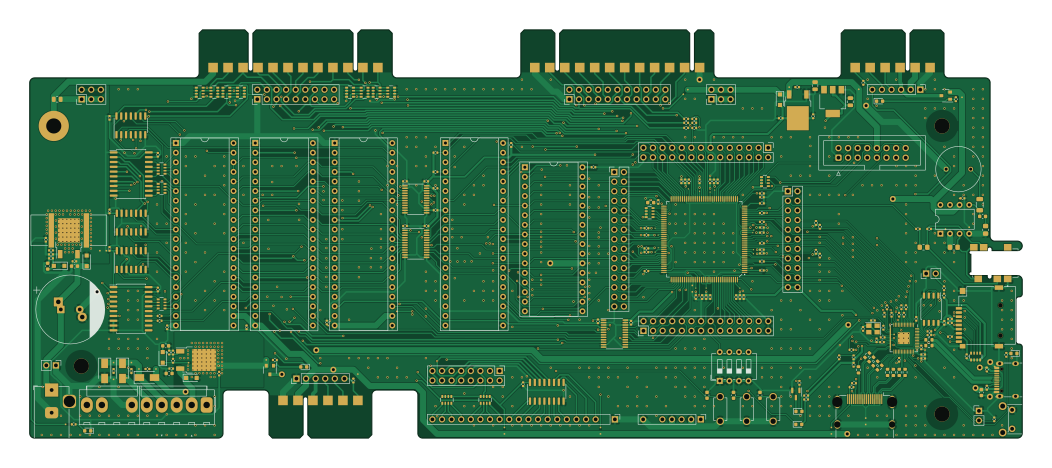
About the Commodore pet clone PCB
Commodore pet clone is an open source RP2040/RP2350 PCB design by DLehenbauer, published on GitHub under the CC0-1.0 license. It is a 2-layer board measuring 262.5 × 108 mm, with 258 components from 107 distinct parts.
Its main chip is the RP2040, from the RP2040/RP2350 family. Other key parts include the 74LS145, SN74LS07, 74LS245, W65C21N and W65C22N. By type, the board carries 89 resistors, 84 capacitors, 27 connectors, 22 ICs, 14 diodes and 10 jumpers.
It belongs with the retro computing designs in this gallery.
From the project
Open hardware clone of the Commodore PET 4032
Note: The latest information on this project is here.
Open hardware clone of the Commodore CBM/PET using modern parts. Some assembly required. :-)
Working prototype. PCB and SMT manufacturing files are here.
This open hardware CBM/PET clone can be used in two ways:
1. By itself with an HDMI display and USB keyboard 2. As a mainboard replacement to repair/enhance a vintage CBM/PET
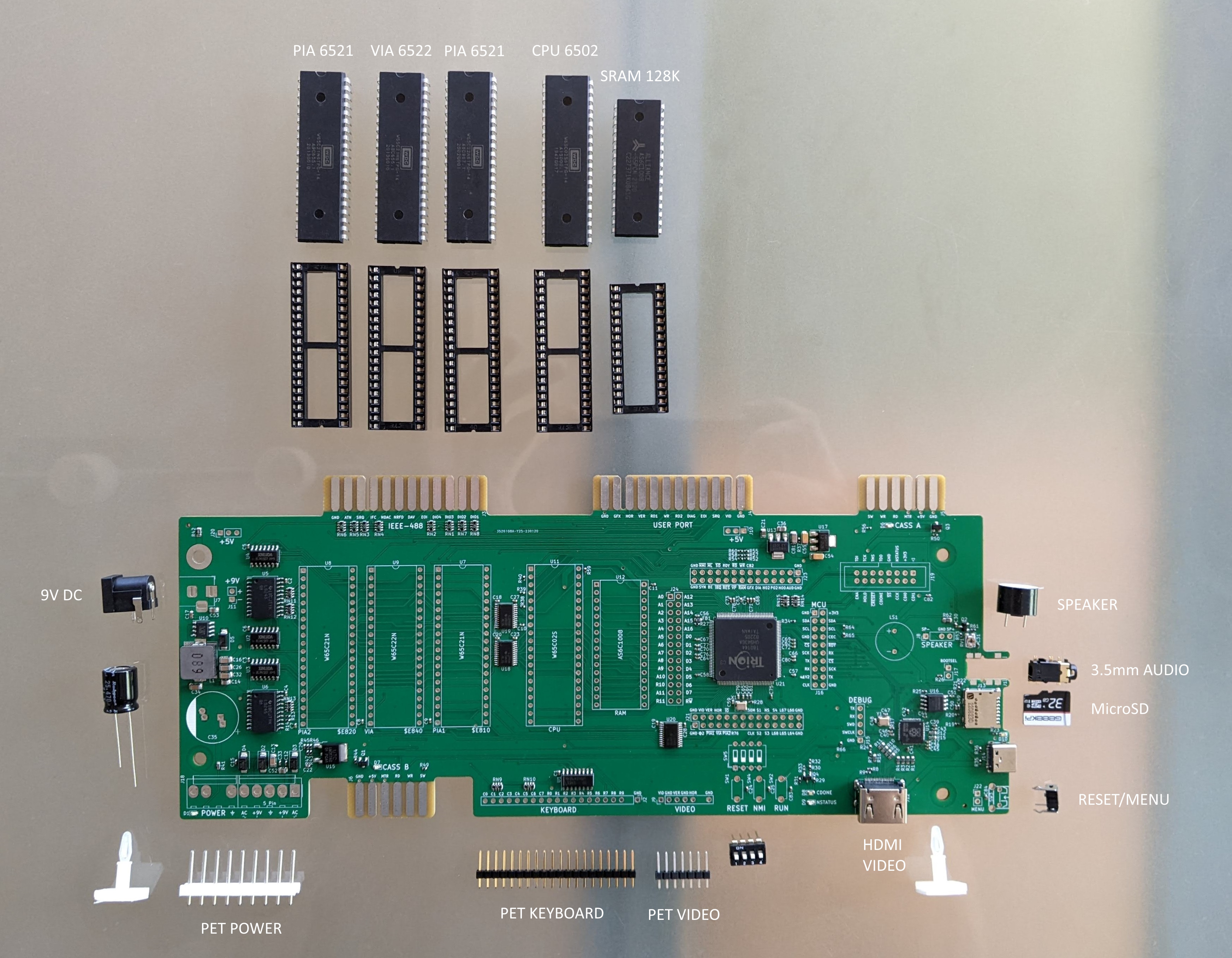
Main components on the Commodore pet clone
Commodore pet clone bill of materials (BOM)
258 components, 107 distinct parts — part numbers from the project's BOM.
| Qty | Part | Footprint | Refs |
|---|---|---|---|
| 1 | 74LS145 | SOIC-16_3.9x9.9mm_P1.27mm | U1 |
| 3 | SN74LS07 | SOIC-14_3.9x8.7mm_P1.27mm | U2, U3, U4 |
| 2 | 74LS245 | SOIC-20W_7.5x12.8mm_P1.27mm | U5, U6 |
| 2 | W65C21N | DIP-40_W15.24mm_Socket | U7, U8 |
| 1 | W65C22N | DIP-40_W15.24mm_Socket | U9 |
| 2 | LM317AG-TN3-R | TO-252-2_ThermalVias | U10, U15 |
| 1 | W65C02S | DIP-40_W15.24mm_Socket | U11 |
| 1 | AS6C1008 | DIP-32_W15.24mm_Socket | U12 |
| 1 | AMS1117-3.3 | SOT-223-3_TabPin2 | U13 |
| 1 | RP2040 | LQFN-56_L7.0-W7.0-P0.4-EP | U14 |
| 1 | W25Q128JVS | SOIC-8_5.23x5.23mm_P1.27mm | U16 |
| 1 | LM317AG-TN3-R | TO-252-2 | U17 |
| 3 | SN74LVC4245APWR | TSSOP-24_4.4x7.8mm_P0.65mm | U18, U19, U20 |
| 1 | T8Q144C3 | QFP50P2200X2200X160-144N | U21 |
| 1 | LM386 | DIP-8_W7.62mm | U22 |
| 2 | AO3401A | SOT-23_L2.9-W1.3-P1.90-LS2.4-BR | Q1, Q3 |
| 1 | MMBT3904 | SOT-23 | Q4 |
| 1 | C9002 12 MHz | Crystal_SMD_3225-4Pin_3.2x2.5mm | Y1 |
| 1 | SJ-43504-SMT SJ-43504-SMT-TR | CUI_SJ-43504-SMT-TR | J1 |
| 1 | 2-826646-0 KEYBOARD | CBM_PET_KEYBOARD_KEYED_20P | J2 |
Show 87 more
| Qty | Part | Footprint | Refs |
|---|---|---|---|
| 1 | IEEE | CBM_PET_IEEE_EDGE_CON_24P | J3 |
| 1 | USER | CBM_PET_USER_EDGE_CON_24P | J4 |
| 1 | CASS A | CBM_PET_CASS_EDGE_CON_12P | J5 |
| 1 | CASS B | CBM_PET_CASS_EDGE_CON_12P | J6 |
| 1 | CON-SOCJ-2155 9V POWER | BarrelJack_Horizontal | J7 |
| 1 | FLASH | PinHeader_1x02_P2.54mm_Vertical | J8 |
| 1 | VIDEO | PET_Video | J9 |
| 2 | 5V PWR | PinHeader_2x03_P2.54mm_Vertical | J10, J20 |
| 1 | 9V POWER | PinHeader_1x02_P2.54mm_Vertical | J11 |
| 1 | C138388 NOT_HDMI_A | HDMI_A_Molex_208658-1001_Horizontal | J12 |
| 1 | C393941 MicroSD | TF-SMD_TF-PUSH | J13 |
| 1 | USB2.0_HOST_TYPE_C | USB-C_SMD-TYPE-C-31-M-12 | J14 |
| 1 | KEYBOARD_EX | PinHeader_2x08_P2.54mm_Vertical | J15 |
| 1 | FPGA_MCU | PinHeader_2x11_P2.54mm_Vertical | J16 |
| 1 | PET POWER | PET_POWER_Molex_KK-396_A-41791-0009_1x09_P3.96mm_Vertical | J18 |
| 1 | PROG | IDC-Header_2x08_P2.54mm_Vertical | J19 |
| 1 | 929975-01-14 FPGA_P3 | PinHeader_2x14_P2.54mm_Vertical | J21 |
| 1 | MENU | PinHeader_1x02_P2.54mm_Vertical | J22 |
| 1 | 929975-01-14 FPGA_P2 | PinHeader_2x14_P2.54mm_Vertical | J23 |
| 1 | CONN_02X15_ODD_EVEN FPGA_P1 | PinHeader_2x15_P2.54mm_Vertical | J24 |
| 1 | IEEE_HEADER | PinHeader_2x09_P2.54mm_Vertical | J25 |
| 1 | USER_HEADER | PinHeader_2x11_P2.54mm_Vertical | J26 |
| 1 | CASS_A_HEADER | PinHeader_1x06_P2.54mm_Vertical | J27 |
| 1 | CASS_B_HEADER | PinHeader_1x06_P2.54mm_Vertical | J28 |
| 1 | V-1100-SMD/B-L Heatsink_Pad | V1100SMDBL | HS1 |
| 1 | CASS A ~{SWITCH} | SolderJumper-3_P1.3mm_Open_RoundedPad1.0x1.5mm | JP1 |
| 1 | CASS B ~{SWITCH} | SolderJumper-3_P1.3mm_Open_RoundedPad1.0x1.5mm | JP2 |
| 1 | CASS A READ | SolderJumper-3_P1.3mm_Open_RoundedPad1.0x1.5mm | JP3 |
| 1 | CASS B READ | SolderJumper-3_P1.3mm_Open_RoundedPad1.0x1.5mm | JP4 |
| 1 | CASS A ~{MOTOR} | SolderJumper-3_P1.3mm_Open_RoundedPad1.0x1.5mm | JP5 |
| 1 | CASS B ~{MOTOR} | SolderJumper-3_P1.3mm_Open_RoundedPad1.0x1.5mm | JP6 |
| 1 | DVI_CEC | SolderJumper-2_P1.3mm_Open_RoundedPad1.0x1.5mm | JP7 |
| 1 | DVI_SDA | SolderJumper-3_P1.3mm_Open_RoundedPad1.0x1.5mm | JP8 |
| 1 | DVI_SCL | SolderJumper-3_P1.3mm_Open_RoundedPad1.0x1.5mm | JP9 |
| 1 | VIDEO_OR_5V | SolderJumper-3_P1.3mm_Open_RoundedPad1.0x1.5mm | JP10 |
| 1 | Speaker | AT1220TT9R | LS1 |
| 1 | RESET | SW-TH_L6.0-W3.5-P6.50 | SW1 |
| 1 | RUN | SW-TH_L6.0-W3.5-P6.50 | SW2 |
| 1 | MENU | APEM_MJTP1117 | SW3 |
| 1 | NMI | SW-TH_L6.0-W3.5-P6.50 | SW4 |
| 1 | CONFIG | SW_DIP_SPSTx04_Slide_6.7x11.72mm_W7.62mm_P2.54mm_LowProfile | SW5 |
| 4 | C2286 LED_RED | LED_0603_1608Metric | D1, D6, D7, D9 |
| 3 | SS34 | D_SMA | D2, D3, D4 |
| 5 | SM4007 | D_SOD-123F | D5, D11, D12, D13, D14 |
| 2 | C72043 LED_GRN | LED_0603_1608Metric | D8, D10 |
| 1 | C1002 600 200ma | L_0603_1608Metric | FB1 |
| 47 | 100N 100n | C_0402_1005Metric | C1, C2, C3, C4, C5, C6, C7, C8 +39 |
| 4 | 22N 22n | C_0402_1005Metric | C12, C15, C33, C59 |
| 8 | 1u | C_0402_1005Metric | C14, C29, C31, C32, C53, C60, C75, C83 |
| 7 | 10U 10u | C_0603_1608Metric | C16, C17, C24, C25, C70, C81, C82 |
| 2 | 22U 22u | C_0805_2012Metric | C21, C36 |
| 1 | 35YXJ470M10X16 470u | CP_Radial_D18.0mm_P5.00mm_P7.50mm | C35 |
| 3 | C12530 2.2u 6.3V | C_0402_1005Metric | C37, C38, C52 |
| 2 | 30P 30p | C_0402_1005Metric | C47, C48 |
| 1 | C15525 10u 6.3V | C_0402_1005Metric | C50 |
| 1 | C96123 47u 10V | C_1206_3216Metric | C54 |
| 1 | 47N 47n | C_0603_1608Metric | C55 |
| 1 | C23733 4.7u 10V | C_0402_1005Metric | C58 |
| 5 | 10N 10n | C_0402_1005Metric | C62, C65, C67, C69, C73 |
| 1 | C19666 4.7u 16V | C_0603_1608Metric | C84 |
| 9 | 270 | R_0603_1608Metric | R1, R2, R3, R4, R5, R6, R10, R11 +1 |
| 7 | 2K2 2k2 | R_0402_1005Metric | R7, R8, R9, R64, R65, R73, R74 |
| 2 | 27 | R_0603_1608Metric | R12, R15 |
| 2 | 470 | R_0402_1005Metric | R13, R14 |
| 6 | 1k | R_0402_1005Metric | R17, R23, R26, R29, R31, R66 |
| 9 | 10K 10k | R_0402_1005Metric | R18, R20, R25, R27, R49, R52, R55, R56 +1 |
| 11 | 33 | R_0402_1005Metric | R19, R21, R22, R48, R51, R63, R67, R68 +3 |
| 1 | 15K 15k | R_0402_1005Metric | R24 |
| 2 | 300 | R_0402_1005Metric | R28, R47 |
| 2 | 100K 100k | R_0402_1005Metric | R30, R33 |
| 1 | 1.2K 1.2k | R_0402_1005Metric | R32 |
| 1 | C25752 12k 1% | R_0402_1005Metric | R34 |
| 2 | 56K 56k | R_0402_1005Metric | R35, R36 |
| 1 | 3.9K 3.9k | R_0402_1005Metric | R37 |
| 4 | 4K7 4k7 | R_0402_1005Metric | R38, R39, R40, R59 |
| 3 | 1K5 1k5 | R_0402_1005Metric | R41, R44, R50 |
| 1 | 68 | R_0805_2012Metric | R42 |
| 1 | 120 | R_0402_1005Metric | R43 |
| 1 | 1.5K 1.5k | R_0402_1005Metric | R45 |
| 1 | 5.1K 5.1k | R_0402_1005Metric | R46 |
| 1 | 4K7 4k7 | R_0805_2012Metric_Pad1.20x1.40mm_HandSolder | R53 |
| 3 | 5.6K 5.6k | R_0402_1005Metric | R54, R58, R60 |
| 1 | 10 | R_0805_2012Metric_Pad1.20x1.40mm_HandSolder | R61 |
| 1 | 12K 12k | R_0805_2012Metric_Pad1.20x1.40mm_HandSolder | R72 |
| 4 | 4.7K 4.7k | R_Array_Convex_4x0603 | RN1, RN3, RN5, RN7 |
| 9 | 10K 10k | R_Array_Convex_4x0603 | RN2, RN4, RN6, RN8, RN9, RN10, RN14, RN15 +1 |
| 3 | 470 | R_Array_Convex_4x0603 | RN11, RN12, RN13 |
Commodore pet clone design files
The KiCad project lives in the DLehenbauer/commodore-pet-clone repository on GitHub; these links point at the commit this page was built from.
Commodore pet clone: common questions
What microcontroller does the Commodore pet clone use?
The Commodore pet clone is built around the RP2040, from the RP2040/RP2350 family.
How big is the Commodore pet clone PCB?
The Commodore pet clone measures 262.5 × 108 mm, has 2 copper layers and is 0.57 mm thick.
How many components are on the Commodore pet clone?
258 components, from 107 distinct parts, with part numbers taken from the project's own BOM. The full bill of materials is listed on this page.
Where can I download the Commodore pet clone design files?
From the DLehenbauer/commodore-pet-clone repository on GitHub, which has the KiCad layout, the schematic and the BOM; the links under Design files point to each one.
Can I use the Commodore pet clone design in my own project?
Yes, under the terms of its CC0-1.0 license, which DLehenbauer chose for the repository.
Can I test firmware for the Commodore pet clone without the hardware?
Yes. HardLabs builds a simulation of the board from its netlist and BOM, so you can run and debug RP2040/RP2350 firmware against it before you order a PCB.
Similar boards
 RP2040/RP2350
Open Book Abridged Edition
joeycastillo
85 × 115 mm29 parts2LCC-BY-SA-4.08.1k RP2040/RP2350
Corne
foostan
277.2 × 107.5 mm164 parts2LCC-BY-4.07.7k RP2040/RP2350
Corne
277.2 × 107.5 mm164 parts2LCC-BY-4.07.7k RP2040/RP2350
Hid remapper
jfedor2
100 × 100 mm124 parts2LMIT1.7k RP2040/RP2350
Msa
Mentra-Community
47.8 × 9.4 mm53 parts2LMIT1.2k RP2040/RP2350
Open Source Smart Glasses
93 × 10.5 mm80 parts4LMIT1.2k