
Esp8266 button

About the Esp8266 button PCB
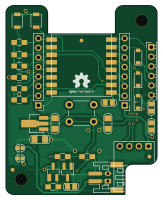
Esp8266 button is an open source ESP8266 PCB design by ep-infosec, published on GitHub under the CC-BY-4.0 license. It is a 2-layer board measuring 40 × 50 mm, with 35 components from 21 distinct parts.
Its main chip is the ESP-12, from the ESP8266 family. Other key parts include the MCP1703A-3302/MB. By type, the board carries 9 resistors, 7 capacitors, 4 connectors, 3 switches, 3 diodes and 2 ICs.
From the project
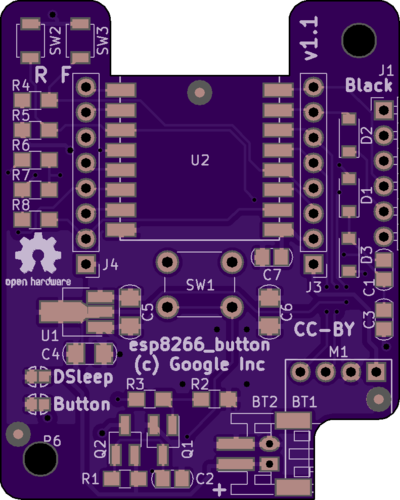
Assemble board. The board itself is 40x50mm, and the mounting holes (centered) are 32x42mm. You probably want a 3d printed housing for it, but you need to choose whether it's powered all the time (using deep sleep), or fully powers off unless you tap SW1. (Close one of "DSleep" o
Assemble board. The board itself is 40x50mm, and the mounting holes (centered) are 32x42mm. You probably want a 3d printed housing for it, but you need to choose whether it's powered all the time (using deep sleep), or fully powers off unless you tap SW1. (Close one of "DSleep" or "Button" solder jumpers.)
Keep GPIO12 set HIGH to power things (including the battery monitor ADC pin and the BMP180 header), otherwise set LOW to conserve power.
Main components on the Esp8266 button
Esp8266 button bill of materials (BOM)
35 components, 21 distinct parts.
| Qty | Part | Footprint | Refs |
|---|---|---|---|
| 1 | MCP1703A-3302/MB | SOT-89-3_Handsoldering | U1 |
| 1 | ESP-12 | ESP-12E | U2 |
| 1 | BMP180_Breakout | BMxx80 | M1 |
| 1 | Q_NMOS_GSD | SOT-23_Handsoldering | Q1 |
| 1 | Q_PMOS_GSD | SOT-23_Handsoldering | Q2 |
| 1 | CONN_01X06 | Pin_Header_Angled_1x06_Pitch2.54mm | J1 |
| 1 | CONN_01X06 | Pogo_6 | J2 |
| 2 | CONN_01X08 | Pin_Header_Straight_1x08_Pitch2.54mm | J3, J4 |
| 1 | Battery_Cell | JST_PH_S2B-PH-K_02x2.00mm_Angled | BT1 |
| 1 | Battery_Cell | JST_PH_S2B-PH-SM4-TB_02x2.00mm_Angled | BT2 |
| 1 | Always On | SJ_1_NO | JP1 |
| 1 | MOS Control | SJ_1_NO | JP2 |
| 1 | SW_Push | SW_PUSH_6mm | SW1 |
| 2 | SW_Push | SW_SPST_B3U-1000P | SW2, SW3 |
| 3 | B5819W | D_SOD-123 | D1, D2, D3 |
| 4 | 220p | C_0805 | C1, C2, C4, C7 |
| 3 | 10u | C_1206 | C3, C5, C6 |
| 2 | 100k | R_0805_HandSoldering | R1, R8 |
| 1 | 220k | R_0805_HandSoldering | R2 |
| 5 | 10k | R_0805_HandSoldering | R3, R4, R5, R6, R9 |
Show 1 more
| Qty | Part | Footprint | Refs |
|---|---|---|---|
| 1 | 320k | R_0805_HandSoldering | R7 |
Esp8266 button design files
The KiCad project lives in the ep-infosec/50_google_makerspace-partsbin repository on GitHub; these links point at the commit this page was built from.
Esp8266 button: common questions
What microcontroller does the Esp8266 button use?
The Esp8266 button is built around the ESP-12, from the ESP8266 family.
How big is the Esp8266 button PCB?
The Esp8266 button measures 40 × 50 mm, has 2 copper layers and is 1.6 mm thick.
How many components are on the Esp8266 button?
35 components, from 21 distinct parts. The full bill of materials is listed on this page.
Where can I download the Esp8266 button design files?
From the ep-infosec/50_google_makerspace-partsbin repository on GitHub, which has the KiCad layout; the links under Design files point to each one.
Can I use the Esp8266 button design in my own project?
Yes, under the terms of its CC-BY-4.0 license, which ep-infosec chose for the repository.
Can I test firmware for the Esp8266 button without the hardware?
Yes. HardLabs builds a simulation of the board from its netlist and BOM, so you can run and debug ESP8266 firmware against it before you order a PCB.
More boards in 50_google_makerspace-partsbin
High current 1
71.8 × 54.6 mm66 parts2LCC-BY-4.00
Esp32 button
44 × 44 mm56 parts2LCC-BY-4.00
Tp5410 breakout
30 × 30 mm27 parts2LCC-BY-4.00
Simple step load
30 × 30 mm19 parts2LCC-BY-4.00
Mp2303 breakout
30 × 30 mm18 parts2LCC-BY-4.00 AVR/Arduino
Smd class
30 × 30 mm16 parts2LCC-BY-4.00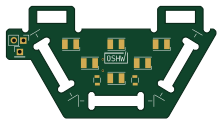
Led board
55.4 × 29.5 mm13 parts2LCC-BY-4.00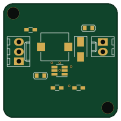
Sx1308 breakout
30 × 30 mm11 parts2LCC-BY-4.00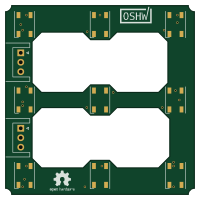
Square grid board
50 × 50 mm11 parts2LCC-BY-4.00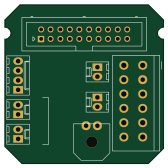
Hangbot breakout
42 × 42 mm8 parts2LCC-BY-4.00
Smd proto
34 × 49 mm6 parts2LCC-BY-4.00
Similar boards
 ESP8266
ESP8266ControllerCircuit
stuartpittaway
75 × 30 mm20 parts2LCC-BY-NC-4.01.1k ESP8266
HASwitchPlate
aderusha
60 × 40 mm8 parts2LMIT738 ESP8266
RatGDO-OpenSource-D1Mini-ESP8266
Kaldek
47.8 × 63.3 mm12 parts2LMIT506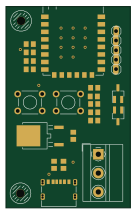 ESP8266
Goatgdo
32.9 × 53.3 mm23 parts2LMIT506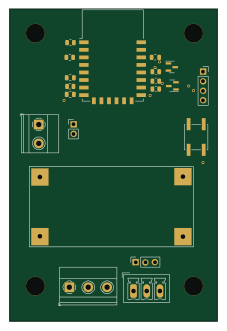 ESP8266
RatGDO-OpenSource-Bare-ESP8266
55 × 82.7 mm20 parts2LMIT506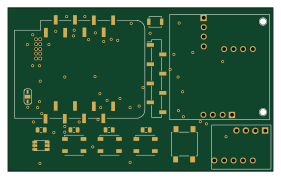 ESP8266
Iaq board
nkitanov
70.1 × 43.2 mm17 parts2LNo license398