
WalkieTalkie

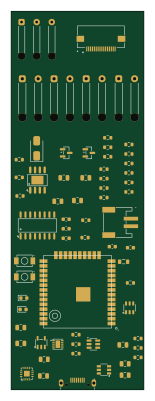
About the WalkieTalkie PCB
WalkieTalkie is an open source ESP32 PCB design by GuzziFlipFlops, published on GitHub under the MIT license. It is a 2-layer board measuring 35 × 100 mm, with 66 components from 39 distinct parts.
Its main chip is the ESP32-WROOM-32U-N4, from the ESP32 family. Other key parts include the USBLC6-2SC6, ME6211C33M5G-N, CH340C, TP4056 and DW01A. By type, the board carries 25 resistors, 16 capacitors, 8 ICs, 8 connectors, 3 transistors and 3 diodes.
It belongs with the displays & leds, audio and power & battery designs in this gallery.
From the project
An open source ESPNOW based walkie talkie with a 600 meter tested distance, with an OLED and multiple buttons to interact with
This is a KiCad PCB for those looking to make the walkie talkie from PCBs. Note that you will still have to solder some components.
Although this custom PCB works, I will be manufactering a redesigned much cleaner version later that avoids the hassle of 2 PCB boards and does everything one one, with a much slimmer walkie talkie design.
In this folder are the source kicad files for the PCB and manufacterable GERBER files.
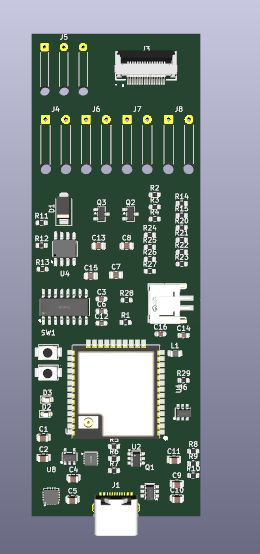
Main components on the WalkieTalkie
WalkieTalkie bill of materials (BOM)
66 components, 39 distinct parts — part numbers from the project's BOM.
| Qty | Part | Footprint | Refs |
|---|---|---|---|
| 1 | ESP32-WROOM-32U-N4 Espressif Systems | WIFIM-SMD_38P-L19.2-W18.0-P1.27 | U1 |
| 1 | USBLC6-2SC6 | SOT-23-6 | U2 |
| 1 | ME6211C33M5G-N MICRONE | SOT-23-5_L3.0-W1.7-P0.95-LS2.8-BL | U3 |
| 1 | CH340C WCH | SOP-16_L10.0-W3.9-P1.27-LS6.0-BL | U4 |
| 1 | TP4056 YONGYUTAI | ESOP-8_L4.9-W3.9-P1.27-LS6.0-BL-EP-4 | U5 |
| 1 | DW01A PUOLOP | SOT-23-6_L2.9-W1.6-P0.95-LS2.8-BL | U6 |
| 1 | TPS63031DSKR Texas Instruments | SON-10_L2.5-W2.5-P0.50-TL-EP | U7 |
| 1 | MAX98357AETE+T Analog Devices / Maxim | TQFN-16_L3.0-W3.0-P0.50-BL-EP1.5 | U8 |
| 1 | FS8205A TECH PUBLIC | SOT-23-6_L2.9-W1.6-P0.95-LS2.8-BR | Q1 |
| 1 | AO3401A | SOT-23 | Q2 |
| 1 | AO3400A | SOT-23 | Q3 |
| 1 | TYPE-C-31-M-12 Korean Hroparts Elec | USB-C_SMD-TYPE-C-31-M-12_1 | J1 |
| 1 | S2B-PH-SM4-TB(LF)(SN) BATTERY JST-PH JST | CONN-SMD_P2.00_S2B-PH-SM4-TB-LF-SN | J2 |
| 1 | AFC01-S16FCC-00 FRONT BOARD FFC JUSHUO | FPC-SMD_P0.50-16P_FGS-XJ-H2.0 | J3 |
| 1 | SPEAKER WIRES | SolderWire-0.25sqmm_1x02_P4.2mm_D0.65mm_OD1.7mm_Relief | J4 |
| 1 | 10k POTENTIOMETER | SolderWire-0.15sqmm_1x03_P4mm_D0.5mm_OD1.5mm_Relief | J5 |
| 1 | PTT BUTTON | SolderWire-0.25sqmm_1x02_P4.2mm_D0.65mm_OD1.7mm_Relief | J6 |
| 1 | EXTERNAL LED | SolderWire-0.25sqmm_1x02_P4.2mm_D0.65mm_OD1.7mm_Relief | J7 |
| 1 | LASER WIRES | SolderWire-0.25sqmm_1x02_P4.2mm_D0.65mm_OD1.7mm_Relief | J8 |
| 1 | TS-1088R-02026 RESET XUNPU | SW-SMD_L3.9-W3.0-P4.45 | SW1 |
Show 19 more
| Qty | Part | Footprint | Refs |
|---|---|---|---|
| 1 | TS-1088R-02026 BOOT XUNPU | SW-SMD_L3.9-W3.0-P4.45 | SW2 |
| 1 | SS34 | D_SMA | D1 |
| 1 | RED CHARGING | LED_0603_1608Metric | D2 |
| 1 | GREEN FULL | LED_0603_1608Metric | D3 |
| 1 | 2.2uH >=2A | L_0805_2012Metric | L1 |
| 3 | 1uF | C_0805_2012Metric | C1, C2, C11 |
| 5 | 100nF | C_0603_1608Metric | C3, C6, C12, C14, C16 |
| 8 | 10uF | C_0805_2012Metric | C4, C5, C7, C8, C9, C10, C13, C15 |
| 2 | 5.1k | R_0603_1608Metric | R1, R2 |
| 1 | 2.4k (500mA) | R_0603_1608Metric | R3 |
| 3 | 1k | R_0603_1608Metric | R4, R5, R7 |
| 1 | 100R | R_0603_1608Metric | R6 |
| 3 | 10k | R_0603_1608Metric | R8, R10, R11 |
| 3 | 100k | R_0603_1608Metric | R9, R12, R15 |
| 1 | 1M | R_0603_1608Metric | R13 |
| 1 | 330R | R_0603_1608Metric | R14 |
| 4 | 0R BLACK | R_0603_1608Metric | R20, R21, R22, R23 |
| 4 | 0R GREY | R_0603_1608Metric | R24, R25, R26, R27 |
| 2 | 220k | R_0603_1608Metric | R28, R29 |
WalkieTalkie design files
The KiCad project lives in the GuzziFlipFlops/ESP32-Walkie-Talkie repository on GitHub; these links point at the commit this page was built from.
WalkieTalkie: common questions
What microcontroller does the WalkieTalkie use?
The WalkieTalkie is built around the ESP32-WROOM-32U-N4, from the ESP32 family.
How big is the WalkieTalkie PCB?
The WalkieTalkie measures 35 × 100 mm, has 2 copper layers and is 1.6 mm thick.
How many components are on the WalkieTalkie?
66 components, from 39 distinct parts, with part numbers taken from the project's own BOM. The full bill of materials is listed on this page.
Where can I download the WalkieTalkie design files?
From the GuzziFlipFlops/ESP32-Walkie-Talkie repository on GitHub, which has the KiCad layout, the schematic and the BOM; the links under Design files point to each one.
Can I use the WalkieTalkie design in my own project?
Yes, under the terms of its MIT license, which GuzziFlipFlops chose for the repository.
Can I test firmware for the WalkieTalkie without the hardware?
Yes. HardLabs builds a simulation of the board from its netlist and BOM, so you can run and debug ESP32 firmware against it before you order a PCB.
More boards in ESP32-Walkie-Talkie
Similar boards
 ESP32
OSO-BOOK-B1
joeycastillo
85 × 115 mm65 parts2LCC-BY-SA-4.08.1k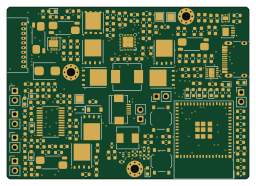 ESP32
Powertrain
byrantech
64 × 45.4 mm171 parts4LMIT4.3k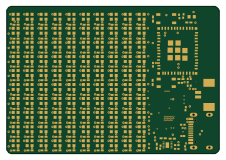 ESP32
Badge
atopile
56.3 × 39 mm239 parts4LMIT4.0k ESP32
Esp32 minimal
36.2 × 26.8 mm20 parts2LMIT4.0k ESP32
Racer
StuckAtPrototype
36 × 50.2 mm70 parts4LApache-2.03.8k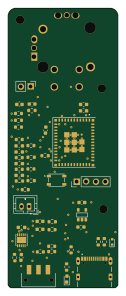 ESP32
Controller
29 × 74 mm58 parts4LApache-2.03.8k