
Silkscreen

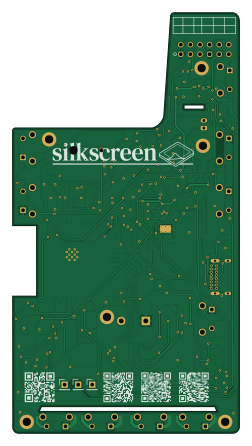
About the Silkscreen PCB
Silkscreen is an open source ESP32 PCB design by iandchasse, published on GitHub under the CERN-OHL-S-2.0 license. It is a 2-layer board measuring 60 × 111.3 mm, with 171 components from 68 distinct parts.
Its main chip is the ESP32-S3-WROOM-1-N16R8, from the ESP32 family. Other key parts include the TPD4E1U06DBVR, TPS2116DRLR, TLV75533PDBVR, DW01A and TPS923610DRLR. By type, the board carries 79 resistors, 36 capacitors, 13 ICs, 11 switches, 9 transistors and 7 connectors.
It belongs with the displays & leds and power & battery designs in this gallery.
From the project
Silkscreen: open-hardware ESP32-S3 e-paper reader mainboard (KiCad 9). Formerly the de-link hub.
An open-source, open-hardware e-reader mainboard.
Silkscreen is a build-it-yourself e-reader. The name covers both this board and a reader built around it; this repository covers the mainboard. You order the board already assembled from a factory, add an e-paper display, a battery and a microSD card, and put it in a case of your own choosing. It is a 2-layer ESP32-S3 board with a 24-pin display connector, optional touch and frontlight, microSD and single-cell Li-ion/LiPo power.
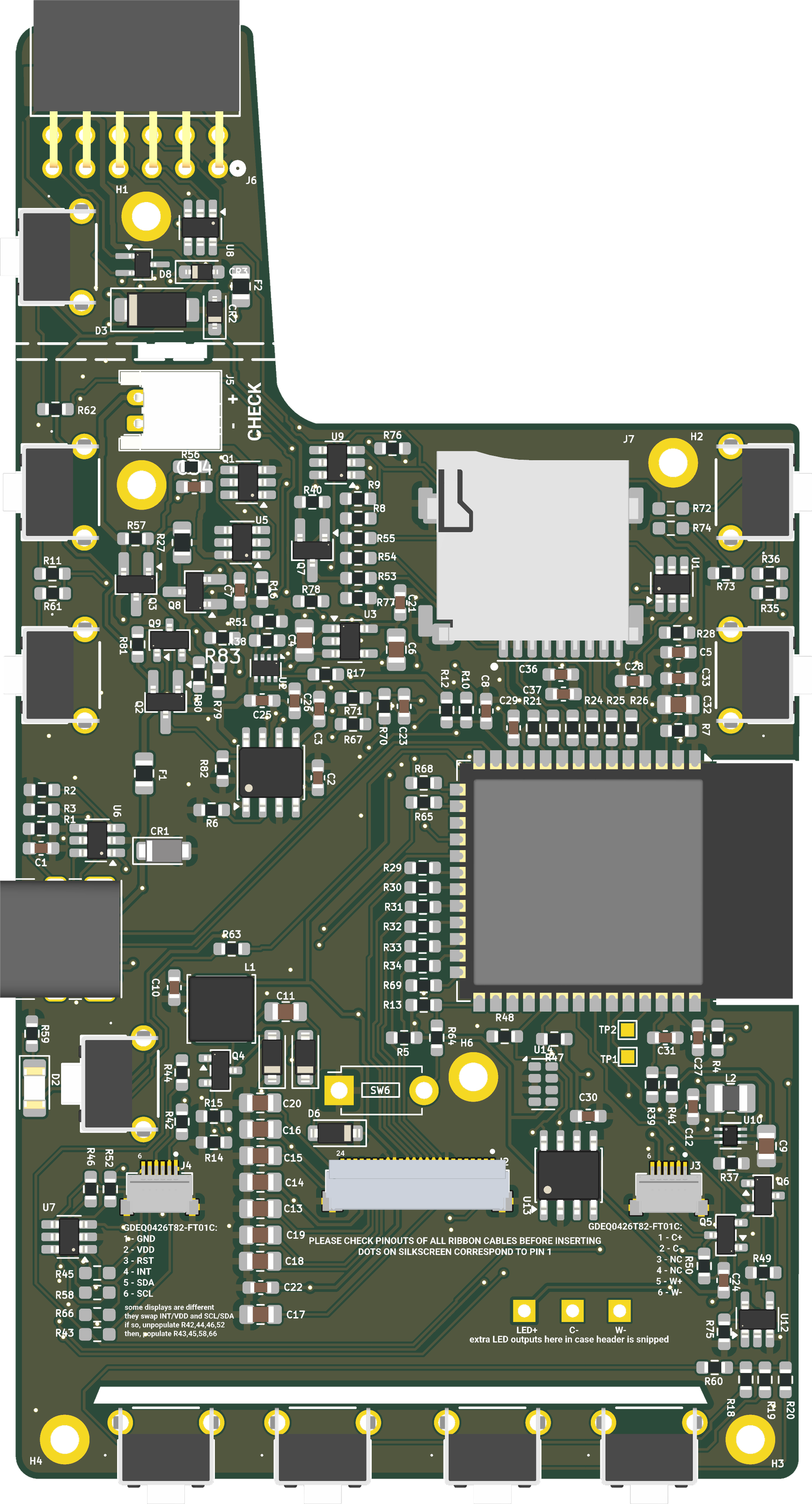
Main components on the Silkscreen
Silkscreen bill of materials (BOM)
171 components, 68 distinct parts — part numbers from the project's BOM.
| Qty | Part | Footprint | Refs |
|---|---|---|---|
| 5 | TPD4E1U06DBVR Texas Instruments | SOT-23-6_Handsoldering | U1, U6, U7, U8, U9 |
| 1 | TPS2116DRLR TPS2116DRL Texas Instruments | SOT-583-8 | U2 |
| 1 | TLV75533PDBVR TLV75533PDBV Texas Instruments | SOT-23-5_HandSoldering | U3 |
| 1 | ESP32-S3-WROOM-1-N16R8 ESP32-S3-WROOM-1 Espressif Systems | ESP32-S3-WROOM-1 | U4 |
| 1 | DW01A Fortune Semiconductor | SOT-23-6_Handsoldering | U5 |
| 1 | TPS923610DRLR Texas Instruments | U_DRL0006A_6L_TEX-M | U10 |
| 1 | TP4056-42-ESOP8 NanJing Top Power (TOPPOWER) | SOIC-8-1EP_3.9x4.9mm_P1.27mm_EP2.41x3.3mm_ThermalVias | U11 |
| 1 | 74LVC1G04GV,125 74LVC1G04 Nexperia | SOT-23-5_HandSoldering | U12 |
| 1 | DS3231MZ+TRL DS3231MZ Analog Devices | SOIC-8_3.9x4.9mm_P1.27mm | U13 |
| 1 | FS8205A EVVOSEMI | SOT-23-6_Handsoldering | Q1 |
| 4 | AO3401A Alpha & Omega Semiconductor | SOT-23_Handsoldering | Q2, Q3, Q7, Q8 |
| 1 | IRLML6346TRPBF Infineon | SOT-23 | Q4 |
| 3 | BSS138LT1G BSS138 onsemi | SOT-23 | Q5, Q6, Q9 |
| 1 | USB4085-GF-A USB_C_Receptacle GCT | USB_C_Receptacle_GCT_USB4085 | J1 |
| 1 | FH34SRJ-24S-0.5SH(50) FH34SRJ-24S-0.5SH_50_ Hirose | HRS_FH34SRJ-24S-0.5SH_50_ | J2 |
| 2 | FH34SRJ-6S-0.5SH(50) FH34SRJ-6S-0.5SH_50_ Hirose | HRS_FH34SRJ-6S-0.5SH_50_ | J3, J4 |
| 1 | S2B-PH-K-S(LF)(SN) Conn_01x02 JST | JST_PH_S2B-PH-K_1x02_P2.00mm_Horizontal | J5 |
| 1 | PPPC062LJBN-RC Sullins | CONN_PPPC062LJBN-RC_SUL | J6 |
| 1 | MEM2075-00-140-01-A Micro_SD_Card GCT | microSD_PushPush_TFPUSH-MEM2075 | J7 |
| 1 | SMF6.5CA Littelfuse | D_SMF | CR1 |
Show 48 more
| Qty | Part | Footprint | Refs |
|---|---|---|---|
| 2 | TSD05CDYFR Texas Instruments | D_SOD-323_HandSoldering | CR2, CR3 |
| 1 | 0805L100WR Littelfuse | Fuse_0805_2012Metric_Pad1.15x1.40mm_HandSolder | F1 |
| 1 | 0805L075WR Littelfuse | Fuse_0805_2012Metric_Pad1.15x1.40mm_HandSolder | F2 |
| 10 | MJTP1117 SW_Push APEM | MJTP1117 | SW1, SW2, SW3, SW4, SW5, SW7, SW8, SW9 +2 |
| 1 | MJTP1243 SW_Push APEM | SW_PUSH_1P1T_6x3.5mm_H4.3_APEM_MJTP1243 | SW6 |
| 3 | TestPoint | PinHeader_1x01_P2.54mm_Vertical | TP3, TP4, TP5 |
| 1 | LTST-C150KRKT LED Lite-On | LED_1206_3216Metric_Pad1.42x1.75mm_HandSolder | D2 |
| 1 | SMAJ26A Littelfuse | D_SMA | D3 |
| 3 | 1N5819HW-7-F B5819W Diodes Incorporated | D_SOD-123 | D4, D5, D6 |
| 1 | PESD2IVN-UX Nexperia | SOT-323_SC-70_Handsoldering | D8 |
| 1 | TYS5040470M-10 47uH Laird | L_APV_ANR5040 | L1 |
| 1 | VLS252012HBX-100M-1 10u TDK | L_1008_2520Metric_Pad1.43x2.20mm_HandSolder | L2 |
| 1 | CL10B102KB8NNNC 1n Samsung Electro-Mechanics | C_0603_1608Metric_Pad1.08x0.95mm_HandSolder | C1 |
| 1 | CL10A106MA8NRNC 10u/25V Samsung Electro-Mechanics | C_0603_1608Metric_Pad1.08x0.95mm_HandSolder | C2 |
| 1 | CL10A106KP8NNNC 10u Samsung Electro-Mechanics | C_0603_1608Metric_Pad1.08x0.95mm_HandSolder | C3 |
| 3 | GRM21BR61E226ME44L 22u Murata Electronics | C_0805_2012Metric_Pad1.18x1.45mm_HandSolder | C4, C6, C32 |
| 7 | CL10A105KB8NNNC 1u Samsung Electro-Mechanics | C_0603_1608Metric_Pad1.08x0.95mm_HandSolder | C5, C8, C21, C22, C25, C26, C37 |
| 7 | CC0603KRX7R9BB104 0.1u Yageo | C_0603_1608Metric_Pad1.08x0.95mm_HandSolder | C7, C23, C24, C30, C31, C33, C36 |
| 7 | CL21A475KBQNNNE 4.7u/50V Samsung Electro-Mechanics | C_0805_2012Metric_Pad1.18x1.45mm_HandSolder | C9, C11, C13, C14, C15, C16, C17 |
| 2 | CL10A475KO8NNNC 4.7u Samsung Electro-Mechanics | C_0603_1608Metric_Pad1.08x0.95mm_HandSolder | C10, C12 |
| 3 | CL21B105KBFNNNE 1u/50V Samsung Electro-Mechanics | C_0805_2012Metric_Pad1.18x1.45mm_HandSolder | C18, C19, C20 |
| 4 | CL10B222KB8NNNC 2.2n Samsung Electro-Mechanics | C_0603_1608Metric_Pad1.08x0.95mm_HandSolder | C27, C28, C29, C34 |
| 11 | RC0603FR-071ML 1M Yageo | R_0603_1608Metric_Pad0.98x0.95mm_HandSolder | R1, R10, R12, R15, R39, R49, R50, R70 +3 |
| 2 | RC0603FR-075K1L 5.1k Yageo | R_0603_1608Metric_Pad0.98x0.95mm_HandSolder | R2, R3 |
| 13 | RC0603FR-0710KL 10k Yageo | R_0603_1608Metric_Pad0.98x0.95mm_HandSolder | R4, R5, R7, R8, R9, R13, R28, R53 +5 |
| 1 | RC0603FR-074K7L 4.7k Yageo | R_0603_1608Metric_Pad0.98x0.95mm_HandSolder | R6 |
| 1 | RC0603FR-0712KL 12k Yageo | R_0603_1608Metric_Pad0.98x0.95mm_HandSolder | R11 |
| 1 | RC0603FR-072R2L 2.2 Yageo | R_0603_1608Metric_Pad0.98x0.95mm_HandSolder | R14 |
| 2 | RC0603FR-071KL 1k Yageo | R_0603_1608Metric_Pad0.98x0.95mm_HandSolder | R16, R78 |
| 1 | RC0603FR-072ML 2M Yageo | R_0603_1608Metric_Pad0.98x0.95mm_HandSolder | R17 |
| 1 | RC0603FR-075K6L 5.6k Yageo | R_0603_1608Metric_Pad0.98x0.95mm_HandSolder | R18 |
| 1 | RC0603FR-0720KL 20k Yageo | R_0603_1608Metric_Pad0.98x0.95mm_HandSolder | R19 |
| 1 | RC0603FR-0756KL 56k Yageo | R_0603_1608Metric_Pad0.98x0.95mm_HandSolder | R20 |
| 15 | RC0603FR-0733RL 33 Yageo | R_0603_1608Metric_Pad0.98x0.95mm_HandSolder | R21, R22, R23, R24, R25, R26, R29, R30 +7 |
| 1 | RC0805JR-070RL 0 Yageo | R_0805_2012Metric_Pad1.20x1.40mm_HandSolder | R27 |
| 1 | RC0603FR-0733KL 33k Yageo | R_0603_1608Metric_Pad0.98x0.95mm_HandSolder | R35 |
| 1 | RC0603FR-0768KL 68k Yageo | R_0603_1608Metric_Pad0.98x0.95mm_HandSolder | R36 |
| 1 | RC0603FR-0715RL 15 Yageo | R_0603_1608Metric_Pad0.98x0.95mm_HandSolder | R37 |
| 1 | RC0603FR-07300KL 300k Yageo | R_0603_1608Metric_Pad0.98x0.95mm_HandSolder | R38 |
| 6 | RC0603FR-07100KL 100k Yageo | R_0603_1608Metric_Pad0.98x0.95mm_HandSolder | R40, R51, R75, R76, R77, R79 |
| 1 | RC0603FR-07120KL 120k Yageo | R_0603_1608Metric_Pad0.98x0.95mm_HandSolder | R41 |
| 6 | RC0603JR-070RL 0 Yageo | R_0603_1608Metric_Pad0.98x0.95mm_HandSolder | R42, R44, R46, R52, R73, R74 |
| 2 | RC0603FR-072K2L 2.2k Yageo | R_0603_1608Metric_Pad0.98x0.95mm_HandSolder | R47, R48 |
| 1 | RC0603FR-0710ML 10M Yageo | R_0603_1608Metric_Pad0.98x0.95mm_HandSolder | R57 |
| 1 | RC0603FR-072KL 2k Yageo | R_0603_1608Metric_Pad0.98x0.95mm_HandSolder | R59 |
| 5 | RC0603FR-07100RL 100 Yageo | R_0603_1608Metric_Pad0.98x0.95mm_HandSolder | R60, R61, R63, R64, R83 |
| 1 | RC0603FR-07510KL 510k Yageo | R_0603_1608Metric_Pad0.98x0.95mm_HandSolder | R67 |
| 1 | RC0603FR-07200KL 200k Yageo | R_0603_1608Metric_Pad0.98x0.95mm_HandSolder | R71 |
Silkscreen design files
The KiCad project lives in the iandchasse/silkscreen-pcb repository on GitHub; these links point at the commit this page was built from.
Silkscreen: common questions
What microcontroller does the Silkscreen use?
The Silkscreen is built around the ESP32-S3-WROOM-1-N16R8, from the ESP32 family.
How big is the Silkscreen PCB?
The Silkscreen measures 60 × 111.3 mm, has 2 copper layers and is 1.6 mm thick.
How many components are on the Silkscreen?
171 components, from 68 distinct parts, with part numbers taken from the project's own BOM. The full bill of materials is listed on this page.
Where can I download the Silkscreen design files?
From the iandchasse/silkscreen-pcb repository on GitHub, which has the KiCad layout, the schematic and the BOM; the links under Design files point to each one.
Can I use the Silkscreen design in my own project?
Yes, under the terms of its CERN-OHL-S-2.0 license, which iandchasse chose for the repository.
Can I test firmware for the Silkscreen without the hardware?
Yes. HardLabs builds a simulation of the board from its netlist and BOM, so you can run and debug ESP32 firmware against it before you order a PCB.
Similar boards
 ESP32
OSO-BOOK-B1
joeycastillo
85 × 115 mm65 parts2LCC-BY-SA-4.08.1k ESP32
Powertrain
byrantech
64 × 45.4 mm171 parts4LMIT4.3k ESP32
Badge
atopile
56.3 × 39 mm239 parts4LMIT4.0k ESP32
Esp32 minimal
36.2 × 26.8 mm20 parts2LMIT4.0k ESP32
Racer
StuckAtPrototype
36 × 50.2 mm70 parts4LApache-2.03.8k ESP32
Controller
29 × 74 mm58 parts4LApache-2.03.8k