
Accoustic Sensing Node

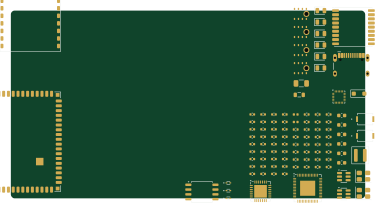
About the Accoustic Sensing Node PCB
Accoustic Sensing Node is an open source ESP32 PCB design by irocobble, published on GitHub. It is a 2-layer board measuring 93.9 × 49.8 mm, with 105 components from 79 distinct parts.
Its main chip is the ESP32-S3, from the ESP32 family. Other key parts include the SX1262IMLTRT, PE4259, SX1262, MAX-M10S and MIC2. By type, the board carries 42 capacitors, 30 resistors, 13 ICs, 10 diodes, 4 inductors and 2 crystals.
It belongs with the rf & radio, iot & wireless and audio designs in this gallery.
From the project
Open-source ESP32-S3 edge computing module with LoRa, GPS, external flash, MicroSD, and expansion support for long-range IoT applications.
Team: Aninda Majumdar (@irocobble) · Subham Basak · Kartik Kajra
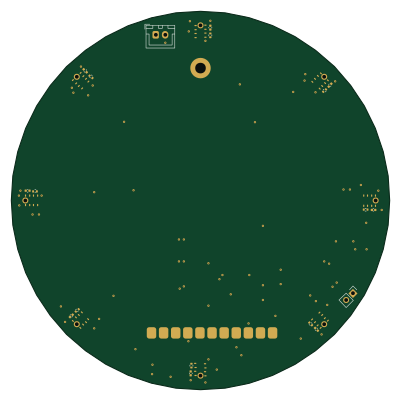
A two-board, field-deployable acoustic sensor for search-and-rescue. The node is placed in rubble or debris and listens for signs of a trapped person (voice, tapping, banging). It works out which direction the sound came from and sends a GPS-tagged alert over LoRa to a rescue dashboard.
Searching collapsed structures is a race against time, and the hardest question is where to dig. Instead of sending people onto unstable rubble to listen, the node sends the ears in first.
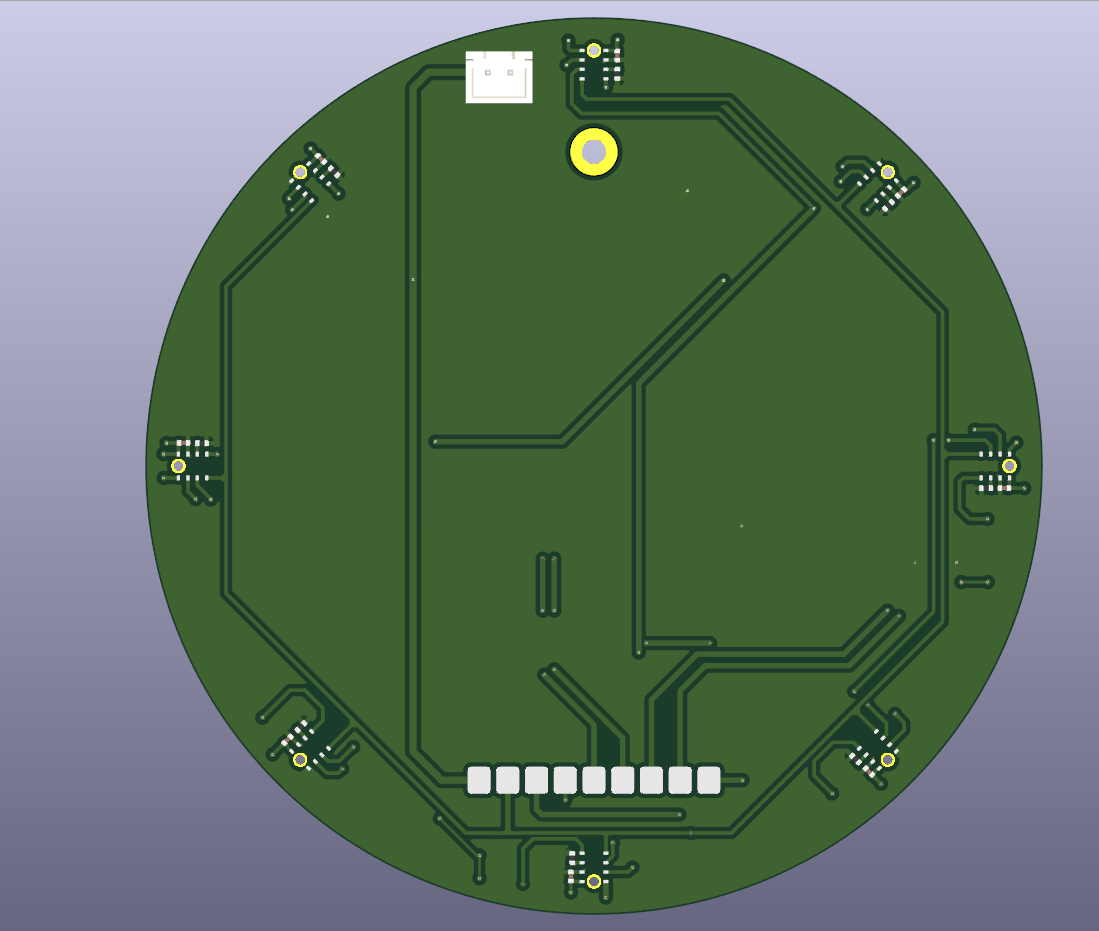
Main components on the Accoustic Sensing Node
Accoustic Sensing Node bill of materials (BOM)
105 components, 79 distinct parts — part numbers from the project's BOM.
| Qty | Part | Footprint | Refs |
|---|---|---|---|
| 1 | SX1262IMLTRT MIC1 Semtech | INMP441 | U1 |
| 1 | PE4259 MIC3 Peregrine | INMP441 | U2 |
| 1 | SX1262 | SX1262-B | U3 |
| 1 | MAX-M10S | ublox_MAX | U4 |
| 1 | MIC2 | INMP441 | U5 |
| 1 | MIC4 | INMP441 | U6 |
| 1 | W25Q128JVS | SOIC-8_5.3x5.3mm_P1.27mm | U7 |
| 1 | ESP32-S3 | QFN-56-1EP_7x7mm_P0.4mm_EP4x4mm | U8 |
| 1 | Sipeed-M1 | Sipeed-M1 | U9 |
| 1 | MPU-9250 | InvenSense_QFN-24_3x3mm_P0.4mm | U10 |
| 1 | CP2102N-Axx-xQFN28 | QFN-28-1EP_5x5mm_P0.5mm_EP3.35x3.35mm | U11 |
| 1 | USBLC6-4SC6 | SOT-23-6 | U13 |
| 1 | AP63203WU | TSOT-23-6 | U14 |
| 1 | 40MHz | Crystal_SMD_3225-4Pin_3.2x2.5mm | Y1 |
| 1 | 12MHz | Crystal_SMD_3225-4Pin_3.2x2.5mm | Y2 |
| 1 | 68000-108HLF USB_C_Receptacle_USB2.0_16P FCI | USB_C_Receptacle_HCTL_HC-TYPE-C-16P-01A | J3 |
| 1 | Polyfuse 2A | Fuse_1206_3216Metric | F2 |
| 1 | BOOT | SW_CS1213AGF260_CRS | SW1 |
| 1 | Reset | SW_CS1213AGF260_CRS | SW2 |
| 1 | LORA_ON | LED_0805_2012Metric | D1 |
Show 59 more
| Qty | Part | Footprint | Refs |
|---|---|---|---|
| 1 | LORA_OFF | LED_0805_2012Metric | D2 |
| 1 | Power | LED_0805_2012Metric | D3 |
| 3 | ESD3.3 | SODFL1006X40N | D4, D5, D7 |
| 1 | UART1_ON | LED_0805_2012Metric | D6 |
| 1 | PMEG4020EP | D_SOD-123F | D11 |
| 1 | USB1 | LED_0805_2012Metric | D12 |
| 1 | USB2 | LED_0805_2012Metric | D13 |
| 1 | BLM21PG220 | L_0805_2012Metric | FB2 |
| 1 | LQW15AN47NJ00D 27nH Murata | L_0402_1005Metric | L1 |
| 1 | CRCW04020000Z0ED 2nH Vishay/Dale | L_0402_1005Metric | L2 |
| 1 | LQW15AN4N7C00D 4.7uH Murata | L_Coilcraft_XAL4030-XXX | L4 |
| 1 | GRM155R71C473KA01D 0.1uF Murata | C_0402_1005Metric | C1 |
| 1 | GJM1555C1H470JB01D 0.1uF Murata | C_0402_1005Metric | C2 |
| 2 | 100nF | C_0402_1005Metric | C3, C42 |
| 1 | GJM1555C1H3R3BB01D 10uF Murata | C_0402_1005Metric | C4 |
| 1 | GJM1555C1H5R6CB01D 100nF Murata | C_0402_1005Metric | C5 |
| 1 | GJM1555C1H390JB01D 1uF Murata | C_0402_1005Metric | C6 |
| 1 | GJM1555C1H2R2BB01D 1uF Murata | C_0402_1005Metric | C7 |
| 1 | GJM1555C1H390JB01D 100nF Murata | C_0402_1005Metric | C8 |
| 1 | GJM1555C1H3R3BB01D 10nF Murata | C_0402_1005Metric | C9 |
| 1 | GJM1555C1H3R3BB01D 0.1uF Murata | C_0402_1005Metric | C10 |
| 1 | GJM1555C1H2R4BB01D 0.1uF Murata | C_0402_1005Metric | C11 |
| 1 | GJM1555C1H1R8BB01D 30pF Murata | C_0402_1005Metric | C12 |
| 1 | 10uF | C_0402_1005Metric | C13 |
| 1 | GRM155R72A102KA01D 30pF Murata | C_0402_1005Metric | C14 |
| 1 | GRM155R72A102KA01D 1uF Murata | C_0402_1005Metric | C15 |
| 3 | GRM155R61C105KA12D 0.1uF Murata | C_0402_1005Metric | C16, C20, C24 |
| 1 | GRM155R71A474KE01D 0.1uF Murata | C_0402_1005Metric | C17 |
| 1 | GRM155R71H104KE14D 0.1uF Murata | C_0402_1005Metric | C18 |
| 4 | 0.1uF | C_0402_1005Metric | C19, C30, C31, C46 |
| 1 | GRM155R61C105KA12D 100nF Murata | C_0402_1005Metric | C21 |
| 1 | GRM188Z71A106KA73D 0.1uF Murata | C_0402_1005Metric | C22 |
| 1 | GRM155R71H104KE14D 10nF Murata | C_0402_1005Metric | C23 |
| 1 | 1uF | C_0402_1005Metric | C25 |
| 1 | GRM188Z71A106KA73D 1uF Murata | C_0402_1005Metric | C26 |
| 1 | GJM1555C1H100JB01D 100nF Murata | C_0402_1005Metric | C27 |
| 1 | GRM155R71H104KE14D 100nF Murata | C_0402_1005Metric | C28 |
| 1 | 10nF | C_0402_1005Metric | C29 |
| 1 | 100n | C_0402_1005Metric | C38 |
| 2 | 10uF | C_0603_1608Metric | C39, C47 |
| 2 | 12pF | C_0402_1005Metric | C40, C41 |
| 2 | 22u | C_0603_1608Metric | C43, C44 |
| 1 | 1uF | C_0603_1608Metric | C45 |
| 1 | 4.7uF | C_0603_1608Metric | C55 |
| 9 | 10k | R_0402_1005Metric | R1, R6, R7, R9, R10, R20, R33, R34 +1 |
| 1 | CRCW06030000Z0EAHP 10k Vishay/Dale | R_0402_1005Metric | R2 |
| 2 | CRCW0402100RFKED 470 Ohm Vishay/Dale | R_0402_1005Metric | R3, R4 |
| 1 | CRCW0402220RJNED 1k Vishay/Dale | R_0402_1005Metric | R5 |
| 1 | 10Ohm | R_0402_1005Metric | R8 |
| 1 | 100 Ohm | R_0402_1005Metric | R11 |
| 1 | CRCW04020000Z0ED 10k Vishay/Dale | R_0402_1005Metric | R12 |
| 1 | CRCW040210K0FKED 1K Vishay/Dale | R_0402_1005Metric | R13 |
| 3 | 470 Ohm | R_0402_1005Metric | R14, R31, R32 |
| 2 | CRCW0402330RFKED 0kOhm Vishay/Dale | R_0402_1005Metric | R15, R16 |
| 2 | 0kOhm | R_0402_1005Metric | R17, R19 |
| 1 | CRCW04020000Z0ED 0kOhm Vishay/Dale | R_0402_1005Metric | R18 |
| 2 | 2.2K | R_0402_1005Metric | R21, R22 |
| 2 | 5.1k | R_0402_1005Metric | R28, R29 |
| 1 | 0 Ohm | R_0402_1005Metric | R30 |
Accoustic Sensing Node design files
The KiCad project lives in the irocobble/CA_LR_ES repository on GitHub; these links point at the commit this page was built from.
Accoustic Sensing Node: common questions
What microcontroller does the Accoustic Sensing Node use?
The Accoustic Sensing Node is built around the ESP32-S3, from the ESP32 family.
How big is the Accoustic Sensing Node PCB?
The Accoustic Sensing Node measures 93.9 × 49.8 mm, has 2 copper layers and is 1.6 mm thick.
How many components are on the Accoustic Sensing Node?
105 components, from 79 distinct parts, with part numbers taken from the project's own BOM. The full bill of materials is listed on this page.
Where can I download the Accoustic Sensing Node design files?
From the irocobble/CA_LR_ES repository on GitHub, which has the KiCad layout, the schematic and the BOM; the links under Design files point to each one.
Can I use the Accoustic Sensing Node design in my own project?
The repository has no license, so all rights stay with irocobble. Use it as a reference, and ask the author before reusing the design.
Can I test firmware for the Accoustic Sensing Node without the hardware?
Yes. HardLabs builds a simulation of the board from its netlist and BOM, so you can run and debug ESP32 firmware against it before you order a PCB.
More boards in CA_LR_ES
Similar boards
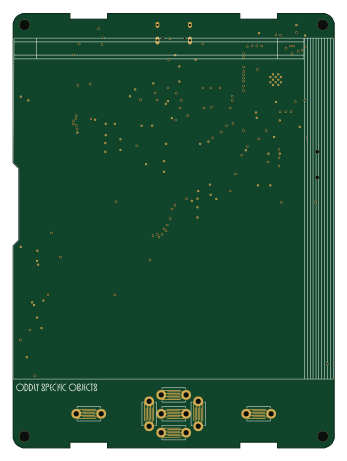 ESP32
ESP32Open Book Abridged Edition
joeycastillo
85 × 115 mm65 parts2LCC-BY-SA-4.08.1k ESP32
ESP32Badge
atopile
56.3 × 39 mm239 parts4LMIT4.0k ESP32
ESP32Esp32 minimal
36.2 × 26.8 mm20 parts2LMIT4.0k ESP32
ESP32Racer
StuckAtPrototype
36 × 50.2 mm70 parts4LApache-2.03.8k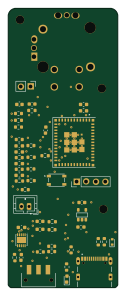 ESP32
ESP32Controller
29 × 74 mm58 parts4LApache-2.03.8k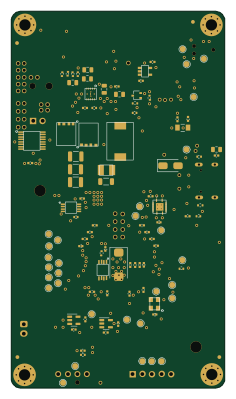 ESP32
ESP32Bitaxe
skot
56.5 × 99.8 mm86 parts4LCERN-OHL-S-2.01.4k