
ESP32 E-Reader

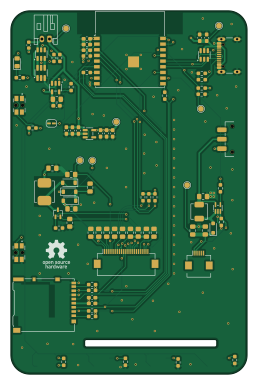
About the ESP32 E-Reader PCB
ESP32 E-Reader is an open source ESP32 PCB design by IS7V4N, published on GitHub. It is a 4-layer board measuring 62.5 × 96.2 mm, with 85 components from 47 distinct parts.
Its main chip is the ESP32-C3-WROOM-02, from the ESP32 family. Other key parts include the MCP73831-2-OT, USBLC6-2SC6, DW01A, ME6211C33M5 and TPS61169DCKR. By type, the board carries 32 capacitors, 27 resistors, 6 ICs, 6 switches, 5 diodes and 4 connectors.
It belongs with the displays & leds and power & battery designs in this gallery.
From the project
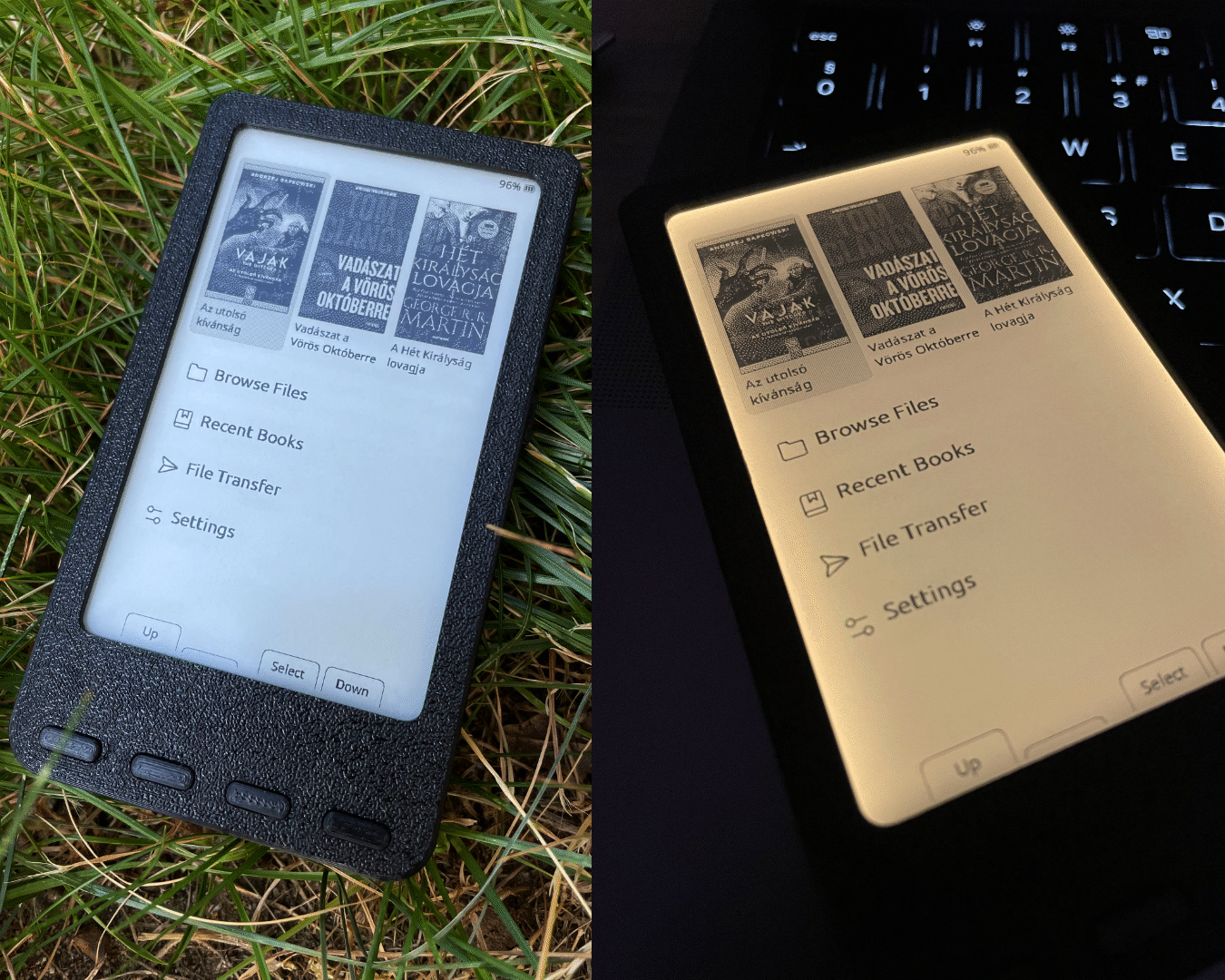
ESP32 based E-Ink reader
A custom-built e-ink reading device based on the ESP32-C3, designed for everyday use. Built around a 4.2" e-ink display with a frontlight for reading in the dark environment, running a modified version of the Crosspoint open-source firmware adapted for custom hardware. The goal was to build a capable, low-cost alternative to commercial e-readers with full control over both hardware and software.
Main components on the ESP32 E-Reader
ESP32 E-Reader bill of materials (BOM)
85 components, 47 distinct parts — part numbers from the project's BOM.
| Qty | Part | Footprint | Refs |
|---|---|---|---|
| 1 | MCP73831-2-OT | SOT-23-5 | U1 |
| 1 | USBLC6-2SC6 | SOT-23-6 | U2 |
| 1 | DW01A | SOT-23-6 | U3 |
| 1 | ESP32-C3-WROOM-02 | ESP32-C3-WROOM-02 | U4 |
| 1 | ME6211C33M5 | SOT-23-5 | U5 |
| 1 | TPS61169DCKR | SOT-353_SC-70-5 | U6 |
| 1 | FS8205A_DUAL_MOSFET | SOT-23-6_Handsoldering | Q1 |
| 1 | SI1308EDL Si1308EDL | SOT-323_SC-70 | Q2 |
| 1 | USB | USB_C_Receptacle_GCT_USB4105-xx-A_16P_TopMnt_Horizontal | J1 |
| 1 | E-INK_DISPLAY_CONNECTOR_01X24_SOCKET E-Ink_Display_connector_01x24_Socket | Mirrored_Hirose_FH12-24S-0.5SH_1x24-1MP_P0.50mm_Horizontal | J2 |
| 1 | EINK_FRONT_LIGHT_CONN_01X06_SOCKET EInk_Front_Light_Conn_01x06_Socket | XUNPU FPC-05FB-6PH20_1x06-1MP_P0.50mm_Horizontal | J3 |
| 1 | Micro_SD_Card | microSD_HC_Hirose_DM3AT-SF-PEJM5 | J4 |
| 1 | Batt | JST_PH_S2B-PH-K_1x02_P2.00mm_Horizontal | BT1 |
| 1 | EN_Push | SW_EVQ-P7C01P | S1 |
| 1 | Power | SW_EVQ-P7C01P | S2 |
| 1 | Back | SW_SKRPACE010 | SW2 |
| 1 | Confirm | SW_SKRPACE010 | SW3 |
| 1 | Left | SW_SKRPACE010 | SW4 |
| 1 | Right | SW_SKRPACE010 | SW6 |
| 1 | CHRG_STAT | LED_0805_2012Metric_Pad1.15x1.40mm_HandSolder | D1 |
Show 27 more
| Qty | Part | Footprint | Refs |
|---|---|---|---|
| 3 | MBR0530 | D_SOD-123 | D2, D3, D4 |
| 1 | NSR0240 | D_SOD-323_HandSoldering | D5 |
| 1 | 47UH 47uH | L_Panasonic_PCC-M0540M | L1 |
| 1 | 10UH 10uH | L_Changjiang_FXL0420 | L2 |
| 3 | 1UF 1uF | C_0603_1608Metric_Pad1.08x0.95mm_HandSolder | C1, C11, C13 |
| 6 | 100NF 100nF | C_0603_1608Metric_Pad1.08x0.95mm_HandSolder | C2, C4, C8, C9, C12, C30 |
| 10 | 4.7UF 4.7uF | C_0805_2012Metric_Pad1.18x1.45mm_HandSolder | C3, C15, C16, C17, C18, C22, C23, C26 +2 |
| 5 | 10UF 10uF | C_0603_1608Metric_Pad1.08x0.95mm_HandSolder | C5, C7, C10, C14, C24 |
| 1 | 10UF 10uF | C_0603_1608Metric | C6 |
| 1 | 10UF 10uF | C_0805_2012Metric_Pad1.18x1.45mm_HandSolder | C19 |
| 1 | 100NF 100nF | R_0805_2012Metric_Pad1.20x1.40mm_HandSolder | C20 |
| 3 | 1UF 1uF | C_0805_2012Metric_Pad1.18x1.45mm_HandSolder | C21, C25, C27 |
| 2 | 100NF 100nF | C_0805_2012Metric_Pad1.18x1.45mm_HandSolder | C31, C32 |
| 1 | 12K 12k | R_0603_1608Metric_Pad0.98x0.95mm_HandSolder | R1 |
| 1 | 5.6K 5.6k | R_0603_1608Metric_Pad0.98x0.95mm_HandSolder | R3 |
| 8 | 10K 10k | R_0603_1608Metric_Pad0.98x0.95mm_HandSolder | R4, R10, R11, R18, R19, R20, R21, R23 |
| 2 | 470R | R_0603_1608Metric_Pad0.98x0.95mm_HandSolder | R5, R14 |
| 1 | 2.2K 2.2k | R_0603_1608Metric_Pad0.98x0.95mm_HandSolder | R6 |
| 2 | 5.1K 5.1k | R_0603_1608Metric_Pad0.98x0.95mm_HandSolder | R7, R8 |
| 1 | 2.5K 2.5k | R_0603_1608Metric_Pad0.98x0.95mm_HandSolder | R9 |
| 4 | 100K 100k | R_0603_1608Metric_Pad0.98x0.95mm_HandSolder | R12, R13, R24, R25 |
| 1 | 2.7K 2.7k | R_0603_1608Metric_Pad0.98x0.95mm_HandSolder | R15 |
| 1 | 1M | R_0603_1608Metric_Pad0.98x0.95mm_HandSolder | R16 |
| 1 | 2.2R | R_0805_2012Metric_Pad1.20x1.40mm_HandSolder | R17 |
| 1 | 10R | R_0603_1608Metric_Pad0.98x0.95mm_HandSolder | R22 |
| 1 | 330R | R_0603_1608Metric_Pad0.98x0.95mm_HandSolder | R26 |
| 2 | 20R | R_0603_1608Metric_Pad0.98x0.95mm_HandSolder | R27, R28 |
ESP32 E-Reader design files
The KiCad project lives in the IS7V4N/ESP32_E-Reader repository on GitHub; these links point at the commit this page was built from.
ESP32 E-Reader: common questions
What microcontroller does the ESP32 E-Reader use?
The ESP32 E-Reader is built around the ESP32-C3-WROOM-02, from the ESP32 family.
How big is the ESP32 E-Reader PCB?
The ESP32 E-Reader measures 62.5 × 96.2 mm, has 4 copper layers and is 1.6062 mm thick.
How many components are on the ESP32 E-Reader?
85 components, from 47 distinct parts, with part numbers taken from the project's own BOM. The full bill of materials is listed on this page.
Where can I download the ESP32 E-Reader design files?
From the IS7V4N/ESP32_E-Reader repository on GitHub, which has the KiCad layout, the schematic and the BOM; the links under Design files point to each one.
Can I use the ESP32 E-Reader design in my own project?
The repository has no license, so all rights stay with IS7V4N. Use it as a reference, and ask the author before reusing the design.
Can I test firmware for the ESP32 E-Reader without the hardware?
Yes. HardLabs builds a simulation of the board from its netlist and BOM, so you can run and debug ESP32 firmware against it before you order a PCB.
Similar boards
 ESP32
ESP32Open Book Abridged Edition
joeycastillo
85 × 115 mm65 parts2LCC-BY-SA-4.08.1k ESP32
ESP32Esp32 minimal
atopile
36.2 × 26.8 mm20 parts2LMIT4.0k ESP32
ESP32Badge
56.3 × 39 mm239 parts4LMIT4.0k ESP32
ESP32Controller
StuckAtPrototype
29 × 74 mm58 parts4LApache-2.03.8k ESP32
ESP32Racer
36 × 50.2 mm70 parts4LApache-2.03.8k ESP32
ESP32Bitaxe
skot
56.5 × 99.8 mm86 parts4LCERN-OHL-S-2.01.4k