
T8-Sequencer

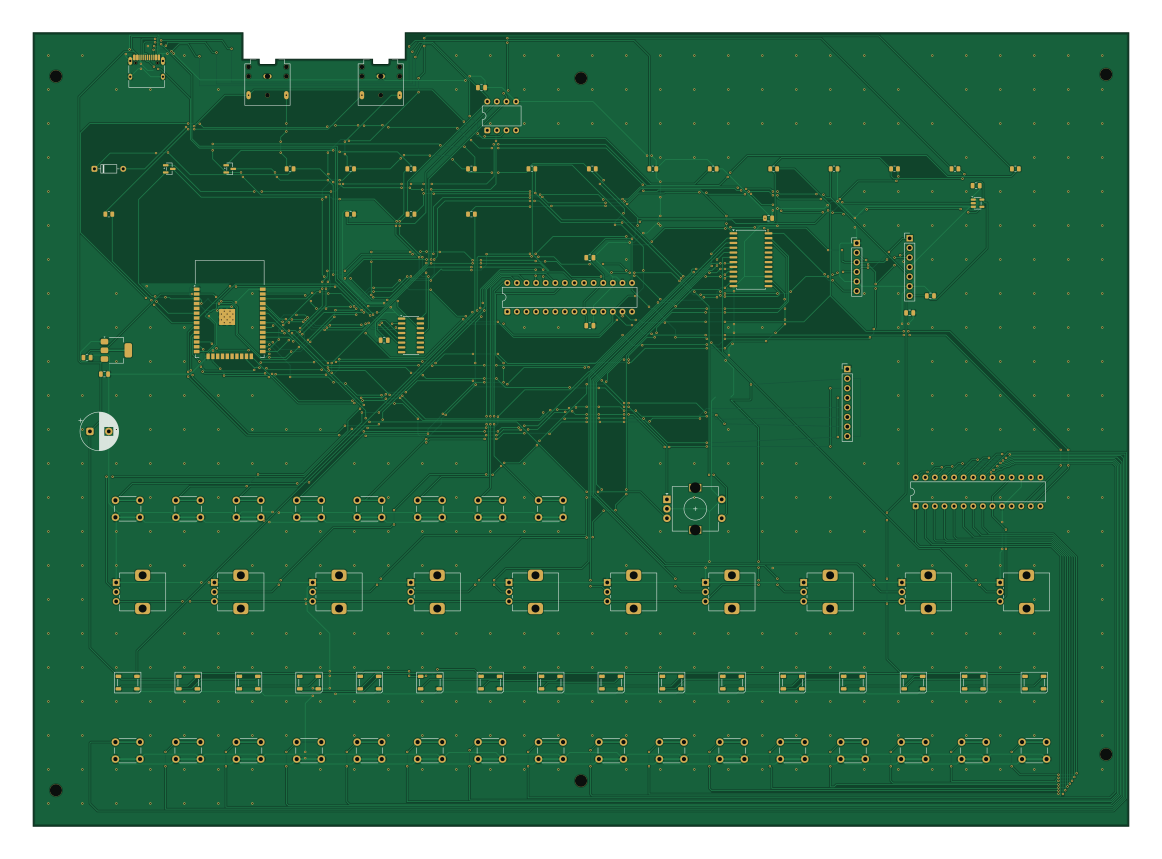
About the T8-Sequencer PCB
T8-Sequencer is an open source ESP32 PCB design by lluisestape-upc, published on GitHub under the MIT license. It is a 2-layer board measuring 290 × 210 mm, with 96 components from 40 distinct parts.
Its main chip is the ESP32-WROOM-32, from the ESP32 family. Other key parts include the ST7789 2.4in modulo, CD74HC4067M, AMS1117-3.3, CH340C and MCP23017x-x-SP. By type, the board carries 24 switches, 17 diodes, 17 resistors, 13 capacitors, 11 ICs and 2 transistors.
It belongs with the audio, displays & leds and usb & debug tools designs in this gallery.
From the project
16-step ESP32 groovebox: two-layer 290x210 mm KiCad board, DRC-clean and fabrication-ready, with the Python scripts that generated and repaired it
A 16-step hardware groovebox built around an ESP32-WROOM-32, designed from scratch in KiCad 10. Two copper layers, 290 × 210 mm, DRC-clean and fabrication-ready.
A desktop groovebox in the spirit of the Roland T-8: sixteen step buttons with per-step RGB feedback, ten pots for live parameter control, a rotary encoder for menu navigation, a 2.4" colour display, MIDI in and out over TRS-A, and two independent audio outputs — a line-level I²S DAC and a class-D amplifier for a small onboard speaker. The whole thing is powered and programmed over a single USB-C connector.
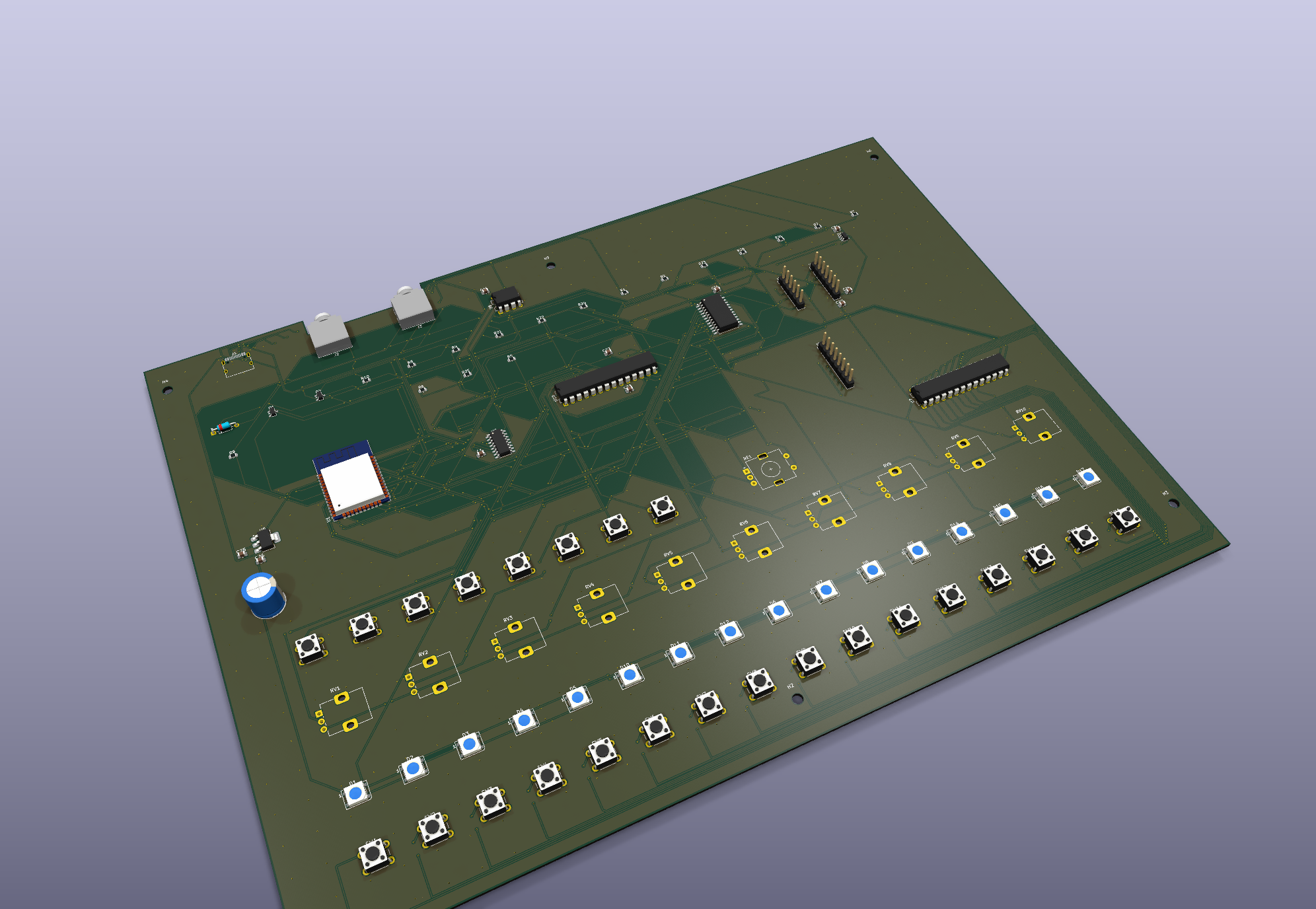
Main components on the T8-Sequencer
T8-Sequencer bill of materials (BOM)
96 components, 40 distinct parts.
| Qty | Part | Footprint | Refs |
|---|---|---|---|
| 1 | ESP32-WROOM-32 | ESP32-WROOM-32 | U1 |
| 1 | ~ | PinHeader_1x06_P2.54mm_Vertical | U2 |
| 1 | ST7789 2.4in modulo | PinHeader_1x08_P2.54mm_Vertical | U3 |
| 1 | CD74HC4067M | SOIC-24W_7.5x15.4mm_P1.27mm | U4 |
| 1 | AMS1117-3.3 | SOT-223-3_TabPin2 | U5 |
| 1 | CH340C | SOIC-16_3.9x9.9mm_P1.27mm | U6 |
| 1 | MCP23017x-x-SP | DIP-28_W7.62mm | U7 |
| 1 | 6N138 | DIP-8_W7.62mm | U8 |
| 1 | MAX98357A (modulo) | PinHeader_1x07_P2.54mm_Vertical | U9 |
| 1 | MCP23017 0x21 | DIP-28_W7.62mm | U10 |
| 1 | 74AHCT1G125 | SOT-23-5 | U11 |
| 2 | Q_NPN_BCE | SOT-23 | Q1, Q2 |
| 1 | USB_C_Receptacle_USB2.0_14P | USB_C_Receptacle_HRO_TYPE-C-31-M-12 | J1 |
| 1 | RotaryEncoder_Switch | RotaryEncoder_Alps_EC11E-Switch_Vertical_H20mm | RE1 |
| 10 | 10k | Potentiometer_Alps_RK09K_Single_Vertical | RV1, RV2, RV3, RV4, RV5, RV6, RV7, RV8 +2 |
| 16 | SW_Push | SW_PUSH_6mm | SW1, SW2, SW3, SW4, SW5, SW6, SW7, SW8 +8 |
| 1 | BTN_PLAY | SW_PUSH_6mm | SW17 |
| 1 | BTN_REC | SW_PUSH_6mm | SW18 |
| 1 | BTN_SHIFT | SW_PUSH_6mm | SW19 |
| 1 | BTN_PATT | SW_PUSH_6mm | SW20 |
Show 20 more
| Qty | Part | Footprint | Refs |
|---|---|---|---|
| 1 | BTN_TEMPO | SW_PUSH_6mm | SW21 |
| 1 | BTN_CLEAR | SW_PUSH_6mm | SW22 |
| 1 | BTN_F1 | SW_PUSH_6mm | SW23 |
| 1 | BTN_F2 | SW_PUSH_6mm | SW24 |
| 16 | WS2812B | LED_WS2812B_PLCC4_5.0x5.0mm_P3.2mm | D1, D2, D3, D4, D5, D6, D7, D8 +8 |
| 1 | 1N4148 | D_DO-35_SOD27_P7.62mm_Horizontal | D13 |
| 1 | C | C_0805_2012Metric | C1 |
| 1 | C_Polarized | CP_Radial_D10.0mm_P5.00mm | C2 |
| 8 | 100nF | C_0805_2012Metric | C20, C21, C22, C23, C24, C27, C29, C30 |
| 3 | 10µF | C_0805_2012Metric | C25, C26, C28 |
| 2 | 5.1kΩ | R_0805_2012Metric | R1, R2 |
| 5 | 10kΩ | R_0805_2012Metric | R3, R4, R20, R21, R22 |
| 1 | 470Ω | R_0805_2012Metric | R5 |
| 1 | 1kΩ | R_0805_2012Metric | R6 |
| 3 | 4.7kΩ | R_0805_2012Metric | R7, R23, R24 |
| 1 | 33Ω | R_0805_2012Metric | R8 |
| 1 | 10Ω | R_0805_2012Metric | R9 |
| 1 | 220 | R_0805_2012Metric | R10 |
| 1 | 10k | R_0805_2012Metric | R25 |
| 1 | 2.7k | R_0805_2012Metric | R26 |
T8-Sequencer design files
The KiCad project lives in the lluisestape-upc/T8-Sequencer repository on GitHub; these links point at the commit this page was built from.
- LayoutT8Sequencer.kicad_pcb
- SchematicT8Sequencer.kicad_sch
T8-Sequencer: common questions
What microcontroller does the T8-Sequencer use?
The T8-Sequencer is built around the ESP32-WROOM-32, from the ESP32 family.
How big is the T8-Sequencer PCB?
The T8-Sequencer measures 290 × 210 mm, has 2 copper layers and is 1.6 mm thick.
How many components are on the T8-Sequencer?
96 components, from 40 distinct parts. The full bill of materials is listed on this page.
Where can I download the T8-Sequencer design files?
From the lluisestape-upc/T8-Sequencer repository on GitHub, which has the KiCad layout and the schematic; the links under Design files point to each one.
Can I use the T8-Sequencer design in my own project?
Yes, under the terms of its MIT license, which lluisestape-upc chose for the repository.
Can I test firmware for the T8-Sequencer without the hardware?
Yes. HardLabs builds a simulation of the board from its netlist and BOM, so you can run and debug ESP32 firmware against it before you order a PCB.
Similar boards
 ESP32
ESP32Open Book Abridged Edition
joeycastillo
85 × 115 mm65 parts2LCC-BY-SA-4.08.1k ESP32
ESP32Esp32 minimal
atopile
36.2 × 26.8 mm20 parts2LMIT4.0k ESP32
ESP32Badge
56.3 × 39 mm239 parts4LMIT4.0k ESP32
ESP32Controller
StuckAtPrototype
29 × 74 mm58 parts4LApache-2.03.8k ESP32
ESP32Racer
36 × 50.2 mm70 parts4LApache-2.03.8k ESP32
ESP32Bitaxe
skot
56.5 × 99.8 mm86 parts4LCERN-OHL-S-2.01.4k