
Robot aio esp32 manuel solder 8 layer updated with 3.3 lineer

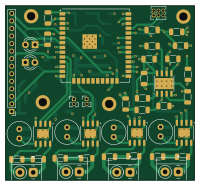
About the Robot aio esp32 manuel solder 8 layer updated with 3.3 lineer PCB
Robot aio esp32 manuel solder 8 layer updated with 3.3 lineer is an open source ESP32 PCB design by manyetox, published on GitHub under the CC-BY-NC-4.0 license. It is a 8-layer board measuring 50 × 46.2 mm, with 54 components from 26 distinct parts.
Its main chip is the ESP32-WROOM-32UE, from the ESP32 family. Other key parts include the AP7361C-33E and TPS56528DDA. By type, the board carries 28 capacitors, 15 resistors, 3 ICs, 2 connectors, 1 LED and 1 inductor.
It belongs with the robotics & motion and sensors designs in this gallery.
From the project
Source-available modular mobile carrier for autonomous photonics experiments using ESP32 control, optical flow, IMU sensing and magnetic wheel encoding.
This folder contains a pre-project ESP32 robot-controller design that influenced later embedded/motor-control work.
It is included only for design history and reusable engineering reference. It is not “Platform V0,” “Platform V1,” or a current photonics-carrier PCB.
Do not use its filename/versioning vocabulary when citing the autonomous-photonics carrier.
Main components on the Robot aio esp32 manuel solder 8 layer updated with 3.3 lineer
Robot aio esp32 manuel solder 8 layer updated with 3.3 lineer bill of materials (BOM)
54 components, 26 distinct parts — part numbers from the project's BOM.
| Qty | Part | Footprint | Refs |
|---|---|---|---|
| 1 | ESP32-WROOM-32UE | ESP32-WROOM-32UE | U1 |
| 1 | AP7361C-33E | SOT-223-3_TabPin2 | U2 |
| 1 | TPS56528DDA | Texas_HSOP-8-1EP_3.9x4.9mm_P1.27mm_ThermalVias | U3 |
| 1 | 5V | PinHeader_1x02_P1.27mm_Vertical | J4 |
| 1 | 3.3V | PinHeader_1x02_P1.27mm_Vertical | J8 |
| 4 | ~ | HSOP-8-1EP_3.9x4.9mm_P1.27mm_EP2.41x3.1mm_ThermalVias | DRV8231DSGR2, DRV8231DSGR3, DRV8231DSGR4, DRV8231DSGR5 |
| 1 | LED | LED_D3.0mm | Onboard1 |
| 1 | 100 Ω @ 100 MHz | L_1206_3216Metric | FB1 |
| 9 | 0.1u | C_1206_3216Metric | C1, C6, C12, C15, C17, C19, C25, C26 +1 |
| 5 | 10u | C_1206_3216Metric | C2, C3, C4, C10, C11 |
| 1 | 22p | C_1206_3216Metric | C5 |
| 3 | 22u | C_1206_3216Metric | C7, C8, C14 |
| 1 | 0.47u | C_1206_3216Metric | C9 |
| 1 | 1u | C_1206_3216Metric | C16 |
| 4 | 100u | C_Radial_D6.3mm_H5.0mm_P2.50mm | C18, C20, C27, C28 |
| 4 | 100n | C_1206_3216Metric | C23, C24, C31, C32 |
| 1 | 500k | R_0805_2012Metric_Pad1.20x1.40mm_HandSolder | R1 |
| 1 | 0 | R_1206_3216Metric | R2 |
| 3 | 1k | R_1206_3216Metric | R10, R12, R27 |
| 1 | 3k | R_1206_3216Metric | R11 |
Show 6 more
| Qty | Part | Footprint | Refs |
|---|---|---|---|
| 1 | 243K | R_1206_3216Metric | R13 |
| 1 | 33k | R_1206_3216Metric | R14 |
| 1 | 20k | R_1206_3216Metric | R16 |
| 4 | 47 | R_1206_3216Metric | R19, R20, R23, R24 |
| 1 | 300k | R_1206_3216Metric | R25 |
| 1 | 56k | R_1206_3216Metric | R26 |
Robot aio esp32 manuel solder 8 layer updated with 3.3 lineer design files
The KiCad project lives in the manyetox/Autonomous-Photonics-Carrier repository on GitHub; these links point at the commit this page was built from.
Robot aio esp32 manuel solder 8 layer updated with 3.3 lineer: common questions
What microcontroller does the Robot aio esp32 manuel solder 8 layer updated with 3.3 lineer use?
The Robot aio esp32 manuel solder 8 layer updated with 3.3 lineer is built around the ESP32-WROOM-32UE, from the ESP32 family.
How big is the Robot aio esp32 manuel solder 8 layer updated with 3.3 lineer PCB?
The Robot aio esp32 manuel solder 8 layer updated with 3.3 lineer measures 50 × 46.2 mm, has 8 copper layers and is 1.6 mm thick.
How many components are on the Robot aio esp32 manuel solder 8 layer updated with 3.3 lineer?
54 components, from 26 distinct parts, with part numbers taken from the project's own BOM. The full bill of materials is listed on this page.
Where can I download the Robot aio esp32 manuel solder 8 layer updated with 3.3 lineer design files?
From the manyetox/Autonomous-Photonics-Carrier repository on GitHub, which has the KiCad layout and the BOM; the links under Design files point to each one.
Can I use the Robot aio esp32 manuel solder 8 layer updated with 3.3 lineer design in my own project?
It is published under CC-BY-NC-4.0, which limits how it may be reused; read the license before building on it.
Can I test firmware for the Robot aio esp32 manuel solder 8 layer updated with 3.3 lineer without the hardware?
Yes. HardLabs builds a simulation of the board from its netlist and BOM, so you can run and debug ESP32 firmware against it before you order a PCB.
More boards in Autonomous-Photonics-Carrier
 ESP32
ESP32V1
50 × 50 mm178 parts8LCC-BY-NC-4.01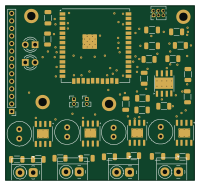 ESP32
ESP32Robot aio esp32 manuel solder 8 layer
50 × 46.2 mm54 parts8LCC-BY-NC-4.01
Motor drivers
25 × 27 mm25 parts4LCC-BY-NC-4.01 ESP32
ESP32V2-4 piece modular vertical
25 × 27.1 mm23 parts4LCC-BY-NC-4.01
Optical tracking sensor paw 3395
19.3 × 24 mm17 parts2LCC-BY-NC-4.01
Wheel-Encoder
20 × 16.8 mm5 parts2LCC-BY-NC-4.01
Similar boards
 ESP32
ESP32Open Book Abridged Edition
joeycastillo
85 × 115 mm65 parts2LCC-BY-SA-4.08.1k ESP32
ESP32Badge
atopile
56.3 × 39 mm239 parts4LMIT4.0k ESP32
ESP32Esp32 minimal
36.2 × 26.8 mm20 parts2LMIT4.0k ESP32
ESP32Racer
StuckAtPrototype
36 × 50.2 mm70 parts4LApache-2.03.8k ESP32
ESP32Controller
29 × 74 mm58 parts4LApache-2.03.8k ESP32
ESP32Bitaxe
skot
56.5 × 99.8 mm86 parts4LCERN-OHL-S-2.01.4k