
Hexa-Pi

About the Hexa-Pi PCB
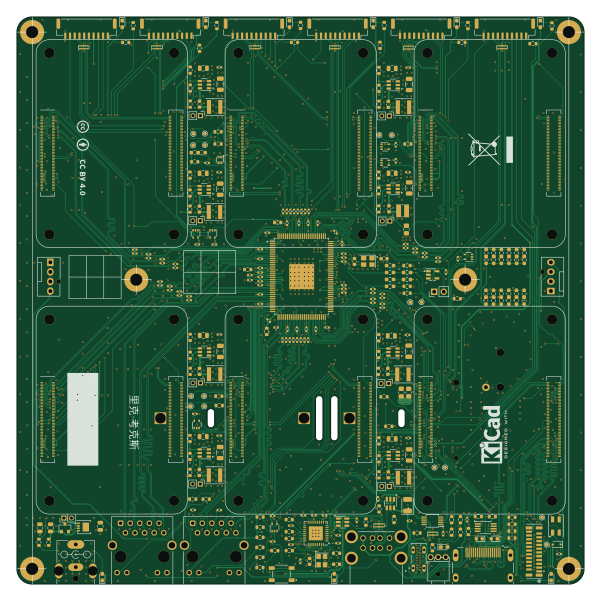
Hexa-Pi is an open source Raspberry Pi PCB design by rickcox, published on GitHub under the CC-BY-4.0 license. It is a 4-layer board measuring 150 × 150 mm, with 352 components from 75 distinct parts.
Its main chip is the ComputeModule4-CM4, from the Raspberry Pi family. Other key parts include the TPD4EUSB30, TPS564201, 74LVC1G07SE-7, TMP102XXDRL and AP62300TWU. By type, the board carries 145 capacitors, 114 resistors, 34 ICs, 19 connectors, 15 diodes and 12 inductors.
It belongs with the displays & leds designs in this gallery.
From the project
6 Compute Module Cluster
Here are some views of the PCB. More are available in the folder.
Dimensions of PCB . Note that the PCB is 1.6MM thick.
The PCB is intended to be mounted with the top and bottom edges exposed, since there are used connectors and LEDS there. Along the top edge are the 6 External Connectors, and 6 Activity LEDS - one for each Module.
Along the bottom - left to right are: - Power in - nominally 12V. This is a standard size 5.5X2.5MM DC Barrel jack - Center positive. This voltage is used directly for the fan, so a 12V fan is required. If the fan is not considered, the on board power regulators…
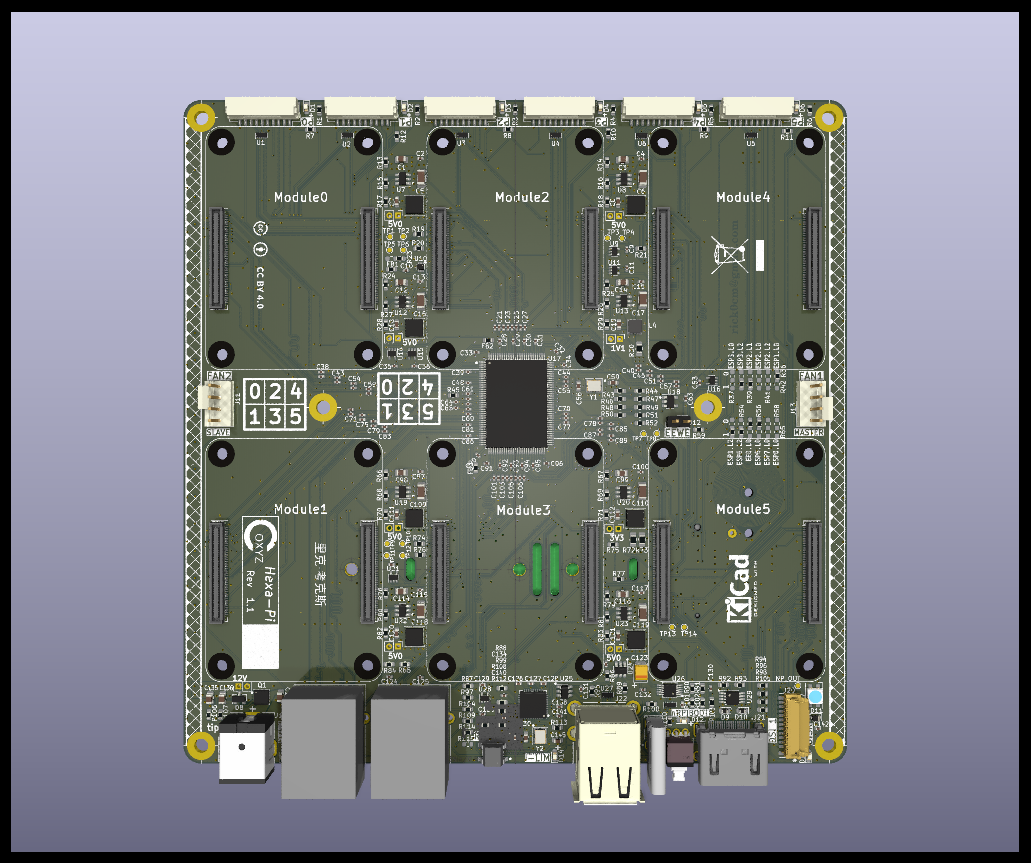
Main components on the Hexa-Pi
Hexa-Pi bill of materials (BOM)
352 components, 75 distinct parts — part numbers from the project's BOM.
| Qty | Part | Footprint | Refs |
|---|---|---|---|
| 8 | TPD4EUSB30 | USON-10_2.5x1.0mm_P0.5mm | U1, U2, U3, U4, U5, U6, U27, U31 |
| 6 | TPS564201 | TSOT-23-6w | U7, U8, U12, U19, U22, U23 |
| 7 | 74LVC1G07SE-7 | SOT-353_SC-70-5 | U9, U11, U14, U15, U16, U21, U28 |
| 1 | TMP102XXDRL TMP102xxDRL | SOT-563 | U10 |
| 2 | AP62300TWU | TSOT-23-6w | U13, U20 |
| 1 | RTL8370N | LQFP-128_14x20mm_P0.5mm_1 | U17 |
| 1 | C232867 24C04-I2C-EEPROM (512X8) | SOT-23-5 | U18 |
| 2 | AP22653W6-7 | SOT-23-6 | U24, U25 |
| 1 | FSUSB42MUX | MSOP-10_3x3mm_P0.5mm | U26 |
| 1 | EMC2301 | MSOP-8_3x3mm_P0.65mm | U29 |
| 1 | USB2514B-AEZC | QFN-36-1EP_6x6mm_P0.5mm_EP3.7x3.7mm | U30 |
| 1 | TK-6580B-1 | SW-TH_TK-6580B-1 | U32 |
| 2 | ABRACON_ARJM11B1-502-AB Abracon_ARJM11B1-502-AB | ARJM11B1-502-AB | U33, U34 |
| 1 | DMP3013SFV-7 | Diodes_PowerDI3333-8 | Q1 |
| 1 | 25MHZ | Crystal_SMD_3225-4Pin_3.2x2.5mm | Y1 |
| 1 | 24MHZ | Crystal_SMD_3225-4Pin_3.2x2.5mm | Y2 |
| 6 | CONN_01X10 Conn_01x10 | JST_GH_SM10B-GHS-TB_1x10-1MP_P1.25mm_Horizontal | J1, J2, J3, J4, J5, J6 |
| 3 | Conn_01x02 | PinHeader_1x02_P2.00mm_Vertical | J10, J15, J18 |
| 2 | C240840 Molex Fan Header | FanPinHeader_1x04_P2.54mm_Vertical | J11, J13 |
| 1 | C7501580 EEWE | PinHeader_1x02_P2.54mm_Vertical | J12 |
Show 55 more
| Qty | Part | Footprint | Refs |
|---|---|---|---|
| 1 | NA Barrel_Jack_HC | CUI_PJ-063AH | J19 |
| 1 | CONN_01X22_FEMALE Conn_01x22_Female | Hirose_FH12-22S-0.5SV55_P0.5mm_Vertical | J20 |
| 1 | HDMI_A_1.4 | EDAC 690-019-298-412 | J21 |
| 1 | UJ2-ADH-1-TH | MOLEX_USB_67298-4090 | J22 |
| 1 | 216989-0001 | Molex-216989-0001-MFG | J23 |
| 1 | SM3ZS067U310AMR1200 | JAE_SM3ZS067U310AMR1200 | J24 |
| 1 | C428492 Micro_SD_Card_Det | SDCARD_MOLEX_503398-1892 | J25 |
| 1 | M.2 2280 Mount | M.2_Standoff | H7 |
| 1 | M.2 2242 Mount | M.2_Standoff | H8 |
| 1 | M.2 2230 Mount | M.2_Standoff | H9 |
| 6 | ComputeModule4-CM4 | Raspberry-Pi-4-Compute-Module | Module0, Module1, Module2, Module3, Module4, Module5 |
| 1 | PUSHBUTTON-PTS647SM38SMTR2LFS pushButton-PTS647SM38SMTR2LFS | pushButton-PTS647SM38SMTR2LFS | SW1 |
| 6 | C965805 LED_GREEN | LED_0603_1608Metric_Pad1.05x0.95mm_HandSolder | D1, D2, D3, D4, D5, D6 |
| 1 | WS8212B-MINI | LED_SK6812MINI_PLCC4_3.5x3.5mm_P1.75mm | D7 |
| 1 | MMBZ5242BLT3G | D_SOT-23_ANK | D8 |
| 2 | BESDU0603-05 | D_0603_1608Metric | D9, D10 |
| 1 | 1N5819 | D_SOD-323 | D11 |
| 1 | C2290 LED_WHITE | LED_0603_1608Metric_Pad1.05x0.95mm_HandSolder | D12 |
| 1 | C2286 LED_RED | LED_0603_1608Metric_Pad1.05x0.95mm_HandSolder | D13 |
| 1 | C72038 LED_YELLOW | LED_0603_1608Metric_Pad1.05x0.95mm_HandSolder | D14 |
| 1 | C19171394 LED_BLUE | LED_0603_1608Metric_Pad1.05x0.95mm_HandSolder | D15 |
| 3 | C1002 FerriteBead_Small | R_0603_1608Metric | FB1, FB2, FB3 |
| 7 | 4020-3R3 | L_Changjiang_FNR4012S | L1, L2, L3, L6, L7, L8, L9 |
| 1 | 3012-1R5 | L_Wuerth_MAPI-3012 | L4 |
| 1 | L PCB | COIL_24T16MM | L5 |
| 9 | C440198 10u 25V | C_0805_2012Metric | C1, C3, C12, C14, C98, C99, C114, C116 +1 |
| 108 | 100N 100n | C_0402_1005Metric | C2, C4, C9, C10, C11, C13, C15, C20 +100 |
| 8 | C96123 47u 10V | C_1206_3216Metric | C5, C6, C16, C17, C109, C110, C118, C119 |
| 8 | 100N 100n | C_0603_1608Metric | C7, C8, C18, C19, C111, C112, C120, C121 |
| 5 | 10U 10u | C_0402_1005Metric | C32, C90, C127, C131, C143 |
| 2 | 12P 12p | C_0603_1608Metric | C50, C56 |
| 1 | 100U 100u | CP_EIA-3528-21_Kemet-B | C123 |
| 2 | C28233 100n 100v | C_0805_2012Metric | C133, C136 |
| 2 | 20P 20p | C_0603_1608Metric | C144, C145 |
| 16 | 1K2 | R_0603_1608Metric | R1, R2, R3, R4, R5, R6, R19, R20 +8 |
| 14 | 10K | R_0603_1608Metric | R7, R8, R9, R10, R11, R12, R13, R14 +6 |
| 6 | 56K2 | R_0603_1608Metric | R15, R16, R27, R68, R80, R81 |
| 10 | 22K | R_0603_1608Metric | R17, R18, R28, R29, R70, R71, R82, R83 +2 |
| 1 | 0R | R_0603_1608Metric_Pad0.98x0.95mm_HandSolder | R22 |
| 7 | C21189 0R | R_0603_1608Metric_Pad0.98x0.95mm_HandSolder | R23, R43, R46, R47, R48, R49, R50 |
| 1 | 4K5 | R_0603_1608Metric | R26 |
| 3 | C1882631 0R HC | R_0805_2012Metric_Pad1.20x1.40mm_HandSolder | R30, R72, R73 |
| 17 | 4K7 DNP | R_0603_1608Metric_Pad0.98x0.95mm_HandSolder | R31, R32, R33, R34, R35, R37, R40, R41 +9 |
| 7 | 4K7 | R_0603_1608Metric_Pad0.98x0.95mm_HandSolder | R36, R38, R39, R55, R56, R60, R61 |
| 4 | 4K7 | R_0603_1608Metric | R44, R51, R98, R105 |
| 1 | 2K49 | R_0603_1608Metric | R45 |
| 1 | 34K | R_0603_1608Metric | R69 |
| 1 | C25197 5R | R_0603_1608Metric | R75 |
| 8 | 39K | R_0603_1608Metric | R77, R88, R89, R95, R99, R103, R108, R112 |
| 4 | 470R | R_0603_1608Metric | R84, R85, R109, R114 |
| 3 | 12K | R_0603_1608Metric | R86, R107, R113 |
| 2 | 2K2 | R_0603_1608Metric | R90, R101 |
| 3 | 510K | R_0603_1608Metric | R91, R97, R104 |
| 2 | C21189 0R | R_0603_1608Metric | R92, R93 |
| 3 | 5K1 | R_0603_1608Metric | R100, R102, R106 |
Hexa-Pi design files
The KiCad project lives in the rickcox/Hexa-Pi repository on GitHub; these links point at the commit this page was built from.
Hexa-Pi: common questions
What microcontroller does the Hexa-Pi use?
The Hexa-Pi is built around the ComputeModule4-CM4, from the Raspberry Pi family.
How big is the Hexa-Pi PCB?
The Hexa-Pi measures 150 × 150 mm, has 4 copper layers and is 1.6 mm thick.
How many components are on the Hexa-Pi?
352 components, from 75 distinct parts, with part numbers taken from the project's own BOM. The full bill of materials is listed on this page.
Where can I download the Hexa-Pi design files?
From the rickcox/Hexa-Pi repository on GitHub, which has the KiCad layout, the schematic and the BOM; the links under Design files point to each one.
Can I use the Hexa-Pi design in my own project?
Yes, under the terms of its CC-BY-4.0 license, which rickcox chose for the repository.
Can I test firmware for the Hexa-Pi without the hardware?
Yes. HardLabs builds a simulation of the board from its netlist and BOM, so you can run and debug Raspberry Pi firmware against it before you order a PCB.
More boards in Hexa-Pi
Similar boards
 Raspberry Pi
Open source rover
nasa-jpl
220 × 178 mm144 parts2LApache-2.09.7k Raspberry Pi
SPIRIT
SPIRIT-org
82 × 155 mm130 parts6LCERN-OHL-S-2.01.3k Raspberry Pi
CM5RevEng
schlae
55 × 40 mm417 parts10LNo license1.0k Raspberry Pi
Haxo hw
cardonabits
102.4 × 211.3 mm38 parts2LCustom license672 Raspberry Pi
PowerBook
BlueSCSI
74.5 × 56.3 mm78 parts2LGPL-3.0449 Raspberry Pi
Desktop 50 Pin TopConn
89.2 × 82.6 mm103 parts2LGPL-3.0449