
ESP32-IoT-Development-Board

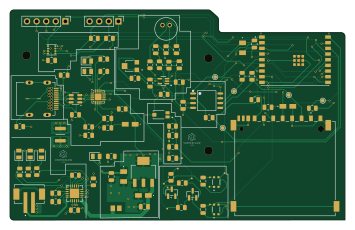
About the ESP32-IoT-Development-Board
ESP32-IoT-Development-Board is an open source ESP32 PCB design by riteshsalikeripatil, published on GitHub under the MIT license. It is a 4-layer board measuring 88.7 × 55.6 mm, with 85 components from 43 distinct parts.
Its main chip is the ESP32-C3-WROOM-02-H4, from the ESP32 family. Other key parts include the MCP73871-4CCI/ML, LM1117MPX-3.3/NOPB, CP2102N-A02-GQFN20, USBLC6-2SC6 and W25Q32JVSSIQ. By type, the board carries 33 resistors, 25 capacitors, 8 ICs, 6 diodes, 5 connectors and 3 transistors.
It belongs with the iot & wireless, dev boards & breakouts and power & battery designs in this gallery.
From the project
Custom ESP32 IoT Development Board designed in KiCad.
This repository contains the complete hardware design of a custom ESP32-C3 Multi-Purpose Development Board developed using KiCad 9.
The board integrates USB Type-C connectivity, LiPo battery charging, MicroSD storage, environmental sensing, microphone input, external flash memory, and GPIO expansion into a compact 4-layer PCB suitable for embedded systems, IoT applications, and rapid prototyping.
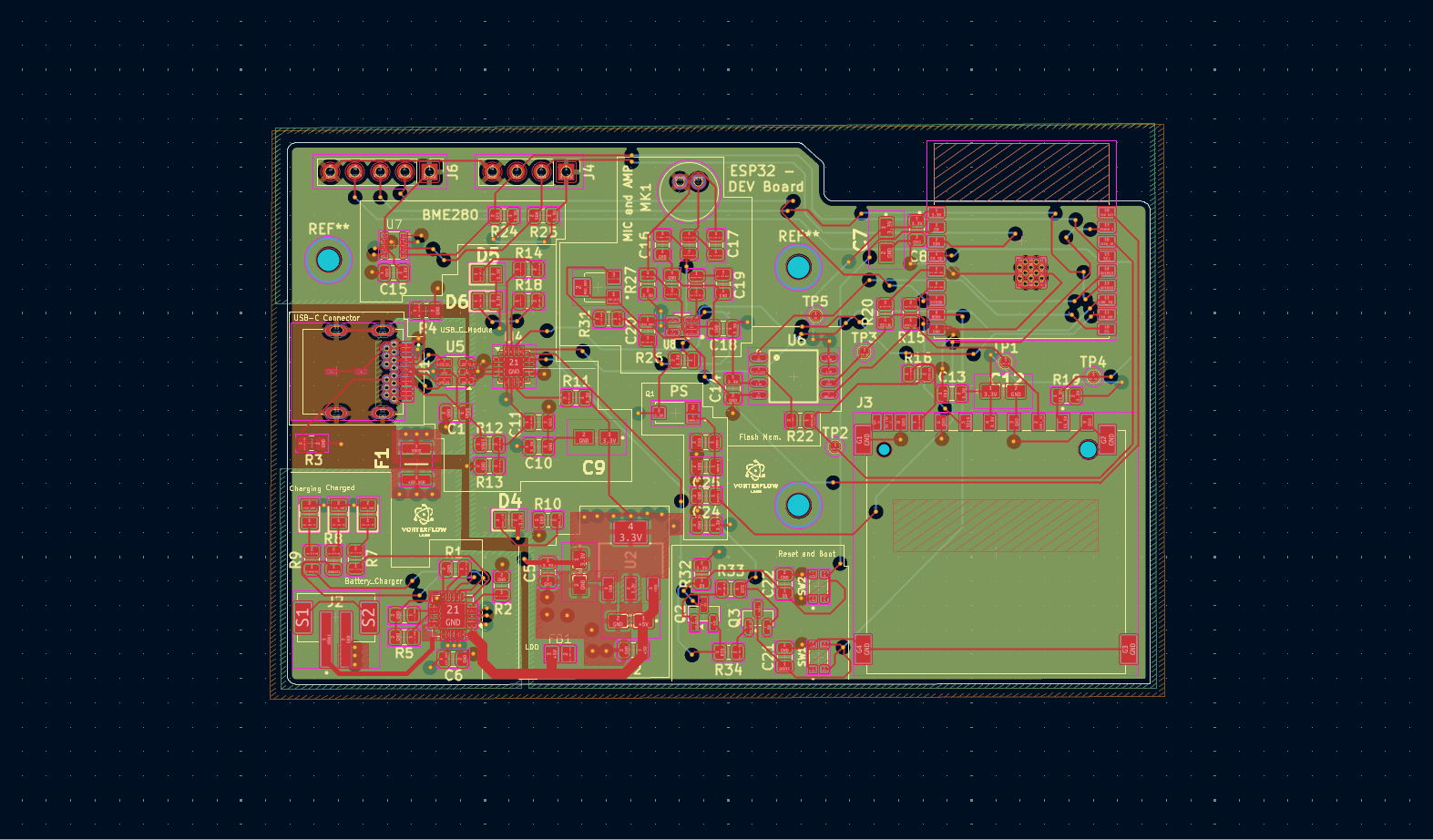
Main components on the ESP32-IoT-Development-Board
ESP32-IoT-Development-Board bill of materials (BOM)
85 components, 43 distinct parts.
| Qty | Part | Footprint | Refs |
|---|---|---|---|
| 1 | MCP73871-4CCI/ML MCP73871 | QFN-20-1EP_4x4mm_P0.5mm_EP2.5x2.5mm | U1 |
| 1 | LM1117MPX-3.3/NOPB LM1117MPX-3.3_NOPB | VREG_LM1117MPX-3.3 | U2 |
| 1 | ESP32-C3-WROOM-02-H4 | MODULE_ESP32-C3-WROOM-02-H4 | U3 |
| 1 | CP2102N-A02-GQFN20 | SiliconLabs_QFN-20-1EP_3x3mm_P0.5mm_EP1.8x1.8mm | U4 |
| 1 | USBLC6-2SC6 | SOT-23-6 | U5 |
| 1 | W25Q32JVSSIQ | SOIC127P790X216-8N | U6 |
| 1 | BME280 | PSON65P250X250X100-8N | U7 |
| 1 | MAX4466EXK+T | SOT65P210X110-5N | U8 |
| 1 | TEMT6000X01 | TRANS_TEMT6000X01 | Q1 |
| 2 | BC817 | SOT-23 | Q2, Q3 |
| 1 | USB_C_Receptacle | BELFUSE_SS-52400-002 | J1 |
| 1 | ? JST_2mm_LiPo | JST_B2B-PH-SM4-TB | J2 |
| 1 | GSD090012SEU | AMPHENOL_GSD090012SEU | J3 |
| 1 | B4B-XH-AM | PinHeader_1x04_P2.54mm_Vertical | J4 |
| 1 | Conn_01x05 | PinHeader_1x05_P2.54mm_Vertical | J6 |
| 1 | 0ZCH0110AF2E | FUSC3226X100N | F1 |
| 1 | CMC-5042PF-AC | CUI_CMC-5042PF-AC | MK1 |
| 2 | 1101NE | SW_USLPT2819DT2TR | SW1, SW2 |
| 3 | LTST-C170KRKT Red | LEDC2012X120N | D1, D4, D6 |
| 2 | LTST-C170GKT Green | LEDC2012X120N | D2, D5 |
Show 23 more
| Qty | Part | Footprint | Refs |
|---|---|---|---|
| 1 | LTST-C170TBKT Blue | LEDC2012X120N | D3 |
| 1 | FBMJ2125HM330-T | BEADC2012X105N | FB1 |
| 12 | 0.1u | C_0805_2012Metric | C1, C2, C5, C8, C10, C13, C14, C15 +4 |
| 4 | T491A106K010AT7280 10u | T491A | C3, C4, C7, C12 |
| 3 | 1u | C_0805_2012Metric | C6, C11, C22 |
| 1 | T491A106K010AT7280 4.7u | T491A | C9 |
| 3 | 10n | C_0805_2012Metric | C17, C24, C25 |
| 1 | 10u | C_0805_2012Metric | C19 |
| 1 | 100p | C_0805_2012Metric | C20 |
| 7 | 10K | R_0805_2012Metric | R1, R2, R19, R23, R32, R33, R34 |
| 2 | 5k1 | R_0805_2012Metric | R3, R4 |
| 3 | 2K | R_0805_2012Metric | R5, R26, R28 |
| 1 | 20K | R_0805_2012Metric | R6 |
| 3 | 470 | R_0805_2012Metric | R7, R8, R9 |
| 3 | 330 | R_0805_2012Metric | R10, R14, R18 |
| 2 | 1K | R_0805_2012Metric | R11, R30 |
| 1 | 22K1 | R_0805_2012Metric | R12 |
| 1 | 47K5 | R_0805_2012Metric | R13 |
| 4 | 50 | R_0805_2012Metric | R15, R16, R20, R22 |
| 1 | 35WR100KLFTR | TRIM_35WR100KLFTR | R17 |
| 2 | 4K7 | R_0805_2012Metric | R24, R25 |
| 2 | 1M | R_0805_2012Metric | R27, R29 |
| 1 | 22K | R_0805_2012Metric | R31 |
ESP32-IoT-Development-Board design files
The KiCad project lives in the riteshsalikeripatil/ESP32-IoT-Development-Board repository on GitHub; these links point at the commit this page was built from.
ESP32-IoT-Development-Board: common questions
What microcontroller does the ESP32-IoT-Development-Board use?
The ESP32-IoT-Development-Board is built around the ESP32-C3-WROOM-02-H4, from the ESP32 family.
How big is the ESP32-IoT-Development-Board?
The ESP32-IoT-Development-Board measures 88.7 × 55.6 mm, has 4 copper layers and is 1.6 mm thick.
How many components are on the ESP32-IoT-Development-Board?
85 components, from 43 distinct parts. The full bill of materials is listed on this page.
Where can I download the ESP32-IoT-Development-Board design files?
From the riteshsalikeripatil/ESP32-IoT-Development-Board repository on GitHub, which has the KiCad layout and the schematic; the links under Design files point to each one.
Can I use the ESP32-IoT-Development-Board design in my own project?
Yes, under the terms of its MIT license, which riteshsalikeripatil chose for the repository.
Can I test firmware for the ESP32-IoT-Development-Board without the hardware?
Yes. HardLabs builds a simulation of the board from its netlist and BOM, so you can run and debug ESP32 firmware against it before you order a PCB.
Similar boards
 ESP32
ESP32Open Book Abridged Edition
joeycastillo
85 × 115 mm65 parts2LCC-BY-SA-4.08.1k ESP32
ESP32Badge
atopile
56.3 × 39 mm239 parts4LMIT4.0k ESP32
ESP32Esp32 minimal
36.2 × 26.8 mm20 parts2LMIT4.0k ESP32
ESP32Racer
StuckAtPrototype
36 × 50.2 mm70 parts4LApache-2.03.8k ESP32
ESP32Controller
29 × 74 mm58 parts4LApache-2.03.8k ESP32
ESP32Bitaxe
skot
56.5 × 99.8 mm86 parts4LCERN-OHL-S-2.01.4k