
Sunrise clock main board

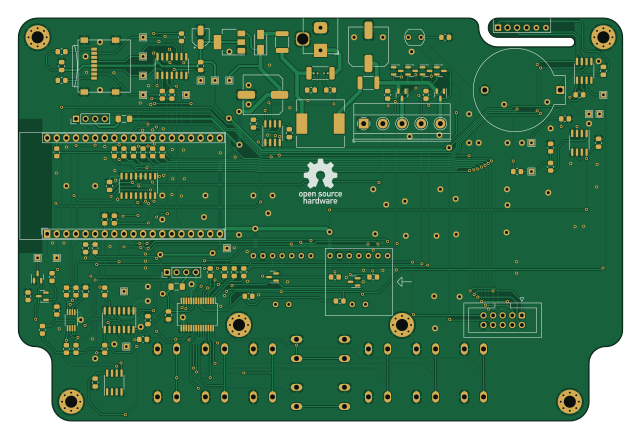
About the Sunrise clock main board
Sunrise clock main board is an open source ESP32 PCB design by atoomnetmarc, published on GitHub under the Apache-2.0 license. It is a 2-layer board measuring 160 × 106.7 mm, with 124 components from 45 distinct parts.
Its main chip is the ESP32-DevKitC, from the ESP32 family. Other key parts include the NCP1117LPST33T3G, MAX809S, LM358DR, DS3231MZ and AT24C512C-SSHD. By type, the board carries 46 resistors, 18 test points, 15 capacitors, 11 ICs, 8 switches and 6 diodes.
It belongs with the audio, displays & leds and sensors designs in this gallery.
From the project
Sunrise clock tries to gently wake the user from its sleep.
:ballotboxwithcheck: SD card auto disconnect when programming via USB\ :ballotboxwithcheck: SD card, 1-bit SDIO\ :ballotboxwithcheck: SD card, HSPI\ :ballotboxwithcheck: RTC battery voltage follower opamp\ :ballotboxwithcheck: 3.3V I2C\ :ballotboxwithcheck: 5V I2C\ :ballotboxwithcheck: INA219 current/power measuring\ :ballotboxwithcheck: AT24C512C EEPROM\ :ballotboxwithcheck: DS3231MZ mems RTC\ :ballotboxwithcheck: BME280 sensor\ :ballotboxwithcheck: MCP23017 I/O expander\ :ballotboxwithcheck: LDR\ :ballotboxwithcheck: LCD displays\ :ballotboxwithcheck: Neopixel\ :ballotboxwithcheck: Polyfuse…
Main components on the Sunrise clock main board
Sunrise clock main board bill of materials (BOM)
124 components, 45 distinct parts.
| Qty | Part | Footprint | Refs |
|---|---|---|---|
| 1 | NCP1117LPST33T3G | SOT-223-3_TabPin2 | U1 |
| 1 | MAX809S | SOT-23 | U2 |
| 1 | LM358DR | SOIC-8_3.9x4.9mm_P1.27mm | U3 |
| 1 | DS3231MZ | SOIC-8_3.9x4.9mm_P1.27mm | U4 |
| 1 | AT24C512C-SSHD | SOIC-8_3.9x4.9mm_P1.27mm | U5 |
| 1 | PCA9306DCTR | MSOP-8_3x3mm_P0.65mm | U6 |
| 1 | 74AHCT125D | SO-14_3.9x8.65mm_P1.27mm | U7 |
| 1 | 74HC4066D | SO-14_3.9x8.65mm_P1.27mm | U8 |
| 1 | MCP23017_SP | SSOP-28_5.3x10.2mm_P0.65mm | U9 |
| 1 | 74HC138D | SO-16_3.9x9.9mm_P1.27mm | U10 |
| 1 | INA219AxD | SOIC-8_3.9x4.9mm_P1.27mm | U11 |
| 1 | ESP32-DevKitC | ESP32-DevKitC | A1 |
| 2 | max98357 | max98357 | A3, A4 |
| 1 | BME280 module 3V | bme280_3V | A5 |
| 2 | IRML2244 | SOT-23 | Q1, Q2 |
| 2 | 2N7002 | SOT-23 | Q3, Q4 |
| 1 | Barrel_Jack_Switch | BarrelJack_Horizontal | J1 |
| 1 | Screw terminal/dnf | TerminalBlock_Phoenix_MKDS-1,5-5-5.08_1x05_P5.08mm_Horizontal | J3 |
| 1 | Conn_02x05_Odd_Even | IDC-Header_2x05_P2.54mm_Vertical | J4 |
| 2 | Conn_01x04_Male | PinHeader_1x04_P2.54mm_Vertical | J5, J6 |
Show 25 more
| Qty | Part | Footprint | Refs |
|---|---|---|---|
| 1 | CR2032 | BatteryHolder-cr2032 | BT1 |
| 2 | Polyfuse 1.5A >=6V | Fuse_1812_4532Metric_Pad1.30x3.40mm_HandSolder | F1, F2 |
| 2 | Polyfuse 250mA >=6V | Fuse_1206_3216Metric_Pad1.42x1.75mm_HandSolder | F3, F4 |
| 1 | Micro_SD_Card | microSD_HC_Wuerth_693072010801 | SD1 |
| 8 | SW_Push | SW_PUSH-12mm | SW1, SW2, SW3, SW4, SW5, SW6, SW7, SW8 |
| 18 | TestPoint | TestPoint_THTPad_1.5x1.5mm_Drill0.7mm | TP1, TP3, TP4, TP6, TP7, TP8, TP9, TP10 +10 |
| 1 | SS34 | D_SMA | D1 |
| 5 | BAV99 | SOT-23 | D2, D3, D4, D5, D6 |
| 1 | 22uH 3A | L_12x12mm_H8mm | L1 |
| 1 | 100pF 16V X7R | C_0805_2012Metric_Pad1.18x1.45mm_HandSolder | C1 |
| 2 | 470uF/16V | C_Elec_10x10.2 | C3, C4 |
| 1 | 1uF | C_0805_2012Metric_Pad1.18x1.45mm_HandSolder | C5 |
| 1 | 10uF | C_0805_2012Metric_Pad1.18x1.45mm_HandSolder | C6 |
| 9 | 100nF | C_0805_2012Metric_Pad1.18x1.45mm_HandSolder | C10, C11, C12, C13, C14, C15, C16, C17 +1 |
| 1 | 33uF/6.3V | CP_Elec_4x5.4 | C33 |
| 1 | 0R05 | R_2512_6332Metric_Pad1.40x3.35mm_HandSolder | R1 |
| 14 | 100R | R_0805_2012Metric_Pad1.20x1.40mm_HandSolder | R2, R3, R4, R5, R6, R7, R8, R9 +6 |
| 2 | 10R | R_0805_2012Metric_Pad1.20x1.40mm_HandSolder | R16, R17 |
| 6 | 4k7 | R_0805_2012Metric_Pad1.20x1.40mm_HandSolder | R30, R31, R32, R33, R34, R36 |
| 8 | 10k | R_0805_2012Metric_Pad1.20x1.40mm_HandSolder | R40, R41, R42, R43, R44, R45, R46, R47 |
| 11 | 100k | R_0805_2012Metric_Pad1.20x1.40mm_HandSolder | R60, R61, R62, R63, R64, R65, R66, R67 +3 |
| 1 | 200k | R_0805_2012Metric_Pad1.20x1.40mm_HandSolder | R78 |
| 1 | 560k | R_0805_2012Metric_Pad1.20x1.40mm_HandSolder | R79 |
| 1 | 10M | R_0805_2012Metric_Pad1.20x1.40mm_HandSolder | R80 |
| 1 | LDR GL5528 | R_LDR_5.1x4.3mm_P3.4mm_Vertical | R90 |
Sunrise clock main board design files
The KiCad project lives in the atoomnetmarc/Sunrise-clock repository on GitHub; these links point at the commit this page was built from.
Sunrise clock main board: common questions
What microcontroller does the Sunrise clock main board use?
The Sunrise clock main board is built around the ESP32-DevKitC, from the ESP32 family.
How big is the Sunrise clock main board?
The Sunrise clock main board measures 160 × 106.7 mm, has 2 copper layers and is 1.6 mm thick.
How many components are on the Sunrise clock main board?
124 components, from 45 distinct parts. The full bill of materials is listed on this page.
Where can I download the Sunrise clock main board design files?
From the atoomnetmarc/Sunrise-clock repository on GitHub, which has the KiCad layout and the schematic; the links under Design files point to each one.
Can I use the Sunrise clock main board design in my own project?
Yes, under the terms of its Apache-2.0 license, which atoomnetmarc chose for the repository.
Can I test firmware for the Sunrise clock main board without the hardware?
Yes. HardLabs builds a simulation of the board from its netlist and BOM, so you can run and debug ESP32 firmware against it before you order a PCB.
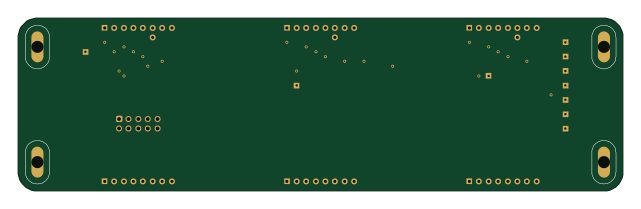
More boards in Sunrise-clock
Similar boards
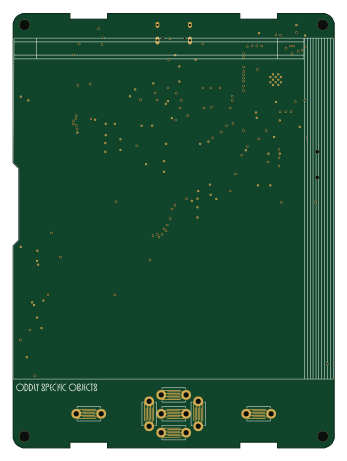 ESP32
ESP32Open Book Abridged Edition
joeycastillo
85 × 115 mm65 parts2LCC-BY-SA-4.08.1k ESP32
ESP32Esp32 minimal
atopile
36.2 × 26.8 mm20 parts2LMIT4.0k ESP32
ESP32Badge
56.3 × 39 mm239 parts4LMIT4.0k ESP32
ESP32Controller
StuckAtPrototype
29 × 74 mm58 parts4LApache-2.03.8k ESP32
ESP32Racer
36 × 50.2 mm70 parts4LApache-2.03.8k ESP32
ESP32Bitaxe
skot
56.5 × 99.8 mm86 parts4LCERN-OHL-S-2.01.4k