
ESP-32 Based Avionics Telemetry Board

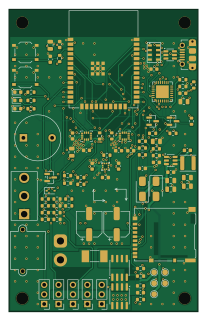
About the ESP-32 Based Avionics Telemetry Board
ESP-32 Based Avionics Telemetry Board is an open source ESP32 PCB design by devjamescollier, published on GitHub under the CERN-OHL-P-2.0 license. It is a 4-layer board measuring 50 × 80 mm, with 95 components from 38 distinct parts.
Its main chip is the ESP32-WROOM-32E-N4, from the ESP32 family. Other key parts include the ASM330LHHTR, LSM6DSV32XTR, MS5611-01BA03, LIS3MDLTR and CP2102N-A02-GQFN28. By type, the board carries 36 resistors, 26 capacitors, 8 ICs, 8 connectors, 6 diodes and 5 transistors.
It belongs with the robotics & motion, power & battery and sensors designs in this gallery.
From the project
2S Li-Po flight computer built around an ESP32-WROOM-32E module. Fuses two IMUs, a magnetometer, and a barometer, logs flight data to microSD, and drives four servos and one ESC from a fused, reverse-polarity-protected battery input with a switched servo rail.
2S Li-Po flight computer built around an ESP32-WROOM-32E module. Fuses two IMUs, a magnetometer, and a barometer, logs flight data to microSD, and drives four servos and one ESC from a fused, reverse-polarity-protected battery input with a switched servo rail.
Designed for small fixed-wing aircraft with USB programming, multiple test points, and battery-voltage monitoring.

Main components on the ESP-32 Based Avionics Telemetry Board
ESP-32 Based Avionics Telemetry Board bill of materials (BOM)
95 components, 38 distinct parts — part numbers from the project's BOM.
| Qty | Part | Footprint | Refs |
|---|---|---|---|
| 1 | ESP32-WROOM-32E-N4 | ESP32-WROOM-32E_Espressif | U1 |
| 1 | ASM330LHHTR | LGA-14_3x2.5mm_P0.5mm_LayoutBorder3x4y | U2 |
| 1 | LSM6DSV32XTR | LGA-14_3x2.5mm_P0.5mm_LayoutBorder3x4y | U3 |
| 1 | MS5611-01BA03 | TE_MS5611-01BA03_LGA-8_3x5mm_P1.25mm | U4 |
| 1 | LIS3MDLTR | LGA-12_2x2mm_P0.5mm | U5 |
| 1 | CP2102N-A02-GQFN28 | QFN-28-1EP_5x5mm_P0.5mm_EP3.35x3.35mm | U6 |
| 1 | AP63203WU-7 | TSOT-23-6 | U9 |
| 1 | USBLC6-2SC6 | SOT-23-6 | U10 |
| 3 | MMBT3904 | SOT-23 | Q1, Q2, Q3 |
| 2 | AO4407A | SOIC-8_3.9x4.9mm_P1.27mm | Q4, Q5 |
| 1 | C114218 Micro_SD_Card | microSD_HC_Hirose_DM3AT-SF-PEJM5 | J1 |
| 4 | Conn_01x03 | PinHeader_1x03_P2.54mm_Vertical | J2, J3, J4, J5 |
| 1 | C136000 USB_B_Micro | USB_Micro-B_Molex-105017-0001_EdgeSilk | J6 |
| 1 | XT30PW-M | AMASS_XT30PW-M_1x02_P2.50mm_Horizontal | J7 |
| 1 | ESC | PinHeader_1x03_P2.54mm_Vertical | J8 |
| 1 | TMB12A03 | Buzzer_12x9.5RM7.6 | BZ1 |
| 1 | 15A | Fuse_Littelfuse-NANO2-451_453 | F1 |
| 2 | SW_Push | SW_Push_1P1T_XKB_TS-1187A | SW1, SW2 |
| 1 | SS12D10G5 | SW_Slide_SPDT_Vertical_ShouHan_SS12D10_P4.8mm | SW3 |
| 1 | C965805 YelGrn | LED_0603_1608Metric | D1 |
Show 18 more
| Qty | Part | Footprint | Refs |
|---|---|---|---|
| 1 | C89811 Yellow | LED_0603_1608Metric | D2 |
| 1 | C2286 Red | LED_0603_1608Metric | D3 |
| 2 | SS54 | D_SMA | D4, D5 |
| 1 | B5819WS | D_SOD-323 | D6 |
| 1 | FNR4030S4R7MT 4.7u | L_Changjiang_FNR4030S | L1 |
| 14 | 100N 100n | C_0603_1608Metric | C1, C2, C3, C4, C5, C6, C8, C11 +6 |
| 2 | 1u | C_0603_1608Metric | C7, C15 |
| 5 | 10U 10u | C_0805_2012Metric | C12, C16, C20, C22, C27 |
| 1 | 4.7U 4.7u | C_0805_2012Metric | C14 |
| 2 | 22U 22u | C_0805_2012Metric | C17, C24 |
| 2 | 100U 100u | CP_Elec_6.3x5.4 | C18, C26 |
| 14 | 10K 10k | R_0603_1608Metric | R1, R2, R4, R5, R14, R15, R16, R17 +6 |
| 7 | 100K 100k | R_0603_1608Metric | R3, R24, R28, R34, R35, R36, R37 |
| 2 | 4.7K 4.7k | R_0603_1608Metric | R8, R9 |
| 10 | 1k | R_0603_1608Metric | R11, R12, R13, R18, R26, R29, R30, R31 +2 |
| 1 | 22.1K 22.1k | R_0603_1608Metric | R19 |
| 1 | 47.5K 47.5k | R_0603_1608Metric | R20 |
| 1 | 39K 39k | R_0603_1608Metric | R25 |
ESP-32 Based Avionics Telemetry Board design files
The KiCad project lives in the devjamescollier/ESP-32_Based_Avionics_Telemetry_Board repository on GitHub; these links point at the commit this page was built from.
ESP-32 Based Avionics Telemetry Board: common questions
What microcontroller does the ESP-32 Based Avionics Telemetry Board use?
The ESP-32 Based Avionics Telemetry Board is built around the ESP32-WROOM-32E-N4, from the ESP32 family.
How big is the ESP-32 Based Avionics Telemetry Board?
The ESP-32 Based Avionics Telemetry Board measures 50 × 80 mm, has 4 copper layers and is 1.6 mm thick.
How many components are on the ESP-32 Based Avionics Telemetry Board?
95 components, from 38 distinct parts, with part numbers taken from the project's own BOM. The full bill of materials is listed on this page.
Where can I download the ESP-32 Based Avionics Telemetry Board design files?
From the devjamescollier/ESP-32_Based_Avionics_Telemetry_Board repository on GitHub, which has the KiCad layout, the schematic and the BOM; the links under Design files point to each one.
Can I use the ESP-32 Based Avionics Telemetry Board design in my own project?
Yes, under the terms of its CERN-OHL-P-2.0 license, which devjamescollier chose for the repository.
Can I test firmware for the ESP-32 Based Avionics Telemetry Board without the hardware?
Yes. HardLabs builds a simulation of the board from its netlist and BOM, so you can run and debug ESP32 firmware against it before you order a PCB.
Similar boards
 ESP32
OSO-BOOK-B1
joeycastillo
85 × 115 mm65 parts2LCC-BY-SA-4.08.1k ESP32
Powertrain
byrantech
64 × 45.4 mm171 parts4LMIT4.3k ESP32
Badge
atopile
56.3 × 39 mm239 parts4LMIT4.0k ESP32
Esp32 minimal
36.2 × 26.8 mm20 parts2LMIT4.0k ESP32
Controller
StuckAtPrototype
29 × 74 mm58 parts4LApache-2.03.8k ESP32
Racer
36 × 50.2 mm70 parts4LApache-2.03.8k