
Phone board

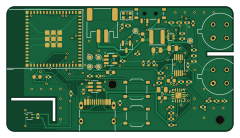
About the Phone board
Phone board is an open source ESP32 PCB design by JamesTwallin, published on GitHub under the MIT license. It is a 4-layer board measuring 60 × 33 mm, with 62 components from 32 distinct parts.
Its main chip is the ESP32-S3-MINI-1-N8, from the ESP32 family. Other key parts include the USBLC6-2SC6, BQ24073RGTR, AP2112K-3.3, TPS61023DRLR and ADS1115IDGSR. By type, the board carries 27 resistors, 18 capacitors, 7 ICs, 5 switches, 2 connectors and 1 transistor.
It belongs with the sensors, iot & wireless and power & battery designs in this gallery.
From the project
A 60 × 33 mm, 4-layer board: bare ESP32-S3-MINI-1, two bare Figaro TGS sensors, ADS1115, SHT40 temp/humidity, LiPo charging and a 5 V heater boost. Position, display, storage and signal processing live on the phone. The electrical spec (why each part, pin map, BLE protocol) is do
A 60 × 33 mm, 4-layer board: bare ESP32-S3-MINI-1, two bare Figaro TGS sensors, ADS1115, SHT40 temp/humidity, LiPo charging and a 5 V heater boost. Position, display, storage and signal processing live on the phone. The electrical spec (why each part, pin map, BLE protocol) is docs/phone_board.md.
Status: rev C is the current design, and the one to build. It is rev B compacted, with the same schematic and parts; this layout has not been fabricated yet. Rev B (66 × 36 mm, git tag rev-b) was fabricated and assembled at JLCPCB and passed bring-up on 2026-09-28: it enumerates over native USB…
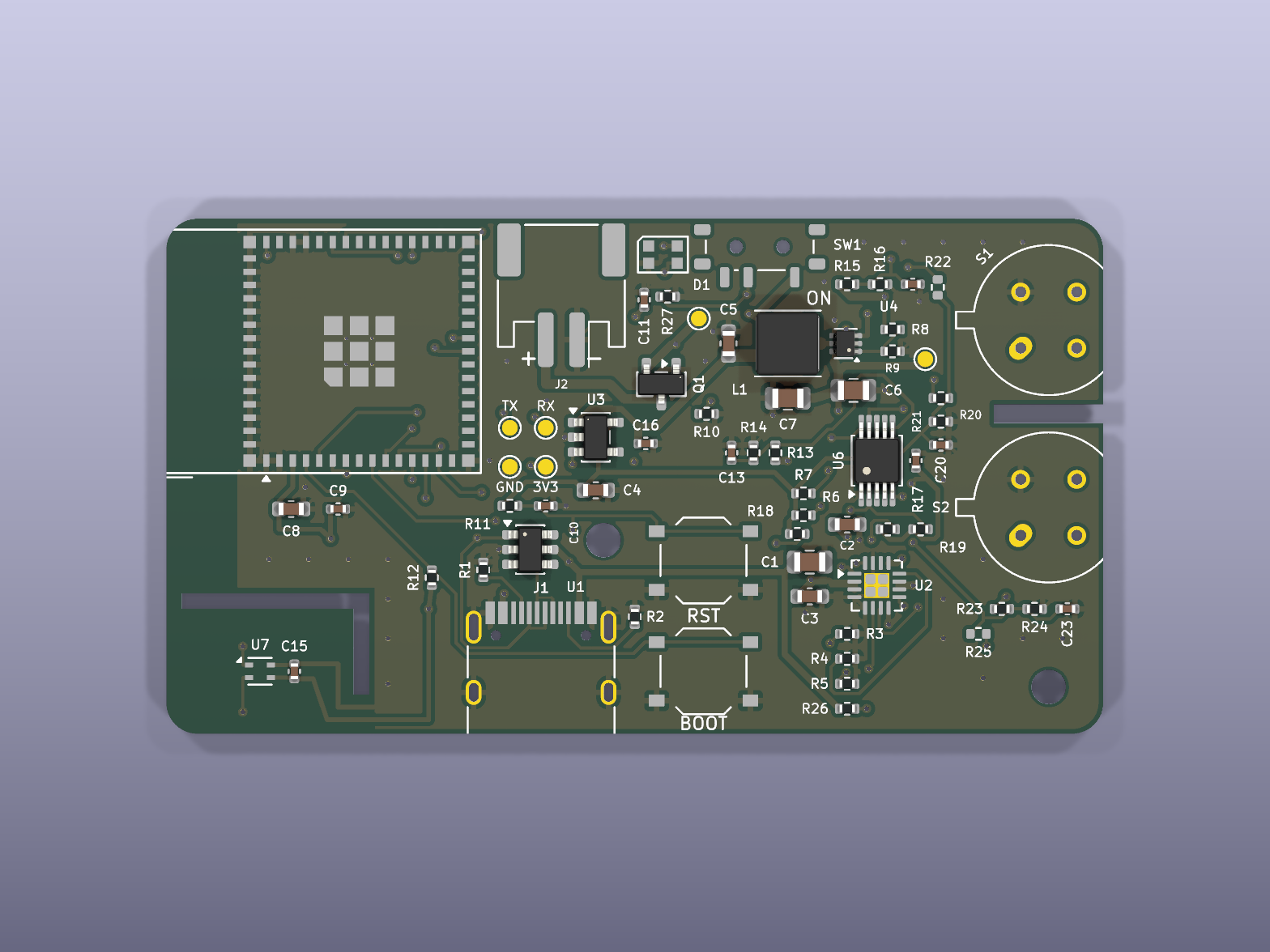
Main components on the Phone board
Phone board bill of materials (BOM)
62 components, 32 distinct parts — part numbers from the project's BOM.
| Qty | Part | Footprint | Refs |
|---|---|---|---|
| 1 | USBLC6-2SC6 | SOT-23-6 | U1 |
| 1 | BQ24073RGTR | VQFN-16-1EP_3x3mm_P0.5mm_EP1.6x1.6mm | U2 |
| 1 | AP2112K-3.3 | SOT-23-5 | U3 |
| 1 | TPS61023DRLR | SOT-563 | U4 |
| 1 | ESP32-S3-MINI-1-N8 | ESP32-S2-MINI-1 | U5 |
| 1 | ADS1115IDGSR | MSOP-10_3x3mm_P0.5mm | U6 |
| 1 | SHT40-AD1B-R2 SHT40-AD1B | Sensirion_DFN-4_1.5x1.5mm_P0.8mm_SHT4x_NoCentralPad | U7 |
| 1 | AO3401A | SOT-23 | Q1 |
| 1 | TYPE-C-31-M-12 | USB_C_Receptacle_HRO_TYPE-C-31-M-12 | J1 |
| 1 | C295747 LiPo 1S | JST_PH_S2B-PH-SM4-TB_1x02-1MP_P2.00mm_Horizontal | J2 |
| 1 | TGS2611-E00 | TO-5-4 | S1 |
| 1 | TGS2610-D00 | TO-5-4 | S2 |
| 1 | C431540 POWER | SW_SPDT_Shouhan_MSK12C02 | SW1 |
| 1 | C318884 RESET | SW_Push_1P1T_XKB_TS-1187A | SW2 |
| 1 | C318884 BOOT | SW_Push_1P1T_XKB_TS-1187A | SW3 |
| 1 | WS2812B-2020 | LED_WS2812B-2020_PLCC4_2.0x2.0mm | D1 |
| 1 | SWPA4030S1R0NT 1uH | L_Sunlord_SWPA4030S | L1 |
| 1 | 10UF 10uF | C_0805_2012Metric | C1 |
| 5 | 10UF 10uF | C_0603_1608Metric | C2, C3, C4, C5, C8 |
| 2 | 22UF 22uF | C_0805_2012Metric | C6, C7 |
Show 12 more
| Qty | Part | Footprint | Refs |
|---|---|---|---|
| 8 | 100NF 100nF | C_0402_1005Metric | C9, C11, C12, C13, C14, C15, C20, C23 |
| 2 | 1UF 1uF | C_0402_1005Metric | C10, C16 |
| 2 | 5.1K 5.1k | R_0402_1005Metric | R1, R2 |
| 6 | 10K 10k | R_0402_1005Metric | R3, R6, R7, R11, R12, R19 |
| 1 | 1.5K 1.5k | R_0402_1005Metric | R4 |
| 1 | 1.8K 1.8k | R_0402_1005Metric | R5 |
| 1 | 732K 732k | R_0402_1005Metric | R8 |
| 5 | 100K 100k | R_0402_1005Metric | R9, R10, R15, R16, R26 |
| 3 | 1M | R_0402_1005Metric | R13, R14, R27 |
| 2 | 4.7K 4.7k | R_0402_1005Metric | R17, R18 |
| 4 | 20K 20k | R_0402_1005Metric | R20, R21, R23, R24 |
| 2 | 1k | R_0402_1005Metric | R22, R25 |
Phone board design files
The KiCad project lives in the JamesTwallin/gas_sensor repository on GitHub; these links point at the commit this page was built from.
Phone board: common questions
What microcontroller does the Phone board use?
The Phone board is built around the ESP32-S3-MINI-1-N8, from the ESP32 family.
How big is the Phone board?
The Phone board measures 60 × 33 mm, has 4 copper layers and is 1.6 mm thick.
How many components are on the Phone board?
62 components, from 32 distinct parts, with part numbers taken from the project's own BOM. The full bill of materials is listed on this page.
Where can I download the Phone board design files?
From the JamesTwallin/gas_sensor repository on GitHub, which has the KiCad layout, the schematic and the BOM; the links under Design files point to each one.
Can I use the Phone board design in my own project?
Yes, under the terms of its MIT license, which JamesTwallin chose for the repository.
Can I test firmware for the Phone board without the hardware?
Yes. HardLabs builds a simulation of the board from its netlist and BOM, so you can run and debug ESP32 firmware against it before you order a PCB.
More boards in gas_sensor
Similar boards
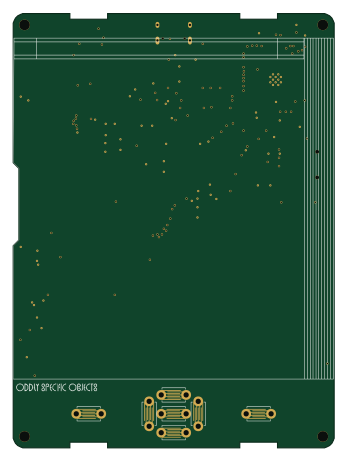 ESP32
OSO-BOOK-B1
joeycastillo
85 × 115 mm65 parts2LCC-BY-SA-4.08.1k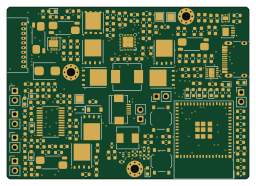 ESP32
Powertrain
byrantech
64 × 45.4 mm171 parts4LMIT4.3k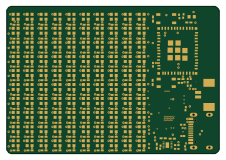 ESP32
Badge
atopile
56.3 × 39 mm239 parts4LMIT4.0k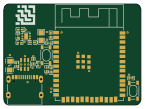 ESP32
Esp32 minimal
36.2 × 26.8 mm20 parts2LMIT4.0k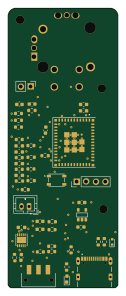 ESP32
Controller
StuckAtPrototype
29 × 74 mm58 parts4LApache-2.03.8k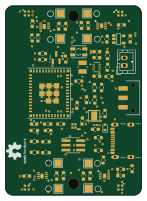 ESP32
Racer
36 × 50.2 mm70 parts4LApache-2.03.8k