
CM5IO

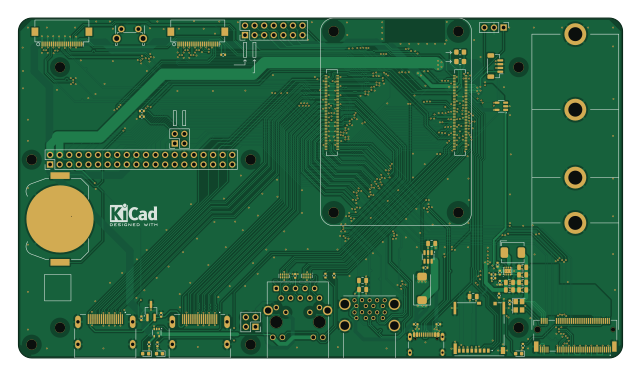
About the CM5IO PCB
CM5IO is an open source Raspberry Pi PCB design by rassweiler, published on GitHub under the GPL-3.0 license. It is a 4-layer board measuring 160 × 90 mm, with 62 components from 35 distinct parts.
Its main chip is the ComputeModule5-CM5, from the Raspberry Pi family. Other key parts include the TPD4EUSB30, MagJack-A70-112-331N126, 74LVC1G07SE-7, AP22653W6 and ASEK-32.768KHZ-L-R-T. By type, the board carries 19 capacitors, 14 resistors, 13 connectors, 9 ICs, 3 diodes and 1 battery holder.
It belongs with the displays & leds, power & battery and dev boards & breakouts designs in this gallery.
From the project
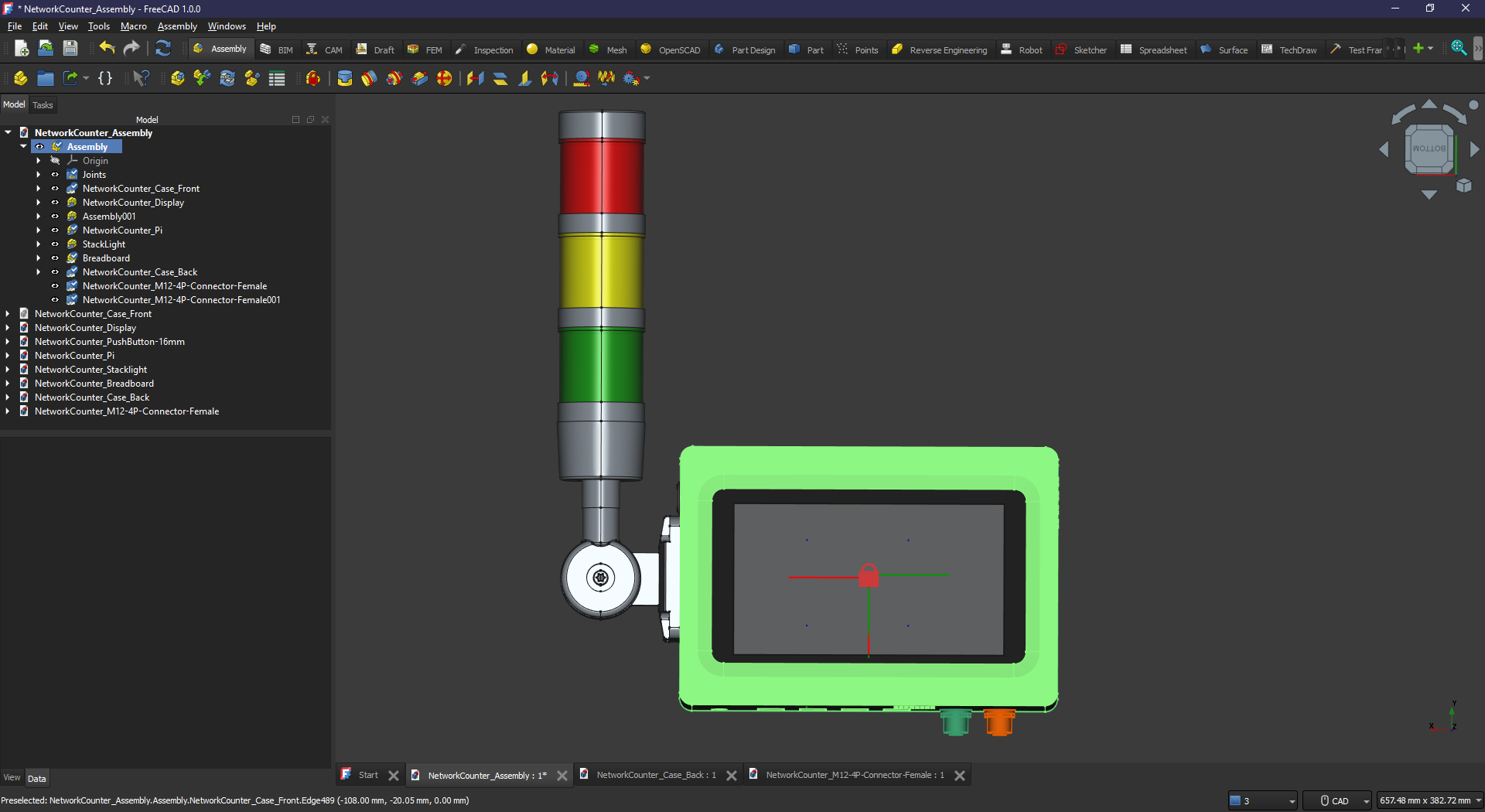
3d printed counter using Pi5, python, pyqt6, and sqlite that can export to folders or sharepoint
- Setup keyring for sharepoint integration Run seahorse and make sure there is a default keystore
- Copy the desktop file to autostart the app:
Then restart the system to get the app in the menu under other, then right click the app and select add to taskbar
- Add to the .settup.toml file your sharepoint access details:
- run the gettoken.sh` script once to initialise your sharepoint token, it should provide a link and a key to login using a browser.
Main components on the CM5IO
CM5IO bill of materials (BOM)
62 components, 35 distinct parts.
| Qty | Part | Footprint | Refs |
|---|---|---|---|
| 2 | TPD4EUSB30 | USON-10_2.5x1.0mm_P0.5mm | U1, U2 |
| 1 | MagJack-A70-112-331N126 | TRJG0926HENL | U3 |
| 1 | 74LVC1G07SE-7 | SOT-353_SC-70-5 | U5 |
| 1 | AP22653W6 | SOT-23-6 | U6 |
| 1 | ASEK-32.768KHZ-L-R-T | Crystal_SMD_3225-4Pin_3.2x2.5mm | U7 |
| 1 | AP3441SHE-7B | DFN-8-1EP_2x2mm_P0.5mm_EP1.05x1.75mm | U8 |
| 1 | RT9742SNGV | TSOT-23_HandSoldering | U12 |
| 1 | RT9742GGJ5 | SOT-23-5 | U18 |
| 1 | Conn_02x07_Odd_Even | PinHeader_2x07_P2.54mm_Vertical | J2 |
| 1 | Bus_M.2_Socket_M | M.2 M Key socket | J4 |
| 2 | Conn_01x22_Female | Hirose_FH12-22S-0.5SH_1x22-1MP_P0.50mm_Horizontal | J5, J16 |
| 2 | THD-02-R | PinHeader_2x02_P2.54mm_Vertical | J6, J9 |
| 1 | Micro_SD_Card_Det | SDCARD_MOLEX_503398-1892 | J7 |
| 1 | THD-20-R | PinHeader_2x20_P2.54mm_Vertical | J8 |
| 2 | 690-019-298-412 | EDAC 690-019-298-412 | J10, J22 |
| 1 | USB_C_Receptacle_USB2.0 | USB_C_Receptacle_GCT_USB4105-xx-A_16P_TopMnt_Horizontal | J11 |
| 1 | USB3_A | MTCONN_UBAF30-D2011 | J12 |
| 1 | JST_SHBM04B-SRSS-TB | JST_SH_BM04B-SRSS-TB_1x04-1MP_P1.00mm_Vertical | J14 |
| 1 | Battery_Cell | BatteryHolder_Keystone_3034_1x20mm | BT1 |
| 1 | ComputeModule5-CM5 | Raspberry-Pi-5-Compute-Module | Module1 |
Show 15 more
| Qty | Part | Footprint | Refs |
|---|---|---|---|
| 1 | Right angle Tact button | SW_Tactile_SPST_Angled_PTS645Vx58-2LFS | SW1 |
| 1 | LED Red | LED_0603_1608Metric | D1 |
| 2 | LED Green | LED_0603_1608Metric | D2, D3 |
| 1 | 2.2uH | L_Bourns_SRP5030CC | L1 |
| 7 | 100n | C_0402_1005Metric | C1, C9, C10, C12, C13, C18, C19 |
| 10 | 10u | C_0805_2012Metric | C2, C4, C5, C6, C7, C8, C14, C15 +2 |
| 1 | 100uF | CP_EIA-7343-31_Kemet-D | C3 |
| 1 | 4.7nF | C_0402_1005Metric | C11 |
| 3 | 1k | R_0402_1005Metric | R1, R10, R17 |
| 2 | 470R | R_0402_1005Metric | R2, R3 |
| 1 | 0R | R_0805_2012Metric_Pad1.20x1.40mm_HandSolder | R5 |
| 5 | 2.2K 1% | R_0402_1005Metric | R6, R7, R8, R9, R16 |
| 1 | 15K 1% | R_0402_1005Metric | R12 |
| 1 | 100K 1% | R_0402_1005Metric | R14 |
| 1 | 10K 1% | R_0402_1005Metric | R15 |
CM5IO design files
The KiCad project lives in the rassweiler/pi-networked-counter repository on GitHub; these links point at the commit this page was built from.
CM5IO: common questions
What microcontroller does the CM5IO use?
The CM5IO is built around the ComputeModule5-CM5, from the Raspberry Pi family.
How big is the CM5IO PCB?
The CM5IO measures 160 × 90 mm, has 4 copper layers and is 1.6 mm thick.
How many components are on the CM5IO?
62 components, from 35 distinct parts. The full bill of materials is listed on this page.
Where can I download the CM5IO design files?
From the rassweiler/pi-networked-counter repository on GitHub, which has the KiCad layout and the schematic; the links under Design files point to each one.
Can I use the CM5IO design in my own project?
Yes, under the terms of its GPL-3.0 license, which rassweiler chose for the repository.
Can I test firmware for the CM5IO without the hardware?
Yes. HardLabs builds a simulation of the board from its netlist and BOM, so you can run and debug Raspberry Pi firmware against it before you order a PCB.
More boards in pi-networked-counter
Similar boards
 Raspberry Pi
Open source rover
nasa-jpl
220 × 178 mm144 parts2LApache-2.09.7k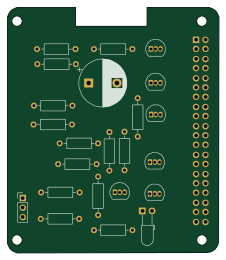 Raspberry Pi
Iot
dotnet
56 × 65 mm24 parts2LMIT2.4k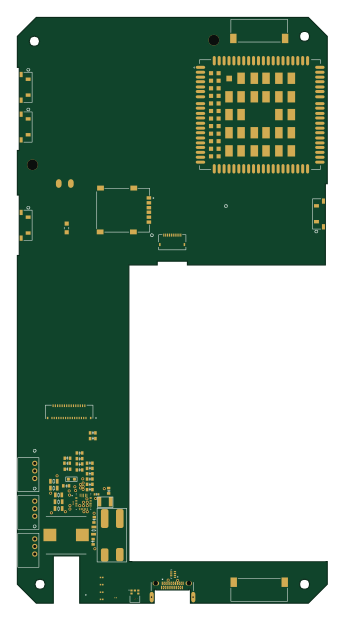 Raspberry Pi
SPIRIT
SPIRIT-org
82 × 155 mm130 parts6LCERN-OHL-S-2.01.3k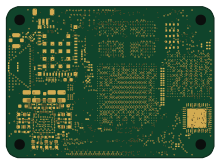 Raspberry Pi
CM5RevEng
schlae
55 × 40 mm417 parts10LNo license1.0k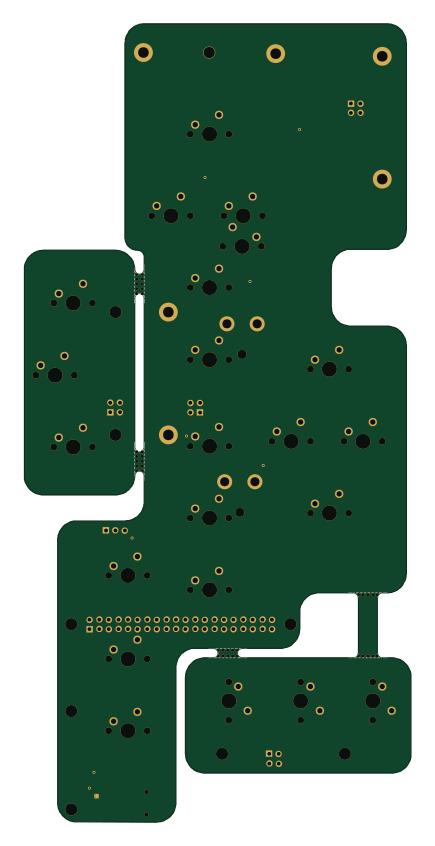 Raspberry Pi
Haxo hw
cardonabits
102.4 × 211.3 mm38 parts2LCustom license672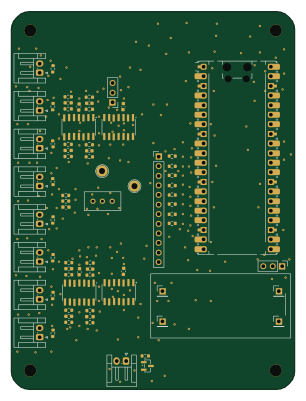 Raspberry Pi
Phased
Neumi
75 × 100 mm71 parts2LNo license507