
LIONv3-R

About the LIONv3-R PCB
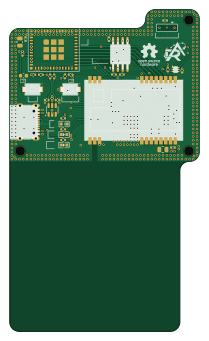
LIONv3-R is an open source ESP32 PCB design by RodrigoCAndrade, published on GitHub. It is a 4-layer board measuring 50.2 × 85.2 mm, with 79 components from 39 distinct parts.
Its main chip is the ESP32-C6-MINI-1-N4, from the ESP32 family. Other key parts include the HC-1_25-2PWT, TMP112AIDRLR, USBLC6-2SC6, TYPE-C_16PIN_2MD(073) and INA226AIDGSR. By type, the board carries 29 resistors, 20 ICs, 20 capacitors, 6 diodes, 2 switches and 2 inductors.
It belongs with the iot & wireless and rf & radio designs in this gallery.
From the project
The LIONv3-R is an IoT and Direct-to-Satellite board powered by the ESP32-C6, combining local Wi-Fi, Zigbee, and Thread networks with high-density LR-FHSS connectivity for scalable global tracking and telemetry.
The LIONv3-R is an IoT and Direct-to-Satellite (DtS) board built around the ESP32-C6, with 16 MB of external flash and local connectivity over Wi-Fi, Zigbee and Thread. Its radio supports LR-FHSS alongside conventional LoRa, enabling reliable uplinks to satellites or terrestrial gateways from remote sites, at device densities conventional LoRa cannot sustain. By bridging local wireless networks with satellite reach, the LIONv3-R is a complete, scalable hardware platform for telemetry, global asset tracking and remote sensing.

Main components on the LIONv3-R
LIONv3-R bill of materials (BOM)
79 components, 39 distinct parts.
| Qty | Part | Footprint | Refs |
|---|---|---|---|
| 6 | HC-1_25-2PWT | CONN-SMD_2P-P1.25-HC-1.25-2PWT | U1, U2, U5, U18, U19, U20 |
| 1 | ESP32-C6-MINI-1-N4 | ESP32-C6-MINI-1 | U3 |
| 1 | TMP112AIDRLR | SOT-563_L1.6-W1.2-P0.50-LS1.6-BR | U6 |
| 1 | USBLC6-2SC6 | SOT-23-6 | U7 |
| 1 | TYPE-C_16PIN_2MD(073) | USB-C-SMD_TYPE-C-16PIN-2MD-073 | U8 |
| 2 | INA226AIDGSR | MSOP-10_L3.0-W3.0-P0.50-LS5.0-BL | U9, U17 |
| 1 | E80-900M2213S | WIFIM-SMD_22P-L26.0-W16.0-P1.27-TL | U10 |
| 1 | W25Q16JVSSIQTR | SOIC-8_L5.3-W5.3-P1.27-LS8.0-BL | U11 |
| 1 | XL-1608UBC-04 | LED0603-RD_BLUE | U12 |
| 1 | XL-1608UGC-04 | LED0603-RD_GREEN | U13 |
| 1 | TPS259474ARPWR | VQFN-10_L2.0-W2.0-P0.45-TL | U14 |
| 1 | TLV76733DRVR | WSON-6_L2.0-W2.0-P0.65-TL-EP | U15 |
| 1 | XL-1608SURC-06 | LED0603-RD_RED | U16 |
| 1 | TCAN3414DR | SOIC-8_L4.9-W3.9-P1.27-LS6.0-BL | U21 |
| 1 | RESET | KEY-SMD_L3.9-W3.0-LS5.0 | SW1 |
| 1 | BOOT | KEY-SMD_L3.9-W3.0-LS5.0 | SW2 |
| 2 | ESD9B3.3ST5G | D_SOD-923 | D1, D2 |
| 3 | PMEG2010ER | Nexperia_CFP3_SOD-123W | D3, D4, D5 |
| 1 | TI ESD752DBZR | SOT-23-3 | D6 |
| 2 | BLM21PG221SN1D | L_0805_2012Metric | FB1, FB2 |
Show 19 more
| Qty | Part | Footprint | Refs |
|---|---|---|---|
| 4 | 22uF | C_0805_2012Metric | C1, C9, C15, C16 |
| 9 | 100nF | C_0402_1005Metric | C2, C4, C7, C8, C10, C11, C12, C19 +1 |
| 3 | 1uF | C_0603_1608Metric | C3, C13, C14 |
| 1 | 3.3nF | C_0402_1005Metric | C17 |
| 1 | 2.2nF | C_0402_1005Metric | C18 |
| 1 | 10uF | C_0805_2012Metric | C20 |
| 1 | 4.7nF | C_0402_1005Metric | C22 |
| 11 | 10k | R_0402_1005Metric | R1, R4, R5, R11, R13, R14, R15, R16 +3 |
| 3 | 4.7k | R_0402_1005Metric | R2, R3, R7 |
| 2 | 0 | R_0402_1005Metric | R6, R8 |
| 2 | 5.1k | R_0402_1005Metric | R9, R10 |
| 2 | 50m | R1206 | R12, R26 |
| 2 | 120 | R_0402_1005Metric | R17, R20 |
| 1 | 60.4k | R_0402_1005Metric | R18 |
| 1 | 15k | R_0402_1005Metric | R19 |
| 1 | 34.8k | R_0402_1005Metric | R23 |
| 1 | 430 | R_0402_1005Metric | R24 |
| 1 | 3.32k | R_0402_1005Metric | R25 |
| 2 | 59 | R_0402_1005Metric | R28, R29 |
LIONv3-R design files
The KiCad project lives in the RodrigoCAndrade/LIONv3-R repository on GitHub; these links point at the commit this page was built from.
LIONv3-R: common questions
What microcontroller does the LIONv3-R use?
The LIONv3-R is built around the ESP32-C6-MINI-1-N4, from the ESP32 family.
How big is the LIONv3-R PCB?
The LIONv3-R measures 50.2 × 85.2 mm, has 4 copper layers and is 1.6 mm thick.
How many components are on the LIONv3-R?
79 components, from 39 distinct parts. The full bill of materials is listed on this page.
Where can I download the LIONv3-R design files?
From the RodrigoCAndrade/LIONv3-R repository on GitHub, which has the KiCad layout and the schematic; the links under Design files point to each one.
Can I use the LIONv3-R design in my own project?
The repository has no license, so all rights stay with RodrigoCAndrade. Use it as a reference, and ask the author before reusing the design.
Can I test firmware for the LIONv3-R without the hardware?
Yes. HardLabs builds a simulation of the board from its netlist and BOM, so you can run and debug ESP32 firmware against it before you order a PCB.
Similar boards
 ESP32
ESP32Open Book Abridged Edition
joeycastillo
85 × 115 mm65 parts2LCC-BY-SA-4.08.1k ESP32
ESP32Badge
atopile
56.3 × 39 mm239 parts4LMIT4.0k ESP32
ESP32Esp32 minimal
36.2 × 26.8 mm20 parts2LMIT4.0k ESP32
ESP32Racer
StuckAtPrototype
36 × 50.2 mm70 parts4LApache-2.03.8k ESP32
ESP32Controller
29 × 74 mm58 parts4LApache-2.03.8k ESP32
ESP32Bitaxe
skot
56.5 × 99.8 mm86 parts4LCERN-OHL-S-2.01.4k