
Virtual scoring box

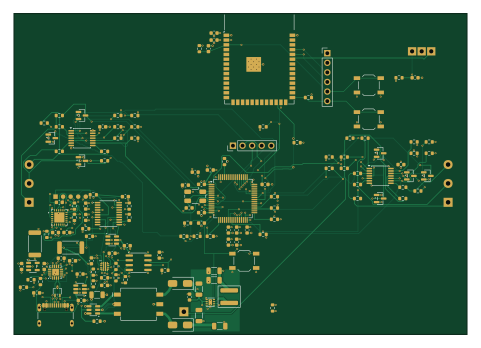
About the Virtual scoring box PCB
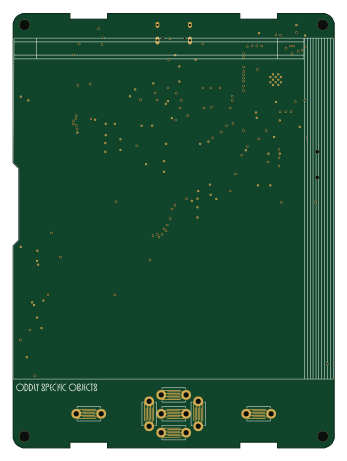
Virtual scoring box is an open source ESP32 PCB design by AndrewCraswell, published on GitHub under the MIT license. It is a 4-layer board measuring 120 × 85 mm, with 142 components from 54 distinct parts.
Its main chip is the ESP32-S3-WROOM-1-N8R8, from the ESP32 family. Other key parts include the STM32G474RET6, TPD2E2U06DCKR, 74LVC125APW,118, TSOP38438 and CP2102N-A02-GQFN20R. By type, the board carries 64 resistors, 44 capacitors, 16 ICs, 9 diodes, 3 connectors and 3 switches.
It belongs with the iot & wireless, displays & leds and power & battery designs in this gallery.
From the project
Open virtual-scoring-box.kicadpro in KiCad 10. This separate development PCB is routed and has an assembly-review export; it has not been released to a manufacturer. The combined ../usb-scoring-platform/ design is frozen at commit ea7c3af023e6ad69eb4b2c7591a94a8ba3619fca`; do not
Open virtual-scoring-box.kicadpro in KiCad 10. This separate development PCB is routed and has an assembly-review export; it has not been released to a manufacturer. The combined ../usb-scoring-platform/ design is frozen at commit ea7c3af023e6ad69eb4b2c7591a94a8ba3619fca`; do not change it while developing this board. Its supplier draft remains paused.
- STM32 determines foil, epee and sabre touches. The laptop displays results and controls the bout; network arrival time never determines contact timing. Timestamped conductor events may also be exported for development and diagnostics. -…
Main components on the Virtual scoring box
Virtual scoring box bill of materials (BOM)
142 components, 54 distinct parts — part numbers from the project's BOM.
| Qty | Part | Footprint | Refs |
|---|---|---|---|
| 1 | STM32G474RET6 STMicroelectronics | LQFP-64_10x10mm_P0.5mm | U1 |
| 1 | ESP32-S3-WROOM-1-N8R8 Espressif Systems | ESP32-S3-WROOM-1_Edge | U2 |
| 1 | TPD2E2U06DCKR Texas Instruments | TPD2E2U06DCKR | U3 |
| 2 | 74LVC125APW,118 74LVC125APW Nexperia | TSSOP-14_4.4x5mm_P0.65mm | U8, U9 |
| 1 | TSOP38438 Vishay | TSOP38438 | U13 |
| 1 | CP2102N-A02-GQFN20R Silicon Labs | CP2102N_QFN20 | U18 |
| 1 | ISO7021DR Texas Instruments | SOIC-8_3.9x4.9mm_P1.27mm | U19 |
| 1 | TPS70933DBVR Texas Instruments | SOT-23-5 | U20 |
| 1 | SN6505BDBVR Texas Instruments | SOT-23-6 | U21 |
| 1 | TPS62162DSGR Texas Instruments | Texas_DSG0008A_WSON-8-1EP_2x2mm_P0.5mm_EP0.9x1.6mm_ThermalVias | U22 |
| 1 | STUSB4500QTR STMicroelectronics | STUSB4500QTR | U23 |
| 1 | STM32C011F6P6 STMicroelectronics | TSSOP-20_4.4x6.5mm_P0.65mm | U24 |
| 1 | TPS259470ARPWR Texas Instruments | TPS25947_RPW | U25 |
| 1 | SN74LVC1G3208DBVR Texas Instruments | SOT-23-6 | U26 |
| 1 | SN74LVC1T45DBVR Texas Instruments | SOT-23-6 | U27 |
| 1 | ABM3B-8.000MHZ-B2-T Abracon | Crystal_SMD_Abracon_ABM3B-4Pin_5.0x3.2mm | Y1 |
| 1 | USB4105-GF-A GCT USB4105-GF-A GCT | USB4105_GF_A | J1 |
| 1 | HTSW-105-07-G-S STM SWD 3.3V Samtec | Samtec_HTSW-105-07-L-S | J2 |
| 1 | HTSW-106-07-G-S ESP 3.3V UART recovery Samtec | Samtec_HTSW-106-07-L-S | J6 |
| 1 | TL3342F160QG STM RESET E-Switch | SW_SPST_TL3342 | SW1 |
Show 34 more
| Qty | Part | Footprint | Refs |
|---|---|---|---|
| 1 | TL3342F160QG ESP RESET E-Switch | SW_SPST_TL3342 | SW2 |
| 1 | TL3342F160QG ESP BOOT E-Switch | SW_SPST_TL3342 | SW3 |
| 1 | 750315371 Wurth Elektronik | 750315371 | T1 |
| 7 | BAT54S,215 BAT54S Nexperia | SOT-23 | D3, D4, D5, D6, D7, D8, D9 |
| 2 | SS14-E3/61T Vishay | D_SMA | D10, D11 |
| 1 | XAL5030-222MEC 2.2uH Coilcraft | L_Coilcraft_XAL5030-XXX | L1 |
| 5 | CC0603KRX7R9BB105 1uF YAGEO | C_0603_1608Metric | C1, C39, C49, C50, C52 |
| 11 | CC0603KRX7R9BB104 100nF 10V Yageo | C_0603_1608Metric | C8, C9, C10, C11, C13, C16, C19, C20 +3 |
| 1 | CC0603KRX7R9BB103 10nF 10V YAGEO | C_0603_1608Metric | C12 |
| 1 | C1608X7S1A475KT000E 4.7uF 10V TDK | C_0603_1608Metric | C14 |
| 3 | CC0603KRX7R9BB105 1uF 10V YAGEO | C_0603_1608Metric | C15, C21, C33 |
| 2 | CC0603JRNPO9BN270 27pF C0G - tune YAGEO | C_0603_1608Metric | C17, C18 |
| 1 | C1608X5R1C106MT000N 10uF 10V TDK | C_0603_1608Metric | C22 |
| 2 | GRM188R61A475KE15D 4.7uF Murata | C_0603_1608Metric | C35, C40 |
| 11 | CC0603KRX7R9BB104 100nF Yageo | C_0603_1608Metric | C36, C37, C38, C47, C48, C51, C53, C55 +3 |
| 6 | C3216X7R1C106KT000N 10uF 16V X7R TDK | C_1206_3216Metric | C41, C42, C43, C44, C45, C46 |
| 1 | CC0603KRX7R9BB103 10nF Yageo | C_0603_1608Metric | C54 |
| 8 | RC0603FR-0710KL 10k YAGEO | R_0603_1608Metric | R5, R6, R28, R29, R75, R78, R80, R95 |
| 7 | ERJPA3F2200V 220R 1% Panasonic | R_0603_1608Metric | R7, R10, R13, R16, R19, R22, R25 |
| 7 | RC0603FR-07390RL 390R 1% YAGEO | R_0603_1608Metric | R8, R11, R14, R17, R20, R23, R26 |
| 16 | RC0603FR-0710KL 10k 1% YAGEO | R_0603_1608Metric | R9, R12, R15, R18, R21, R24, R27, R45 +8 |
| 1 | RC0603FR-07100RL 100R YAGEO | R_0603_1608Metric | R32 |
| 7 | RC0603FR-071KL 1k 1% YAGEO | R_0603_1608Metric | R65, R66, R67, R68, R69, R70, R71 |
| 1 | RC0603FR-071KL 1k Yageo | R_0603_1608Metric | R74 |
| 1 | RC0603FR-0722K1L 22.1k Yageo | R_0603_1608Metric | R76 |
| 1 | RC0603FR-0747K5L 47.5k Yageo | R_0603_1608Metric | R77 |
| 4 | RC0603FR-07100KL 100k Yageo | R_0603_1608Metric | R79, R89, R90, R91 |
| 1 | RT0603BRD0723K7L 23.7k 0.1% Yageo | R_0603_1608Metric | R81 |
| 2 | ERA3AEB103V 10k 0.1% Panasonic | R_0603_1608Metric | R82, R84 |
| 1 | RT0603BRD0734K8L 34.8k 0.1% Yageo | R_0603_1608Metric | R83 |
| 1 | RC0603FR-072K74L 2.74k Yageo | R_0603_1608Metric | R85 |
| 2 | RC0603FR-074K7L 4.7k Yageo | R_0603_1608Metric | R86, R87 |
| 2 | AF0603FR-0747KL 47k Yageo | R_0603_1608Metric | R88, R92 |
| 2 | RC2512FK-071KL 1k 1W Yageo | R_2512_6332Metric | R93, R94 |
Virtual scoring box design files
The KiCad project lives in the AndrewCraswell/agency repository on GitHub; these links point at the commit this page was built from.
Virtual scoring box: common questions
What microcontroller does the Virtual scoring box use?
The Virtual scoring box is built around the ESP32-S3-WROOM-1-N8R8, from the ESP32 family.
How big is the Virtual scoring box PCB?
The Virtual scoring box measures 120 × 85 mm, has 4 copper layers and is 1.6 mm thick.
How many components are on the Virtual scoring box?
142 components, from 54 distinct parts, with part numbers taken from the project's own BOM. The full bill of materials is listed on this page.
Where can I download the Virtual scoring box design files?
From the AndrewCraswell/agency repository on GitHub, which has the KiCad layout, the schematic and the BOM; the links under Design files point to each one.
Can I use the Virtual scoring box design in my own project?
Yes, under the terms of its MIT license, which AndrewCraswell chose for the repository.
Can I test firmware for the Virtual scoring box without the hardware?
Yes. HardLabs builds a simulation of the board from its netlist and BOM, so you can run and debug ESP32 firmware against it before you order a PCB.
More boards in agency
Similar boards
 ESP32
ESP32Open Book Abridged Edition
joeycastillo
85 × 115 mm65 parts2LCC-BY-SA-4.08.1k ESP32
ESP32Esp32 minimal
atopile
36.2 × 26.8 mm20 parts2LMIT4.0k ESP32
ESP32Badge
56.3 × 39 mm239 parts4LMIT4.0k ESP32
ESP32Controller
StuckAtPrototype
29 × 74 mm58 parts4LApache-2.03.8k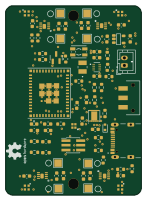 ESP32
ESP32Racer
36 × 50.2 mm70 parts4LApache-2.03.8k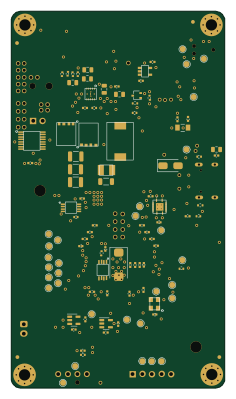 ESP32
ESP32Bitaxe
skot
56.5 × 99.8 mm86 parts4LCERN-OHL-S-2.01.4k