
BitaxeGamma

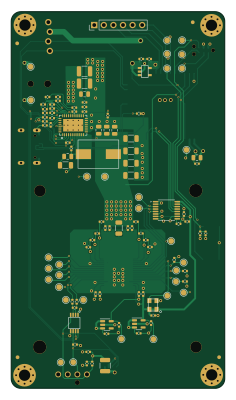
About the BitaxeGamma PCB
BitaxeGamma is an open source ESP32 PCB design by bitaxeorg, published on GitHub under the CERN-OHL-S-2.0 license. It is a 4-layer board measuring 56.5 × 99.8 mm, with 90 components from 42 distinct parts.
Its main chip is the ESP32-S3-WROOM-1, from the ESP32 family. Other key parts include the TPS546D24ARVFR, RT9080-33GJ5, MCP1824T-1202E/OT, MCP1824T-0802E and 25MHZ. By type, the board carries 53 capacitors, 20 resistors, 9 ICs, 5 connectors, 2 switches and 1 inductor.
It belongs with the iot & wireless designs in this gallery.
From the project
Bitaxe based on the BM1370 from the S21 Pro
- Bitmain claims the BM1370 has 15 J/TH efficiency. We can get pretty close to that with the BitaxeGamma - The Antminer S21 Pro has a nominal hashrate of 234 TH/s. There are 3 hashboards with 65 chips each, for a total of 195 chips. The bitaxeGamma has a single one of these chips. That means about 1.2 TH/s per bitaxeGamma. Initial testing looks good! - The BM1370 is brand new and isn't available individually yet. The best place to get these chips is right out of a S21 Pro. - The BM1370 has a different footprint and pinout from the BM1368, BM1366, BM1397 and BM1387 in previous bitaxe.
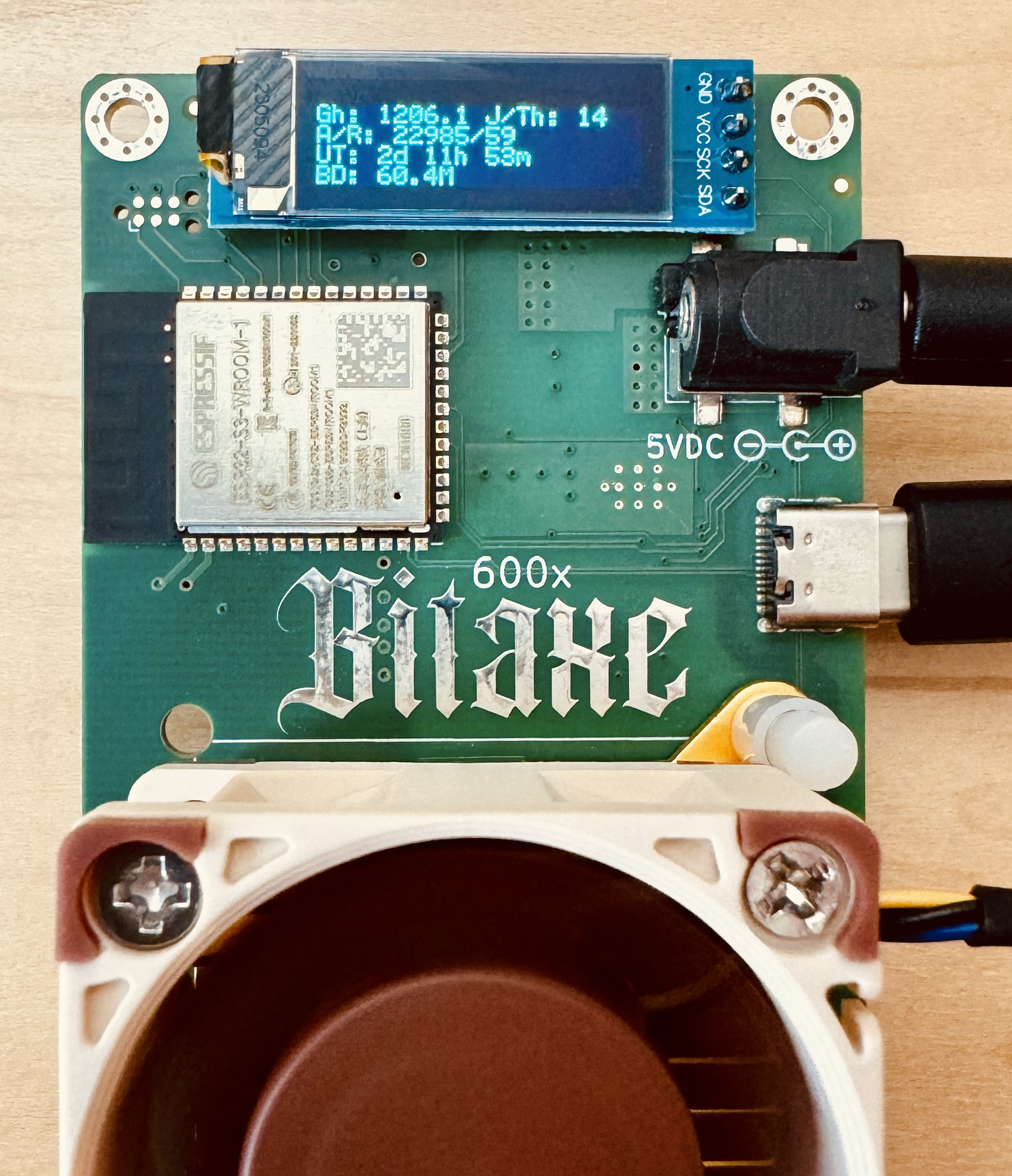
Main components on the BitaxeGamma
BitaxeGamma bill of materials (BOM)
90 components, 42 distinct parts — part numbers from the project's BOM.
| Qty | Part | Footprint | Refs |
|---|---|---|---|
| 1 | TPS546D24ARVFR | LQFN40-CLIP | U2 |
| 1 | RT9080-33GJ5 | RT9080-33GJ5 | U3 |
| 1 | ESP32-S3-WROOM-1 | ESP32-S3-WROOM-1 | U4 |
| 1 | MCP1824T-1202E/OT | SOT-23-5 | U5 |
| 1 | MCP1824T-0802E | SOT-23-5 | U6 |
| 1 | 25MHZ 25MHz | SMD3225-4P | U7 |
| 1 | BM1370_MODE1 BM1370_mode1 | BM1370 | U8 |
| 1 | SN74AVC4T774 | TSSOP-16_4.4x5mm_P0.65mm | U9 |
| 1 | EMC2101 | TSSOP-8_3x3mm_P0.65mm | U10 |
| 1 | 54-00164 | TENSILITY_54-00164 | J1 |
| 1 | Conn_01x04 | PinHeader_1x04_P2.54mm_Vertical_shifted | J3 |
| 1 | USB_C_RECEPTACLE_USB2.0 USB_C_Receptacle_USB2.0 | USB_C_Receptacle_GCT_USB4105-xx-A | J5 |
| 1 | CONN_01X04 Conn_01x04 | 470531000 | J6 |
| 1 | CONN_01X04 Conn_01x04 | JST_SH_BM04B-SRSS-TB_1x04-1MP_P1.00mm_Vertical | J7 |
| 2 | GT-TC029B-H025-L1N | SW_CS1213AGF260_CRS | SW1, SW2 |
| 1 | 300NH 300nH | SLC1175-271MEC_COC | L1 |
| 24 | 1UF 1uF | C_0402_1005Metric | C1, C5, C7, C21, C22, C23, C26, C27 +16 |
| 2 | 10UF 10uF | C_0805_2012Metric | C2, C24 |
| 3 | 47UF 47uF | C_1210_3225Metric | C3, C4, C51 |
| 1 | 4700PF 4700pF | C_0402_1005Metric | C6 |
Show 22 more
| Qty | Part | Footprint | Refs |
|---|---|---|---|
| 10 | 0.1UF 0.1uF | C_0402_1005Metric | C8, C12, C25, C29, C37, C38, C47, C49 +2 |
| 1 | 2200PF 2200pF | C_0402_1005Metric | C9 |
| 1 | 4.7UF 4.7uF | C_0402_1005Metric | C10 |
| 1 | 1000PF 1000pF | C_0805_2012Metric | C11 |
| 1 | 100PF 100pF | C_0402_1005Metric | C13 |
| 3 | 22UF 22uF | C_0805_2012Metric | C14, C15, C16 |
| 5 | 100UF 100uF | C_1206_3216Metric | C17, C18, C19, C20, C43 |
| 1 | 470PF 470pF | C_0402_1005Metric | C50 |
| 1 | 8.25K 8.25k | R_0402_1005Metric | R1 |
| 1 | 14.7K 14.7k | R_0402_1005Metric | R5 |
| 1 | 0 | R_0402_1005Metric | R6 |
| 1 | 3.74K 3.74k | R_0402_1005Metric | R8 |
| 1 | 11.8K 11.8k | R_0402_1005Metric | R9 |
| 1 | 68.1K 68.1k | R_0402_1005Metric | R10 |
| 1 | 10 | R_0402_1005Metric | R11 |
| 1 | 1 | R_1206_3216Metric | R12 |
| 2 | 49.9 | R_0402_1005Metric | R13, R14 |
| 4 | 10K 10k | R_0402_1005Metric | R15, R16, R17, R25 |
| 2 | 1k | R_0402_1005Metric | R18, R19 |
| 1 | 20K 20k | R_0402_1005Metric | R21 |
| 2 | 100 | R_0402_1005Metric | R22, R23 |
| 1 | 5.6K 5.6k | R_0402_1005Metric | R24 |
BitaxeGamma design files
The KiCad project lives in the bitaxeorg/bitaxeGamma repository on GitHub; these links point at the commit this page was built from.
BitaxeGamma: common questions
What microcontroller does the BitaxeGamma use?
The BitaxeGamma is built around the ESP32-S3-WROOM-1, from the ESP32 family.
How big is the BitaxeGamma PCB?
The BitaxeGamma measures 56.5 × 99.8 mm, has 4 copper layers and is 1.6 mm thick.
How many components are on the BitaxeGamma?
90 components, from 42 distinct parts, with part numbers taken from the project's own BOM. The full bill of materials is listed on this page.
Where can I download the BitaxeGamma design files?
From the bitaxeorg/bitaxeGamma repository on GitHub, which has the KiCad layout, the schematic and the BOM; the links under Design files point to each one.
Can I use the BitaxeGamma design in my own project?
Yes, under the terms of its CERN-OHL-S-2.0 license, which bitaxeorg chose for the repository.
Can I test firmware for the BitaxeGamma without the hardware?
Yes. HardLabs builds a simulation of the board from its netlist and BOM, so you can run and debug ESP32 firmware against it before you order a PCB.
Similar boards
 ESP32
ESP32Open Book Abridged Edition
joeycastillo
85 × 115 mm65 parts2LCC-BY-SA-4.08.1k ESP32
ESP32Badge
atopile
56.3 × 39 mm239 parts4LMIT4.0k ESP32
ESP32Esp32 minimal
36.2 × 26.8 mm20 parts2LMIT4.0k ESP32
ESP32Racer
StuckAtPrototype
36 × 50.2 mm70 parts4LApache-2.03.8k ESP32
ESP32Controller
29 × 74 mm58 parts4LApache-2.03.8k ESP32
ESP32Bitaxe
skot
56.5 × 99.8 mm86 parts4LCERN-OHL-S-2.01.4k