
Spikeling

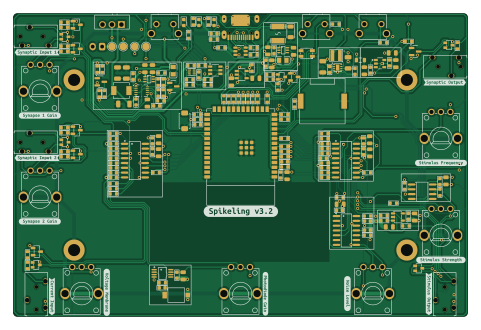
About the Spikeling PCB
Spikeling is an open source ESP32 PCB design by OpenSourceNeuro, published on GitHub under the GPL-3.0 license. It is a 2-layer board measuring 120 × 80 mm, with 211 components from 67 distinct parts.
Its main chip is the ESP32-S3-WROOM-1-N4, from the ESP32 family. Other key parts include the MF-MSMF050-2, LM66100DCKR, TPS62162DSGR, TPS7A2033PDBVR and MCP73812T-420I/OT. By type, the board carries 82 resistors, 64 capacitors, 19 diodes, 15 ICs, 7 connectors and 5 switches.
From the project
A hardware implementation of spiking neurons for neuroscience teaching and outreach
This directory contains the hardware design sources (KiCad schematics/PCBs, fabrication outputs). Copyright (c) 2026 OpenSourceNeuro contributors.
Source Location: https://github.com/OpenSourceNeuro/Spikeling License text: see PCB/LICENSE (CERN-OHL-S v2)
- Ordering PCB - Assembling Spikeling - Acrylic Covers

Main components on the Spikeling
Spikeling bill of materials (BOM)
211 components, 67 distinct parts — part numbers from the project's BOM.
| Qty | Part | Footprint | Refs |
|---|---|---|---|
| 1 | MF-MSMF050-2 | F1812 | U1 |
| 2 | LM66100DCKR | SC-70-6_L2.0-W1.3-P0.65-LS2.1-BL | U2, U8 |
| 1 | TPS62162DSGR | WSON-8_L2.0-W2.0-P0.50-TL-EP | U3 |
| 1 | TPS7A2033PDBVR | SOT-23-5_L2.9-W1.6-P0.95-LS2.8-BR | U4 |
| 1 | MCP73812T-420I/OT | SOT-23-5_L3.0-W1.7-P0.95-LS2.8-BR | U5 |
| 1 | BQ29700DSER | WSON-6_L1.5-W1.5-P0.50-TL | U6 |
| 1 | TPS61200DRCR | VSON-10_L3.0-W3.0-P0.50-TL-EP_TPS62410DRCR | U7 |
| 1 | MCP4922-E/SL | SOIC-14_L8.7-W3.9-P1.27-LS6.0-BL | U9 |
| 2 | MCP3208T-CI/SL | SOIC-16_L9.9-W3.9-P1.27-LS6.0-BL | U10, U11 |
| 1 | ESP32-S3-WROOM-1-N4 | WIFIM-SMD_ESP32-S3-WROOM-1-N8 | U12 |
| 1 | OPA380AIDGKR | VSSOP-8_L3.0-W3.0-P0.65-LS4.9-BL | U13 |
| 1 | TLV9001IDBVR | SOT-23-5_L3.0-W1.7-P0.95-LS2.8-BR | U14 |
| 1 | MCP6002T-I/SN | SOIC-8_L4.9-W3.9-P1.27-LS6.0-BL | U15 |
| 1 | FS8205A | SOT-23-6_L2.9-W1.6-P0.95-LS2.8-BR | Q1 |
| 3 | 2N7002 Changjiang Electronics Tech (CJ) | Q_SOT-23 | Q2, Q3, Q4 |
| 1 | C2927039 Connector, USB-TYPE-C-16P | TYPE-C-SMD_HX-TYPE-C-16PIN | J1 |
| 1 | C19189087 Synapse1 In | AUDIO-SMD_HX-PJ-320A-3P-DIP | J2 |
| 1 | C19189087 Synapse2 In | AUDIO-SMD_HX-PJ-320A-3P-DIP | J3 |
| 1 | C19189087 Input Current | AUDIO-SMD_HX-PJ-320A-3P-DIP | J4 |
| 1 | C19189087 Stimulus Out | AUDIO-SMD_HX-PJ-320A-3P-DIP | J5 |
Show 47 more
| Qty | Part | Footprint | Refs |
|---|---|---|---|
| 1 | C19189087 Synapse Out | AUDIO-SMD_HX-PJ-320A-3P-DIP | J6 |
| 1 | C18594 Oscilloscope Output | AUDIO-SMD_PJ-320B | J7 |
| 1 | 4KHZ 4kHz | BUZ-TH_L12.0-W12.0 | B1 |
| 1 | C265283 Battery_Cell | JST_XH_B2B-XH-A_1x02_P2.50mm_Vertical | BT1 |
| 1 | K3-1260D-L1 | SW-TH_K3-1260D-L1 | SW1 |
| 1 | C720477 Tactile Button, 160gf XUNPU | SW_TS-1088-AR02016 | SW2 |
| 3 | SKHHLVA010 | KEY-TH_4P-L7.5-W6.8-P4.50-LS7.2 | SW3, SW4, SW5 |
| 1 | SRV05-4-P-T7 | SOT-23-6_L2.9-W1.6-P0.95-LS2.8-BR | TV1 |
| 7 | 10kΩ | RES-TH_RK09D1130C2P | VR1, VR2, VR3, VR4, VR5, VR6, VR7 |
| 1 | SMF6.0A | D_SOD-123FL | D1 |
| 2 | C2286 Red Hubei KENTO Elec | D_0603 | D2, D3 |
| 1 | C89811 Yellow Foshan NationStar Optoelectronics | D_0603 | D4 |
| 6 | TPD2E2U06DCKR | SC-70-3_L2.0-W1.3-P0.65-LS2.1-BL | D5, D8, D11, D14, D17, D18 |
| 6 | BAT54S | SOT-23-3_L2.9-W1.3-P1.90-LS2.4-BR | D6, D7, D9, D10, D12, D19 |
| 1 | BPW34S-Z | SENSOR-TH_BPW34S-Z | D13 |
| 1 | LED_BGKR | LED_Kingbright_APFA3010_3x1.5mm_Horizontal | D15 |
| 1 | MHPC3528CRGBCT | LED-SMD_4P-L3.2-W2.8-BL | D16 |
| 2 | BLM21PG221SN1D | L0805 | L1, L5 |
| 1 | 2.2UH 2.2uH | IND-SMD_L3.0-W3.0_XFL3012 | L2 |
| 1 | MPZ2012S601 | L_0805 | L3 |
| 1 | 2.2UH 2.2uH | IND-SMD_L4.4-W4.0_PHC0420 | L4 |
| 2 | 1NF 1nF | C_0603 | C1, C55 |
| 10 | 1UF 1uF | C_0805 | C2, C4, C11, C14, C24, C25, C26, C36 +2 |
| 30 | 100NF 100nF | C_0603 | C3, C6, C8, C10, C12, C13, C18, C21 +22 |
| 10 | 4.7UF 4.7uF | C_0805 | C5, C15, C16, C17, C29, C31, C34, C38 +2 |
| 2 | 10UF 10uF | C_1206 | C7, C22 |
| 3 | 22UF 22uF | C_1206 | C9, C19, C20 |
| 1 | 10UF 10uF | C_0805 | C41 |
| 1 | 4.7NF 4.7nF | C_0603 | C43 |
| 4 | 10NF 10nF | C_0603 | C46, C48, C50, C63 |
| 1 | 10PF 10pF | C_0603 | C54 |
| 5 | 1MΩ | R_0603 | R1, R16, R18, R24, R61 |
| 5 | 5.1kΩ | R_0603 | R2, R3, R4, R5, R22 |
| 1 | 0Ω | R_0603 | R6 |
| 1 | 4.7kΩ | R_0603 | R7 |
| 2 | 5.1MΩ | R_0603 | R8, R10 |
| 12 | 100Ω | R_0603 | R9, R11, R23, R26, R27, R45, R69, R70 +4 |
| 1 | 2.2kΩ | R_0603 | R12 |
| 1 | 330Ω | R_0603 | R13 |
| 1 | 910kΩ | R_0603 | R14 |
| 18 | 100kΩ | R_0603 | R15, R17, R19, R20, R21, R31, R32, R33 +10 |
| 9 | 10kΩ | R_0603 | R25, R30, R35, R44, R46, R66, R75, R78 +1 |
| 2 | 220Ω | R_0603 | R28, R29 |
| 2 | 22Ω | R_0603 | R36, R37 |
| 6 | 47Ω | R_0603 | R38, R39, R40, R41, R42, R43 |
| 15 | 1kΩ | R_0603 | R47, R50, R51, R52, R55, R56, R57, R58 +7 |
| 1 | 150Ω | R_0603 | R68 |
Spikeling design files
The KiCad project lives in the OpenSourceNeuro/Spikeling repository on GitHub; these links point at the commit this page was built from.
Spikeling: common questions
What microcontroller does the Spikeling use?
The Spikeling is built around the ESP32-S3-WROOM-1-N4, from the ESP32 family.
How big is the Spikeling PCB?
The Spikeling measures 120 × 80 mm, has 2 copper layers and is 1.6 mm thick.
How many components are on the Spikeling?
211 components, from 67 distinct parts, with part numbers taken from the project's own BOM. The full bill of materials is listed on this page.
Where can I download the Spikeling design files?
From the OpenSourceNeuro/Spikeling repository on GitHub, which has the KiCad layout, the schematic and the BOM; the links under Design files point to each one.
Can I use the Spikeling design in my own project?
Yes, under the terms of its GPL-3.0 license, which OpenSourceNeuro chose for the repository.
Can I test firmware for the Spikeling without the hardware?
Yes. HardLabs builds a simulation of the board from its netlist and BOM, so you can run and debug ESP32 firmware against it before you order a PCB.
Earlier revisions in the repo: Spikeling_V2.5
Similar boards
 ESP32
OSO-BOOK-B1
joeycastillo
85 × 115 mm65 parts2LCC-BY-SA-4.08.1k ESP32
Powertrain
byrantech
64 × 45.4 mm171 parts4LMIT4.3k ESP32
Esp32 minimal
atopile
36.2 × 26.8 mm20 parts2LMIT4.0k ESP32
Badge
56.3 × 39 mm239 parts4LMIT4.0k ESP32
Racer
StuckAtPrototype
36 × 50.2 mm70 parts4LApache-2.03.8k ESP32
Controller
29 × 74 mm58 parts4LApache-2.03.8k