
Glider

About the Glider PCB
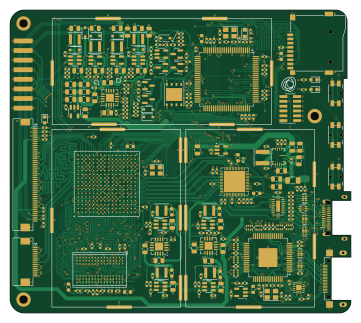
Glider is an open source STM32 PCB design by Modos-Labs, published on GitHub under the CERN-OHL-S-2.0 license. It is a 4-layer board measuring 90 × 80 mm, with 356 components from 65 distinct parts.
Its main chip is the STM32H750VBTx, from the STM32 family. Other key parts include the XC6SLX-FTG256, SY8113C, MT9700, TPS22914BYFPR and LGS5145. By type, the board carries 191 capacitors, 90 resistors, 27 ICs, 16 diodes, 12 inductors and 7 connectors.
It belongs with the displays & leds designs in this gallery.
From the project
Open-source E-ink monitor. Mirror of https://gitlab.com/zephray/glider
Open-source Eink monitor with an emphasis on low latency.
Note: This repo only contains the hardware design, the gateware running on the FPGA is my open-source Caster EPDC design. This README also contains information about the Caster as well.
This is a long document, containing not just information about this project, but also pretty much everything I know about Eink. Given it's a bit hard to gather information about Eink online, I think this is the right thing to do. Use the following table of contents to navigate around.

Main components on the Glider
Glider bill of materials (BOM)
356 components, 65 distinct parts.
| Qty | Part | Footprint | Refs |
|---|---|---|---|
| 1 | XC6SLX-FTG256 | Xilinx_FTG256 | U1 |
| 4 | SY8113C | TSOT-23-6 | U2, U5, U20, U28 |
| 1 | STM32H750VBTx | LQFP-100_14x14mm_P0.5mm | U3 |
| 3 | MT9700 | SOT-23-5 | U4, U6, U10 |
| 2 | TPS22914BYFPR | WLP-4_0.83x0.83mm_P0.4mm | U7, U8 |
| 2 | LGS5145 | TSOT-23-6 | U9, U26 |
| 1 | LM321 | SOT-23-5 | U11 |
| 1 | MT41K64M16TW | BGA-96_9.0x14.0mm_P0.8mm | U12 |
| 1 | JW3651QFNE | QFN15_3X4_JW3651 | U13 |
| 1 | W25Q32JV | WSON-8-1EP_6x5mm_P1.27mm_EP3.4x4.3mm | U14 |
| 1 | ADV7611 | LQFP-64-1EP_10x10mm_P0.5mm_EP5x5mm | U15 |
| 1 | USBLC6-2P6 | SOT-666-Alt | U16 |
| 1 | FUSB302BMPX | WQFN-14-1EP_2.5x2.5mm_P0.5mm_EP1.45x1.45mm | U17 |
| 1 | CBTL02043A | WQFN-20-1EP_2.5x4.5mm_P0.5mm_EP1x2.9mm | U18 |
| 1 | PTN3460 | QFN-56-1EP_7x7mm_P0.4mm_EP5.6x5.6mm | U19 |
| 3 | INA3221 | Texas_RGV0016A_VQFN-16-1EP_4x4mm_P0.65mm_EP2.1x2.1mm | U21, U22, U27 |
| 2 | LGS6302B5 | SOT-23-5 | U23, U24 |
| 3 | AO3401A | SOT-23 | Q1, Q7, Q8 |
| 1 | S8050 | SOT-23 | Q2 |
| 1 | AO3400A | SOT-23 | Q6 |
Show 45 more
| Qty | Part | Footprint | Refs |
|---|---|---|---|
| 1 | 33.33MHz | Oscillator_SMD_Abracon_ASE-4Pin_3.2x2.5mm | X1 |
| 2 | 24MHz | Crystal_SMD_3225-4Pin_3.2x2.5mm | Y1, Y3 |
| 1 | 32.768K | Crystal_SMD_TXC_9HT11-2Pin_2.0x1.2mm_HandSoldering | Y2 |
| 1 | GT-USB-7007A | USB_C_Receptacle_GT-USB-7007A | J1 |
| 1 | Conn_01x08_MountingPin | 8P_2.54 | J2 |
| 1 | FPC-05F-16PH20 | Xunpu_FPC-05F-16PH20_1x16-1MP_P0.50mm_Horizontal | J3 |
| 1 | HDMI_C_1.3 | HDMI_C_GT-HD006A-CGNGX | J4 |
| 1 | 2x6_1.27_HDR | PinSocket_2x06_P1.27mm_Vertical_SMD | J5 |
| 1 | FPC-05F-50PH20 | Xunpu_FPC-05F-50PH20_1x50-1MP_P0.50mm_Horizontal | J6 |
| 1 | MICRO_SD(TFC-WPAPR-08) | TFC-WPAPR-08 | J7 |
| 1 | 3A | Fuse_1206_3216Metric | F1 |
| 3 | SW | Panasonic_EVQPUL_EVQPUC | SW1, SW2, SW3 |
| 8 | 1N5819WS | D_SOD-323_Alt | D1, D2, D3, D4, D5, D6, D15, D17 |
| 2 | LED GREEN | LED_0603_1608Metric | D8, D19 |
| 5 | RCLAMP0524P | Diodes_UDFN-10_1.0x2.5mm_P0.5mm | D9, D10, D11, D12, D13 |
| 1 | LED RED | LED_0603_1608Metric | D20 |
| 3 | 120R@100M | L_0603_1608Metric | FB1, FB2, FB3 |
| 8 | WPN3012H4R7MT | L_Changjiang_FNR3012S | L1, L2, L3, L5, L6, L8, L10, L12 |
| 1 | WPN4020H2R2MT | L_Changjiang_FNR4020S | L15 |
| 17 | 22uF/10V | C_0805_2012Metric | C1, C2, C17, C27, C32, C37, C42, C45 +9 |
| 77 | 100nF/50V | C_0402_1005Metric | C3, C4, C5, C7, C8, C9, C29, C30 +69 |
| 14 | 18pF/50V | C_0402_1005Metric | C6, C10, C11, C12, C13, C28, C38, C41 +6 |
| 22 | 22uF/6.3V | C_0603_1608Metric | C14, C15, C16, C18, C19, C20, C21, C26 +14 |
| 21 | 4.7uF/6.3V | C_0402_1005Metric | C22, C23, C24, C34, C47, C56, C57, C59 +13 |
| 22 | 470nF/25V | C_0402_1005Metric | C25, C52, C58, C68, C69, C70, C73, C79 +14 |
| 11 | 4.7uF/50V | C_0805_2012Metric | C33, C44, C46, C98, C99, C140, C166, C167 +3 |
| 3 | 1nF/50V | C_0402_1005Metric | C91, C95, C170 |
| 4 | 1nF/25V | C_0402_1005Metric | C163, C164, C168, C169 |
| 10 | 5.1K/1% | R_0402_1005Metric | R1, R2, R9, R29, R30, R35, R36, R44 +2 |
| 17 | 100K/1% | R_0402_1005Metric | R3, R13, R26, R28, R34, R51, R57, R58 +9 |
| 5 | 22K/1% | R_0402_1005Metric | R4, R25, R27, R64, R89 |
| 2 | 150K/1% | R_0402_1005Metric | R5, R78 |
| 2 | 120K/1% | R_0402_1005Metric | R6, R48 |
| 8 | 20mR | R_0805_2012Metric | R7, R8, R53, R54, R56, R60, R61, R72 |
| 2 | 240K/1% | R_0402_1005Metric | R10, R18 |
| 13 | 10K/1% | R_0402_1005Metric | R11, R12, R14, R16, R17, R19, R21, R23 +5 |
| 3 | 100R/1% | R_0402_1005Metric | R15, R40, R100 |
| 6 | 1K/1% | R_0402_1005Metric | R20, R22, R37, R43, R104, R105 |
| 2 | 390K/1% | R_0402_1005Metric | R24, R88 |
| 6 | 1M/1% | R_0402_1005Metric | R45, R50, R96, R98, R115, R117 |
| 4 | 33R/1% | R_0402_1005Metric | R46, R63, R66, R109 |
| 1 | 13K/1% | R_0402_1005Metric | R79 |
| 1 | 240R/1% | R_0402_1005Metric | R102 |
| 1 | 470K/1% | R_0402_1005Metric | R123 |
| 7 | 33R / 4D02WGF330JTCE | R_Array_Convex_4x0402 | RN7, RN8, RN9, RN10, RN11, RN12, RN13 |
Glider design files
The KiCad project lives in the Modos-Labs/Glider repository on GitHub; these links point at the commit this page was built from.
- Layoutpcb/mainboard/pcb.kicad_pcb
- Schematicpcb/mainboard/pcb.kicad_sch
Glider: common questions
What microcontroller does the Glider use?
The Glider is built around the STM32H750VBTx, from the STM32 family.
How big is the Glider PCB?
The Glider measures 90 × 80 mm, has 4 copper layers and is 1.0044 mm thick.
How many components are on the Glider?
356 components, from 65 distinct parts. The full bill of materials is listed on this page.
Where can I download the Glider design files?
From the Modos-Labs/Glider repository on GitHub, which has the KiCad layout and the schematic; the links under Design files point to each one.
Can I use the Glider design in my own project?
Yes, under the terms of its CERN-OHL-S-2.0 license, which Modos-Labs chose for the repository.
Can I test firmware for the Glider without the hardware?
Yes. HardLabs builds a simulation of the board from its netlist and BOM, so you can run and debug STM32 firmware against it before you order a PCB.
More boards in Glider
Similar boards
 STM32
STM32LumenPnP Motherboard
opulo-inc
149 × 95 mm296 parts4LCC-BY-SA-4.03.7k STM32
STM32Type c
google
188 × 30 mm17 parts2LApache-2.02.9k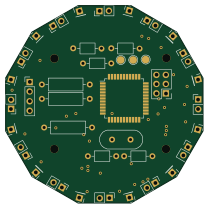 STM32
STM32Base
52.3 × 52.3 mm36 parts2LApache-2.02.9k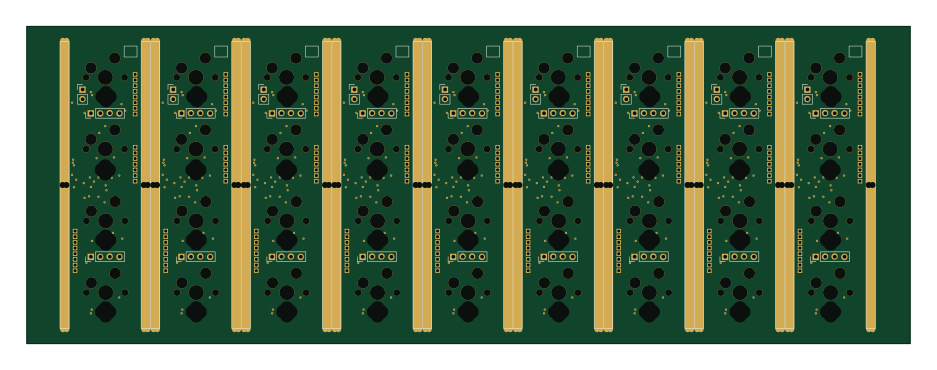 STM32
STM32Main panel
234 × 84 mm26 parts4LApache-2.02.9k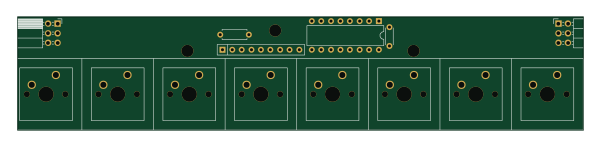 STM32
STM32Type a
150 × 30 mm14 parts2LApache-2.02.9k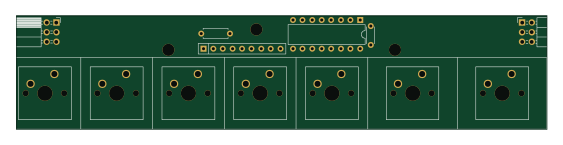 STM32
STM32Type e
140.5 × 30 mm13 parts2LApache-2.02.9k