
AS3397 proto DIP

About the AS3397 proto DIP PCB
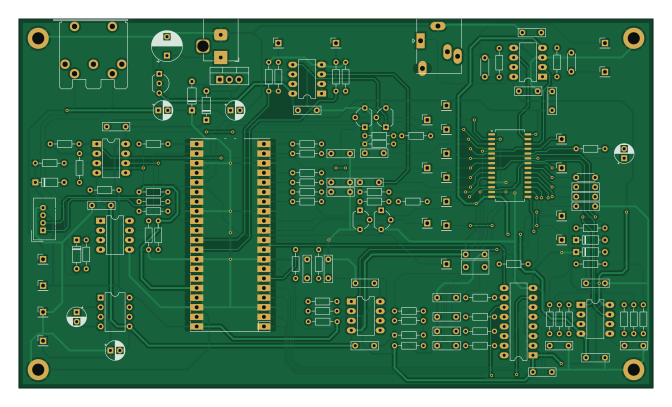
AS3397 proto DIP is an open source RP2040/RP2350 PCB design by PhysicsDptAngers, published on GitHub under the MIT license. It is a 2-layer board measuring 167.6 × 97.5 mm, with 138 components from 69 distinct parts.
Its main chip is the Pico, from the RP2040/RP2350 family. Other key parts include the TC7662, LM7812, TS922, 6N138 and TL072. By type, the board carries 52 resistors, 38 capacitors, 22 test points, 11 ICs, 6 diodes and 4 transistors.
It belongs with the audio designs in this gallery.
From the project
Open source, analog and polyphonic synthesizer
The simplest version to assemble and arguably the best starting point. This is a standalone analog voice module that does not require a conductor board to generate sound. Additionaly, the board is large and use trhough-hole component (except for the as3397 chip). It also includes a dedicated MIDI input socket and power circuitry, allowing you to simply connect a MIDI cable and a +12V power supply to get a fully functional monophonic analog synthesizer!
Main components on the AS3397 proto DIP
AS3397 proto DIP bill of materials (BOM)
138 components, 69 distinct parts.
| Qty | Part | Footprint | Refs |
|---|---|---|---|
| 1 | TC7662 | DIP-8_W7.62mm | U1 |
| 1 | LM7812 | TO-92_Inline_Wide | U2 |
| 1 | Pico | RPi_Pico_SMD_TH | U3 |
| 4 | TS922 | DIP-8_W7.62mm_LongPads | U4, U8, U9, U11 |
| 1 | 6N138 | DIP-8_W7.62mm_LongPads | U5 |
| 1 | TL072 | DIP-8_W7.62mm_LongPads | U6 |
| 1 | 4050 | DIP-16_W7.62mm_LongPads | U7 |
| 1 | LM7805 | TO-220-3_Vertical | U10 |
| 4 | BS170 | TO-92_Wide | Q2, Q3, Q4, Q5 |
| 1 | +15V | BarrelJack_Horizontal | J1 |
| 1 | MIDI IN | MIDI_DIN5 | J2 |
| 1 | OUTPUT | Jack_3.5mm_Ledino_KB3SPRS_Horizontal | J3 |
| 1 | I2C | NS-Tech_Grove_1x04_P2mm_Vertical | J4 |
| 1 | AS3397 | SOIC-28W_7.5x18.7mm_P1.27mm | AS1 |
| 1 | CTA | PinHeader_1x01_P2.54mm_Vertical | TP1 |
| 1 | CTB | PinHeader_1x01_P2.54mm_Vertical | TP2 |
| 1 | GND | PinHeader_1x01_P2.54mm_Vertical | TP3 |
| 1 | PAN | PinHeader_1x01_P2.54mm_Vertical | TP4 |
| 1 | MOD | PinHeader_1x01_P2.54mm_Vertical | TP5 |
| 1 | PWA | PinHeader_1x01_P2.54mm_Vertical | TP6 |
Show 49 more
| Qty | Part | Footprint | Refs |
|---|---|---|---|
| 1 | RES | PinHeader_1x01_P2.54mm_Vertical | TP7 |
| 1 | PWB | PinHeader_1x01_P2.54mm_Vertical | TP8 |
| 1 | GAIN | PinHeader_1x01_P2.54mm_Vertical | TP9 |
| 1 | FREQ | PinHeader_1x01_P2.54mm_Vertical | TP10 |
| 1 | BAL | PinHeader_1x01_P2.54mm_Vertical | TP11 |
| 1 | WSEL | PinHeader_1x01_P2.54mm_Vertical | TP12 |
| 1 | DSO | PinHeader_1x01_P2.54mm_Vertical | TP13 |
| 1 | WFA | PinHeader_1x01_P2.54mm_Vertical | TP14 |
| 1 | WFB | PinHeader_1x01_P2.54mm_Vertical | TP15 |
| 1 | FREQA | PinHeader_1x01_P2.54mm_Vertical | TP16 |
| 1 | FREQB | PinHeader_1x01_P2.54mm_Vertical | TP17 |
| 1 | OUTL | PinHeader_1x01_P2.54mm_Vertical | TP18 |
| 1 | OUTR | PinHeader_1x01_P2.54mm_Vertical | TP19 |
| 1 | -5V | PinHeader_1x01_P2.54mm_Vertical | TP20 |
| 1 | +12V | PinHeader_1x01_P2.54mm_Vertical | TP21 |
| 1 | +5V | PinHeader_1x01_P2.54mm_Vertical | TP22 |
| 4 | 1N4148 | D_DO-35_SOD27_P7.62mm_Horizontal | D1, D2, D5, D6 |
| 2 | BAT48 | D_DO-35_SOD27_P7.62mm_Horizontal | D3, D4 |
| 1 | 100uF | CP_Radial_D8.0mm_P5.00mm | C1 |
| 3 | 10uF | CP_Radial_D5.0mm_P2.50mm | C2, C5, C11 |
| 2 | 1uF | CP_Radial_D5.0mm_P2.50mm | C3, C37 |
| 1 | 2.2nF | C_Rect_L7.0mm_W2.0mm_P5.00mm | C4 |
| 2 | 3.3nF | C_Rect_L7.0mm_W2.0mm_P5.00mm | C6, C10 |
| 8 | 22nF | C_Rect_L7.0mm_W2.0mm_P5.00mm | C7, C8, C21, C22, C24, C26, C36, C40 |
| 12 | 100nF | C_Rect_L7.0mm_W2.0mm_P5.00mm | C9, C12, C28, C29, C30, C31, C32, C33 +4 |
| 3 | 33nF | C_Rect_L7.0mm_W2.0mm_P5.00mm | C13, C14, C15 |
| 1 | 470pF | C_Disc_D4.3mm_W1.9mm_P5.00mm | C16 |
| 2 | 1.5nF | C_Rect_L7.0mm_W2.0mm_P5.00mm | C17, C18 |
| 2 | 120pF | C_Disc_D4.3mm_W1.9mm_P5.00mm | C19, C20 |
| 1 | 1uF | C_Rect_L7.0mm_W3.5mm_P5.00mm | C27 |
| 3 | 3k9 | R_Axial_DIN0204_L3.6mm_D1.6mm_P7.62mm_Horizontal | R1, R3, R9 |
| 3 | 1M | R_Axial_DIN0204_L3.6mm_D1.6mm_P7.62mm_Horizontal | R2, R4, R10 |
| 15 | 10k | R_Axial_DIN0204_L3.6mm_D1.6mm_P7.62mm_Horizontal | R5, R6, R25, R26, R28, R30, R42, R43 +7 |
| 3 | 4k7 | R_Axial_DIN0204_L3.6mm_D1.6mm_P7.62mm_Horizontal | R7, R8, R19 |
| 2 | 422k | R_Axial_DIN0204_L3.6mm_D1.6mm_P7.62mm_Horizontal | R11, R12 |
| 1 | 220 | R_Axial_DIN0204_L3.6mm_D1.6mm_P7.62mm_Horizontal | R13 |
| 1 | 68k | R_Axial_DIN0204_L3.6mm_D1.6mm_P7.62mm_Horizontal | R14 |
| 4 | 33k | R_Axial_DIN0204_L3.6mm_D1.6mm_P7.62mm_Horizontal | R15, R18, R35, R36 |
| 1 | 4.7k | R_Axial_DIN0204_L3.6mm_D1.6mm_P7.62mm_Horizontal | R16 |
| 1 | 47k | R_Axial_DIN0204_L3.6mm_D1.6mm_P7.62mm_Horizontal | R17 |
| 4 | 3.6k | R_Axial_DIN0204_L3.6mm_D1.6mm_P7.62mm_Horizontal | R20, R21, R33, R34 |
| 2 | 470 | R_Axial_DIN0204_L3.6mm_D1.6mm_P7.62mm_Horizontal | R22, R41 |
| 2 | 50K | R_Axial_DIN0204_L3.6mm_D1.6mm_P7.62mm_Horizontal | R23, R24 |
| 2 | 1.2k | R_Axial_DIN0204_L3.6mm_D1.6mm_P7.62mm_Horizontal | R31, R32 |
| 3 | 1k | R_Axial_DIN0204_L3.6mm_D1.6mm_P7.62mm_Horizontal | R37, R50, R54 |
| 1 | 22k | R_Axial_DIN0204_L3.6mm_D1.6mm_P7.62mm_Horizontal | R38 |
| 1 | 28k | R_Axial_DIN0204_L3.6mm_D1.6mm_P7.62mm_Horizontal | R39 |
| 1 | 680 | R_Axial_DIN0204_L3.6mm_D1.6mm_P7.62mm_Horizontal | R40 |
| 2 | 6.8k | R_Axial_DIN0204_L3.6mm_D1.6mm_P7.62mm_Horizontal | R49, R53 |
AS3397 proto DIP design files
The KiCad project lives in the PhysicsDptAngers/polyUAnalog repository on GitHub; these links point at the commit this page was built from.
AS3397 proto DIP: common questions
What microcontroller does the AS3397 proto DIP use?
The AS3397 proto DIP is built around the Pico, from the RP2040/RP2350 family.
How big is the AS3397 proto DIP PCB?
The AS3397 proto DIP measures 167.6 × 97.5 mm, has 2 copper layers and is 1.6 mm thick.
How many components are on the AS3397 proto DIP?
138 components, from 69 distinct parts. The full bill of materials is listed on this page.
Where can I download the AS3397 proto DIP design files?
From the PhysicsDptAngers/polyUAnalog repository on GitHub, which has the KiCad layout and the schematic; the links under Design files point to each one.
Can I use the AS3397 proto DIP design in my own project?
Yes, under the terms of its MIT license, which PhysicsDptAngers chose for the repository.
Can I test firmware for the AS3397 proto DIP without the hardware?
Yes. HardLabs builds a simulation of the board from its netlist and BOM, so you can run and debug RP2040/RP2350 firmware against it before you order a PCB.
More boards in polyUAnalog
 RP2040/RP2350
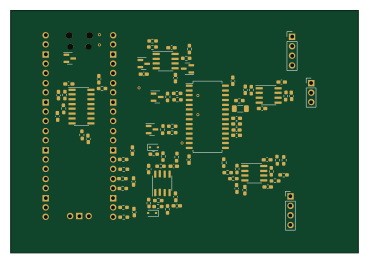
AS3397 eurorack 0603
92.2 × 64.2 mm110 parts2LMIT87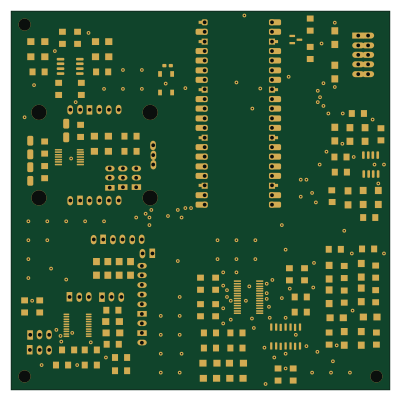 RP2040/RP2350
Carte FX 0
100 × 100 mm107 parts2LMIT87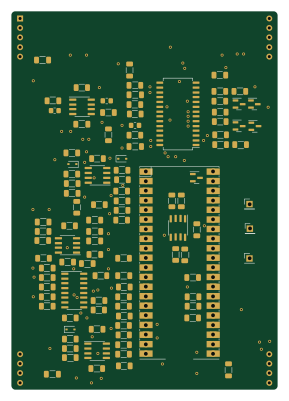 RP2040/RP2350
AS3397 proto SMS
70.5 × 100.2 mm105 parts2LMIT87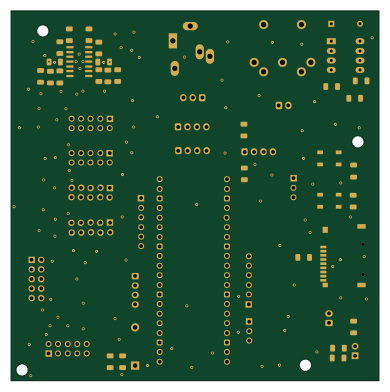 Raspberry Pi
AS3397-Conductor
97.3 × 97.8 mm53 parts2LMIT87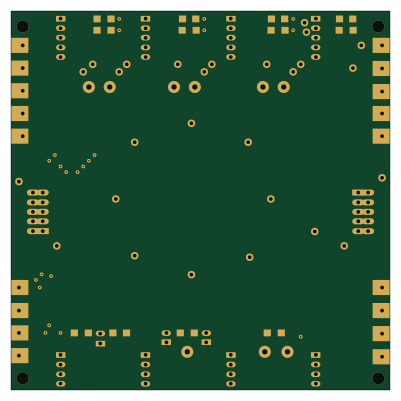
Carte BUS 1
100 × 100 mm52 parts2LMIT87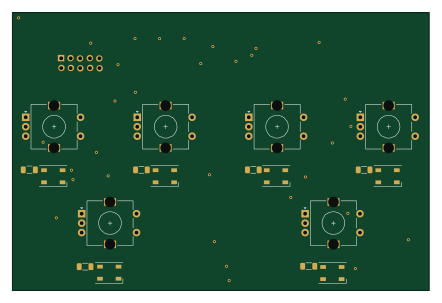
Poly UA controller 6enc 4sw
110.3 × 73.5 mm29 parts2LMIT87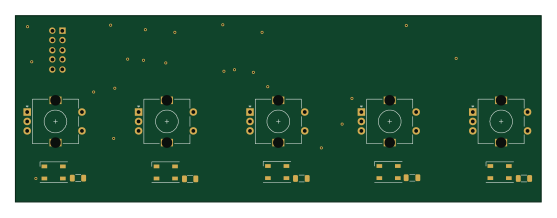
Poly UA controller 5enc 5sw
139.2 × 49.3 mm26 parts2LMIT87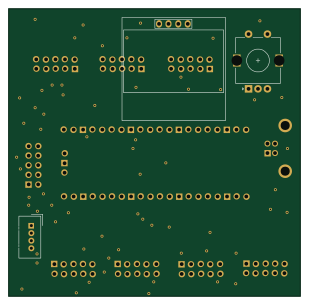 RP2040/RP2350
Main board
77.2 × 76.1 mm14 parts2LMIT87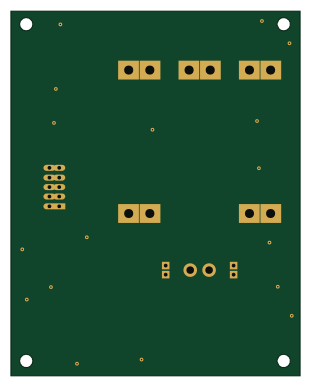
Power
76.6 × 96.6 mm3 parts2LMIT87
Similar boards
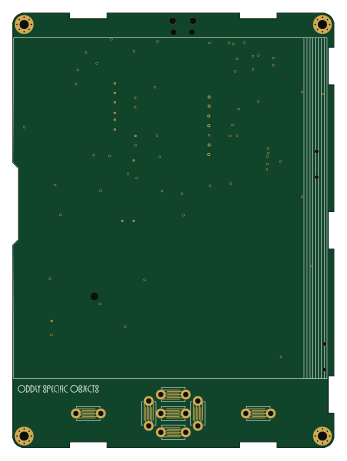 RP2040/RP2350
Open Book Abridged Edition
joeycastillo
85 × 115 mm29 parts2LCC-BY-SA-4.08.1k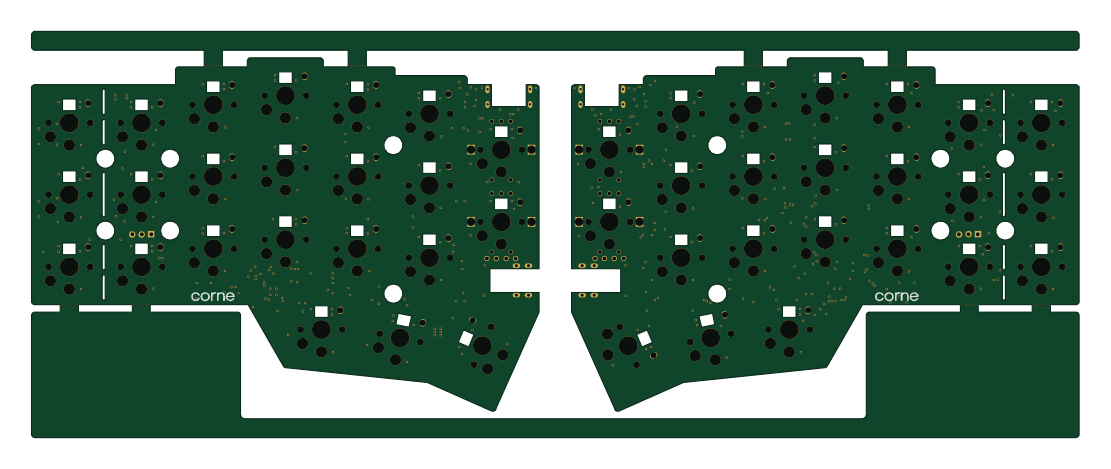 RP2040/RP2350
Corne
foostan
277.2 × 107.5 mm164 parts2LCC-BY-4.07.7k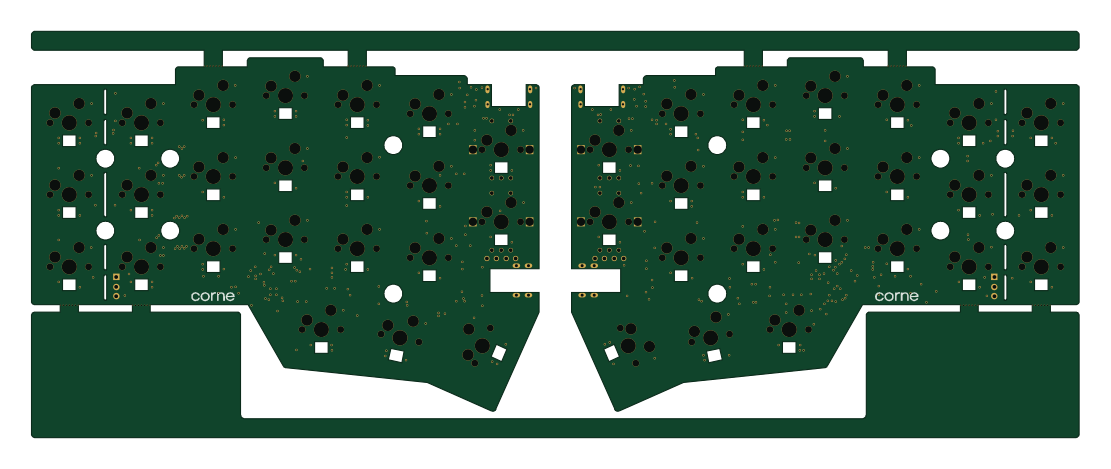 RP2040/RP2350
Corne
277.2 × 107.5 mm164 parts2LCC-BY-4.07.7k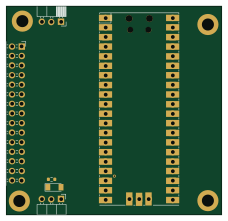 RP2040/RP2350
LogicAnalyzer
gusmanb
57 × 55.2 mm6 parts2LGPL-3.05.0k RP2040/RP2350
Jitx design
55.5 × 65 mm26 parts4LGPL-3.05.0k RP2040/RP2350
Pro V2
kata0510
290.1 × 130 mm270 parts2LMIT2.3k