
2 open source boards using the TDA2050
Real designs built with the TDA2050, from public GitHub projects: a quick way to see how others power, decouple and connect it. Each board comes with its KiCad files, full parts list and a render — and you can simulate its firmware on HardLabs.
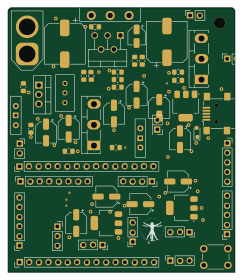 ESP32
ESP32ThermovitalSync
emiirkaya
60 × 70 mm96 parts4LMIT2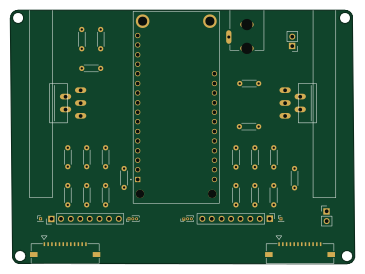
Nano core v4
bwnzhng
91 × 67 mm33 parts2LNo license0
The TDA2050 in open source designs
The gallery holds 2 open source boards using the TDA2050 from 2 GitHub repositories; a typical one measures about 75.5 × 68.5 mm and carries around 65 components.
50% are two-layer designs, the rest use four layers or more, and 50% carry an open source license.
The most starred is ThermovitalSync-PCB by emiirkaya.
Microcontrollers on boards using the TDA2050
What boards using the TDA2050 are built for
TDA2050: common questions
Where can I find a TDA2050 reference design?
Each of the 2 boards on this page is a real design using the TDA2050. Open one to see how it is wired up, with the full BOM, a render of the layout and links to its KiCad files.
Which microcontrollers do boards using the TDA2050 use?
Most are built on ESP32 (1).
How big is a typical board using the TDA2050?
The median is 75.5 × 68.5 mm, and 50% are two-layer designs.
What is the most popular open source board using the TDA2050?
By GitHub stars, ThermovitalSync-PCB by emiirkaya, with 2 stars.
Can I simulate one of these boards using the TDA2050 before building it?
Yes. HardLabs turns a board's netlist and BOM into a working simulation, so you can boot and test firmware against it with no hardware on your desk.