
10 open source boards using the ISM330DHCX
Real designs built with the ISM330DHCX, from public GitHub projects: a quick way to see how others power, decouple and connect it. Each board comes with its KiCad files, full parts list and a render — and you can simulate its firmware on HardLabs.
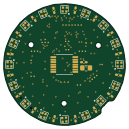 STM32
BLDCM MCU
brenocq
32 × 32 mm91 parts4LMIT10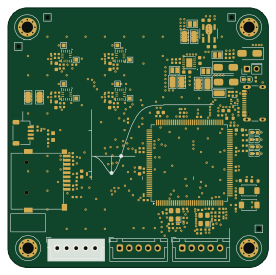 STM32
GMWM Analysis Board
thejamesrhodes
68.8 × 68.6 mm152 parts4LMIT1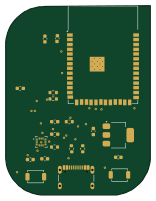 ESP32
IMU-board
MohamadAminGhanoum
38.2 × 50.1 mm21 parts2LNo license1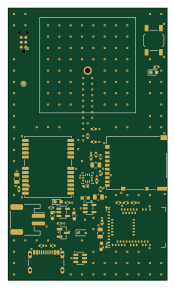 Nordic nRF
Football gnss tracker
Bouhafs-Aek
42 × 72 mm44 parts4LNo license0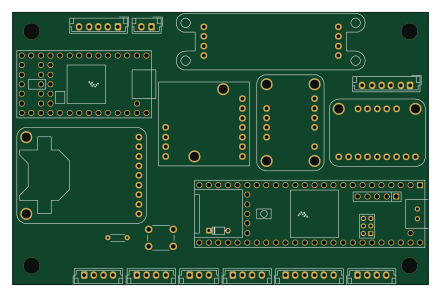 NXP
SBBMicro
stefphd
110 × 72 mm30 parts2LNo license0 AVR/Arduino
Imu board
eshazen
11.2 × 18 mm10 parts4LNo license0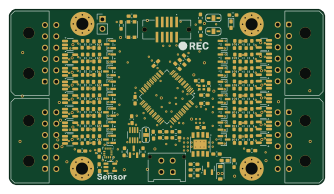 ESP32
16 Channel Sensor Hub
sufst
83.4 × 46.3 mm147 parts4LGPL-3.019 AVR/Arduino
Imu board
BUNPC
16 × 8 mm10 parts4LNo license5 AVR/Arduino
Imu board
16 × 8 mm10 parts4LNo license10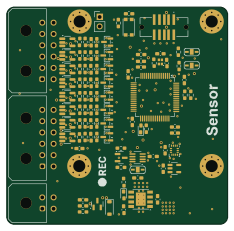 ESP32
8 Channel Sensor Hub
58.5 × 57.5 mm96 parts4LGPL-3.019
How designs wire the ISM330DHCX
Read from the KiCad layouts of 9 open source designs, one per repository: what each pin of the ISM330DHCX connects to, and the resistors, capacitors and other passives placed on it.
- The VDD pins have a decoupling capacitor on 8 of 9 designs, most often 100 nF (then 10 µF).
- The OCS_AUX pins is left unconnected on 9 of 9 designs.
- The SDO_AUX pins is left unconnected on 9 of 9 designs.
- The SCX pins is tied to GND on 8 of 9 designs.
| Pin | Connected to | Parts on the pin |
|---|---|---|
| SDXpin 2, P2 | Connected to: GND 78% · not connected 22% | — |
| SCXpin 3, P3 | Connected to: GND 89% | — |
| VDDIOpin 5 | Connected to: 3.3V 67% · a signal 33% |
|
| GNDpin 6, 7 | Connected to: GND 83% · a signal 17% | — |
| VDDpin 8, P8 | Connected to: 3.3V 78% |
|
| OCS_AUXpin 10, P10 | Connected to: Not connected 100% | — |
| SDO_AUXpin 11, P11 | Connected to: Not connected 100% | — |
| VDD_IOpin P5 | Connected to: VCC 100% |
|
| GND@6pin P6 | Connected to: GND 100% | — |
| GND@7pin P7 | Connected to: GND 100% | — |
7 more pins vary from design to design. Connections count pins, parts count designs; values in brackets are how many parts had that value. Designs read include 16 Channel Sensor Hub by sufst, BLDCM MCU by brenocq, Imu board by BUNPC and Imu board by BUNPC.
The ISM330DHCX in open source designs
The gallery holds 10 open source boards using the ISM330DHCX from 9 GitHub repositories; a typical one measures about 40.1 × 48.2 mm and carries around 37 components.
80% use four copper layers or more, and 40% carry an open source license.
The most starred is 16 Channel Sensor Hub by sufst.
Parts used alongside the ISM330DHCX
Microcontrollers on boards using the ISM330DHCX
What boards using the ISM330DHCX are built for
ISM330DHCX: common questions
Where can I find a ISM330DHCX reference design?
Each of the 10 boards on this page is a real design using the ISM330DHCX. Open one to see how it is wired up, with the full BOM, a render of the layout and links to its KiCad files.
What decoupling capacitors do designs use on the ISM330DHCX VDD pin?
The VDD pins have a decoupling capacitor on 8 of 9 designs, most often 100 nF (then 10 µF). Counted from the KiCad layouts of 9 open source designs using the ISM330DHCX.
How is the ISM330DHCX OCS_AUX pin connected?
The OCS_AUX pins is left unconnected on 9 of 9 designs. Counted from the KiCad layouts of 9 open source designs using the ISM330DHCX.
How is the ISM330DHCX SDO_AUX pin connected?
The SDO_AUX pins is left unconnected on 9 of 9 designs. Counted from the KiCad layouts of 9 open source designs using the ISM330DHCX.
Which microcontrollers do boards using the ISM330DHCX use?
Most are built on AVR/Arduino (3), ESP32 (3), STM32 (2) and Nordic nRF (1).
How big is a typical board using the ISM330DHCX?
The median is 40.1 × 48.2 mm, and 20% are two-layer designs.
What is the most popular open source board using the ISM330DHCX?
By GitHub stars, 16 Channel Sensor Hub by sufst, with 19 stars.
Can I simulate one of these boards using the ISM330DHCX before building it?
Yes. HardLabs turns a board's netlist and BOM into a working simulation, so you can boot and test firmware against it with no hardware on your desk.