
14 open source boards using the RC4558
Real designs built with the RC4558, from public GitHub projects: a quick way to see how others power, decouple and connect it. Each board comes with its KiCad files, full parts list and a render — and you can simulate its firmware on HardLabs.
- schematic only · 190 parts
PC-Engine-Duo
Board-Folk
190 partsNo license37 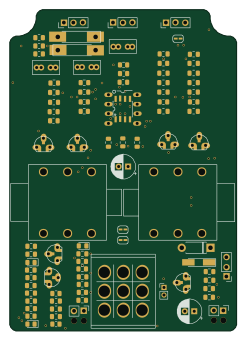
IceScreamer
UC3Music
60 × 85 mm87 parts2LNo license19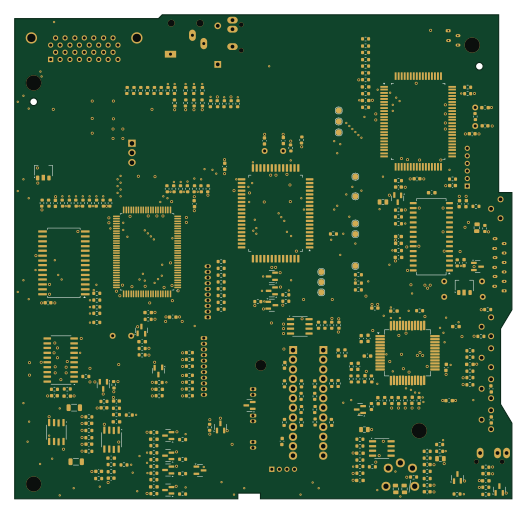
PC-Engine CDR-30A (CD-ROM2) MAIN PWR Reproduction
rgalland
131.5 × 128 mm326 parts4LGPL-3.015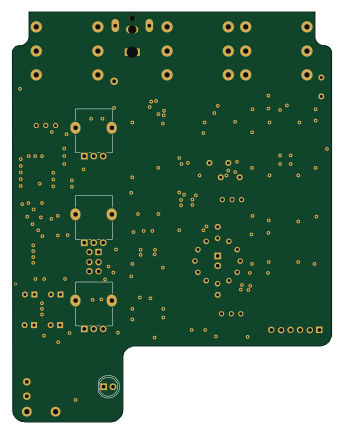
Phasor II
JordanAceto
84.5 × 108.3 mm178 parts2LCC-BY-4.06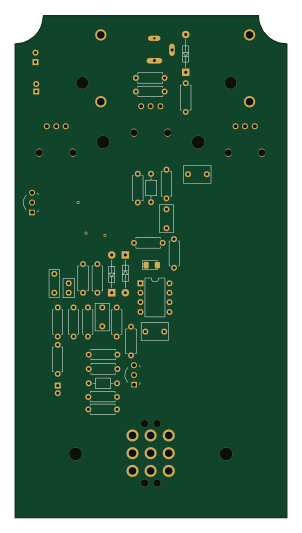
TS808-Clone
runverzagt
72 × 133 mm44 parts2LNo license2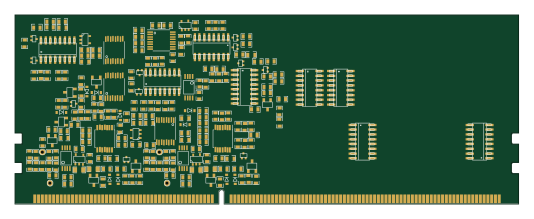
Voice
minisystem
133.4 × 50 mm426 parts2LNo license1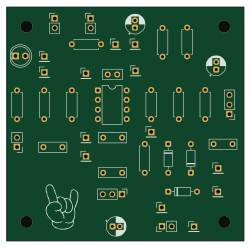
Pseudo metal zone
marciosouzajunior
62.7 × 61.8 mm12 parts2LNo license0
MAIN PWR
131.5 × 128 mm319 parts2LGPL-3.015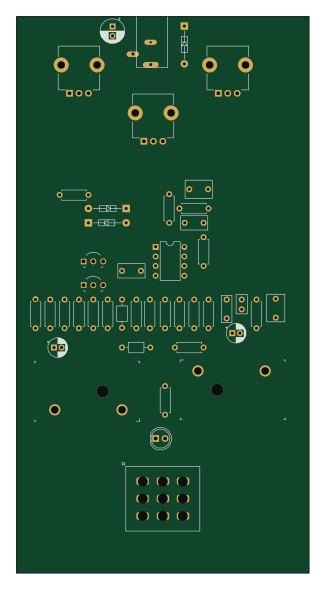
TS808 draft1
77.5 × 147.3 mm44 parts2LNo license2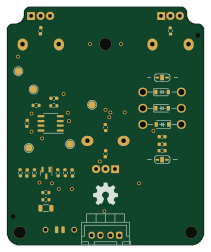
404
Chrismettal
52 × 63 mm29 parts2LCC-BY-SA-4.011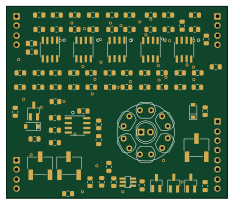
Optical phasor plug in board
58.4 × 50.8 mm89 parts2LCC-BY-4.011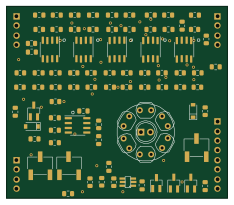 STM32
Optical phasor plug in board
58.4 × 50.8 mm89 parts2LCC-BY-4.02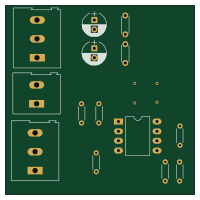
Receptor
MyCloudExample
50 × 50 mm14 parts2LNo license1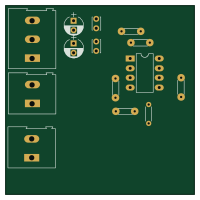
Transmisor
50 × 50 mm14 parts2LNo license1
How designs wire the RC4558
Read from the KiCad layouts of 10 open source designs, one per repository: what each pin of the RC4558 connects to, and the resistors, capacitors and other passives placed on it.
- The - pins have a series resistor on 10 of 10 designs, most often 4.7 kΩ (then 10 kΩ).
- Pin 1 has a series resistor on 9 of 10 designs, most often 4.7 kΩ (then 1 kΩ).
- Pin 7 has a series resistor on 9 of 10 designs, most often 33 kΩ (then 4.7 kΩ).
- Pin 1 has a series capacitor on 6 of 10 designs, most often 47 pF (then 1 nF).
| Pin | Connected to | Parts on the pin |
|---|---|---|
| Pin 1 | Connected to: A connector 30% |
|
| -pin 2, 6 | Connected to: Signal 95% |
|
| +pin 3, 5 | Connected to: A connector 25% · GND 15% |
|
| V-pin 4 | Connected to: GND 50% · -12V 40% |
|
| Pin 7 | Connected to: A connector 20% |
|
| V+pin 8 | Connected to: 12V 90% |
|
Connections count pins, parts count designs; values in brackets are how many parts had that value. Designs read include IceScreamer by UC3Music, PC-Engine CDR-30A (CD-ROM2) MAIN PWR Reproduction by rgalland, 404 by Chrismettal and Optical phasor plug in board by JordanAceto.
The RC4558 in open source designs
The gallery holds 14 open source boards using the RC4558 from 11 GitHub repositories; a typical one measures about 62.7 × 63 mm and carries around 88 components.
92% are two-layer designs, the rest use four layers or more, and 43% carry an open source license.
The most starred is PC-Engine-Duo by Board-Folk.
Microcontrollers on boards using the RC4558
What boards using the RC4558 are built for
RC4558: common questions
Where can I find a RC4558 reference design?
Each of the 14 boards on this page is a real design using the RC4558. Open one to see how it is wired up, with the full BOM, a render of the layout and links to its KiCad files.
What resistor goes on the RC4558 - pin?
The - pins have a series resistor on 10 of 10 designs, most often 4.7 kΩ (then 10 kΩ). Counted from the KiCad layouts of 10 open source designs using the RC4558.
What resistor goes on the RC4558 pin 1?
Pin 1 has a series resistor on 9 of 10 designs, most often 4.7 kΩ (then 1 kΩ). Counted from the KiCad layouts of 10 open source designs using the RC4558.
What resistor goes on the RC4558 pin 7?
Pin 7 has a series resistor on 9 of 10 designs, most often 33 kΩ (then 4.7 kΩ). Counted from the KiCad layouts of 10 open source designs using the RC4558.
What parts are used alongside the RC4558?
The TL072, LM13700 and SSI2162 appear in the most repositories here.
Which microcontrollers do boards using the RC4558 use?
Most are built on STM32 (1).
How big is a typical board using the RC4558?
The median is 62.7 × 63 mm, and 92% are two-layer designs.
What is the most popular open source board using the RC4558?
By GitHub stars, PC-Engine-Duo by Board-Folk, with 37 stars.
Can I simulate one of these boards using the RC4558 before building it?
Yes. HardLabs turns a board's netlist and BOM into a working simulation, so you can boot and test firmware against it with no hardware on your desk.