
6 open source boards using the PESD2CAN
Real designs built with the PESD2CAN, from public GitHub projects: a quick way to see how others power, decouple and connect it. Each board comes with its KiCad files, full parts list and a render — and you can simulate its firmware on HardLabs.
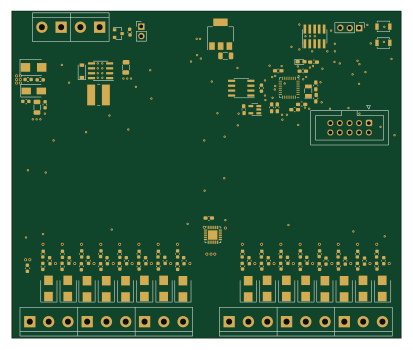 STM32
STM32Spha btni hardware
sillevl
103 × 86.5 mm112 parts2LNo license0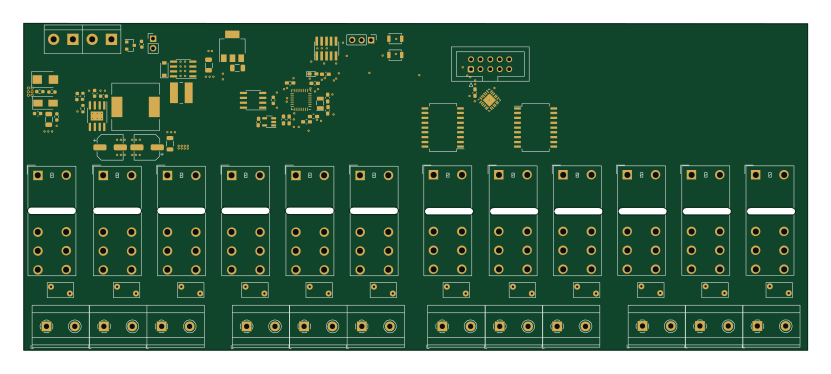 STM32
STM32Spha rel12-hardware
207.5 × 86.5 mm89 parts2LNo license0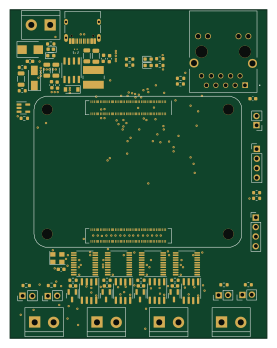 Raspberry Pi
Spha gateway hardware
68 × 87 mm75 parts4LNo license0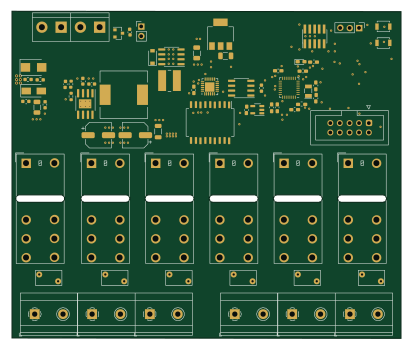 STM32
STM32Spha rel6-hardware
103 × 86.5 mm70 parts2LNo license0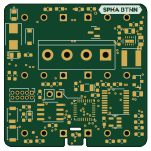 STM32
STM32Spha btnn hardware
37.6 × 37.6 mm68 parts4LNo license0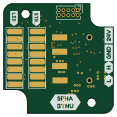 STM32
STM32Spha btnu hardware
29 × 29 mm47 parts4LNo license0
How designs wire the PESD2CAN
Read from the KiCad layouts of 6 open source designs, one per repository: what each pin of the PESD2CAN connects to, and the resistors, capacitors and other passives placed on it.
- The K pins have a series resistor on 5 of 6 designs, most often 10 kΩ (then 120 Ω).
- The A pin is tied to GND on 6 of 6 designs.
| Pin | Connected to | Parts on the pin |
|---|---|---|
| Kpin 1, 2 | Connected to: SN65HVD230 100%, a connector 100% |
|
| Apin 3 | Connected to: GND 100% | — |
Connections count pins, parts count designs; values in brackets are how many parts had that value. Designs read include Spha btni hardware by sillevl, Spha btnn hardware by sillevl, Spha btnu hardware by sillevl and Spha gateway hardware by sillevl.
The PESD2CAN in open source designs
The gallery holds 6 open source boards using the PESD2CAN from 6 GitHub repositories; a typical one measures about 85.5 × 86.5 mm and carries around 73 components.
50% are two-layer designs, the rest use four layers or more, and 0% carry an open source license.
The most starred is Spha btni hardware by sillevl.
Parts used alongside the PESD2CAN
Microcontrollers on boards using the PESD2CAN
PESD2CAN: common questions
Where can I find a PESD2CAN reference design?
Each of the 6 boards on this page is a real design using the PESD2CAN. Open one to see how it is wired up, with the full BOM, a render of the layout and links to its KiCad files.
What resistor goes on the PESD2CAN K pin?
The K pins have a series resistor on 5 of 6 designs, most often 10 kΩ (then 120 Ω). Counted from the KiCad layouts of 6 open source designs using the PESD2CAN.
How is the PESD2CAN A pin connected?
The A pin is tied to GND on 6 of 6 designs. Counted from the KiCad layouts of 6 open source designs using the PESD2CAN.
What parts are used alongside the PESD2CAN?
The SN65HVD230, STM32L432KCUx, LM2594M-5.0, AT24CS32-STUM and MCP1825S appear in the most repositories here.
Which microcontrollers do boards using the PESD2CAN use?
Most are built on STM32 (5) and Raspberry Pi (1).
How big is a typical board using the PESD2CAN?
The median is 85.5 × 86.5 mm, and 50% are two-layer designs.
What is the most popular open source board using the PESD2CAN?
By GitHub stars, Spha btni hardware by sillevl, with 0 stars.
Can I simulate one of these boards using the PESD2CAN before building it?
Yes. HardLabs turns a board's netlist and BOM into a working simulation, so you can boot and test firmware against it with no hardware on your desk.